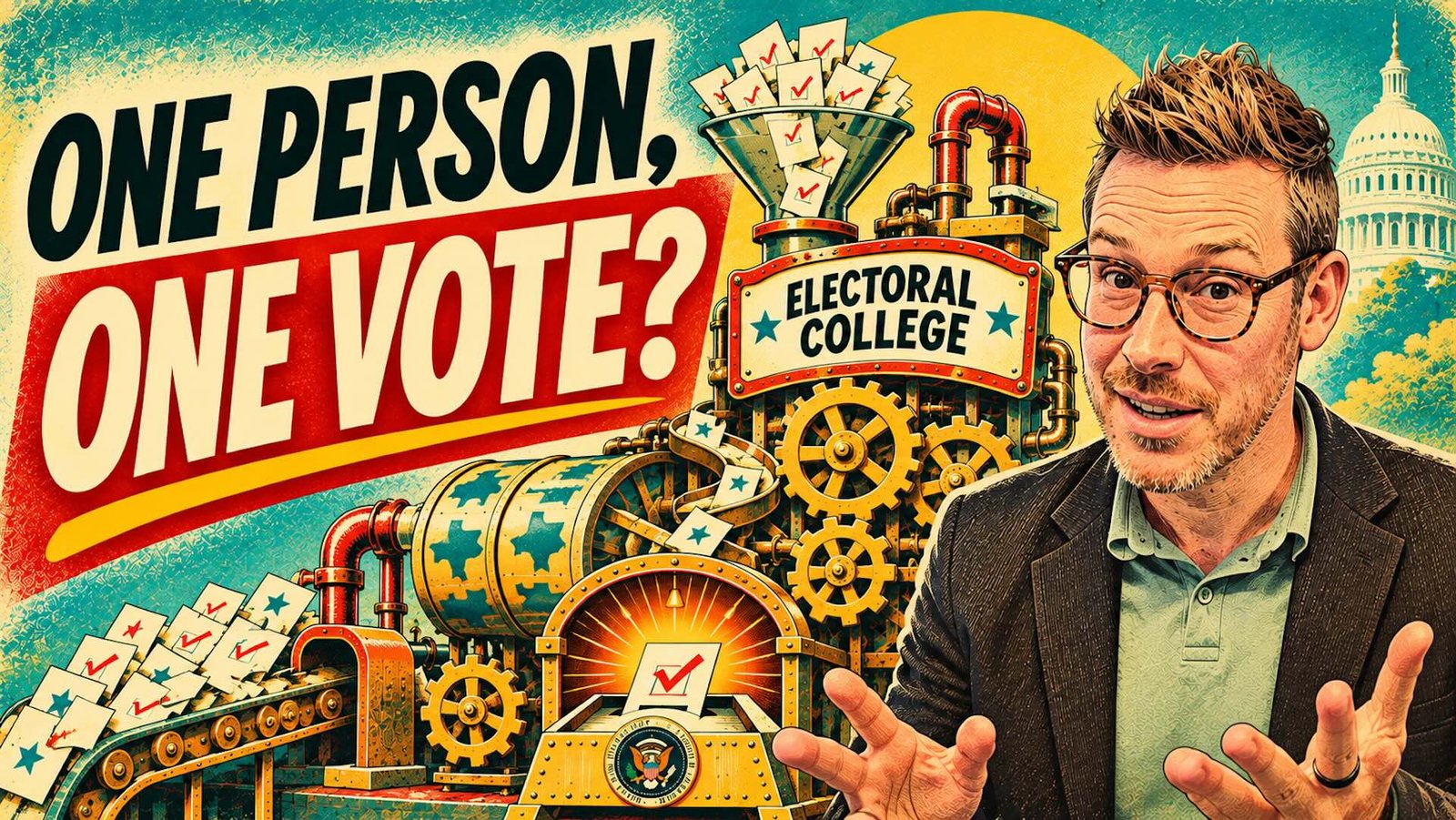
Today I want to talk about college, but not the kind I love. Specifically, we’re going to talk about the stupidest college ever invented.
I am, of course, talking about the Electoral College.
Remember, this show is not a “political” one, it’s about the systems that impact our lives. And sometimes, those systems are governance ones.
Given the midterm elections we had here in the U.S. two weeks ago, it felt like a good time to talk about a very peculiar governance system that only exists here, and absolutely messes with ALL of our lives every four years when we elect a president.
I want to talk about this because the Electoral College perfectly illustrates one of the most important ideas we talk about on Hello Tomorrow: how we humans build systems to try to solve a problem, but then eventually we forget that we built it and the system starts to feel permanent. Immovable. Natural, even.
When systems start to feel like gravity, we’ve got a really BIG problem because we’ve stopped thinking we can change them.
But this, of course, is not the truth.
⸻
There are three things we need to understand about the Electoral College system:
1) Representation, 2) Power, and 3) Incentives.
1. REPRESENTATION
To understand the Electoral College, we need to go back to Philadelphia in 1787, when the people writing the Constitution were trying to decide how to choose a president. Some delegates wanted Congress to make the decision. Others preferred a direct popular election. Some worried about giving the national government too much power, while others worried that voters wouldn’t have enough information to evaluate candidates from distant parts of the country.
Remember, this was 1787. No internet, no television, not even radio. News traveled slowly. Fair concerns… 240 years ago.
But there was another enormous consideration shaping the discussion: slavery.
At the time, a substantial portion of the population in Southern states was enslaved. Those people couldn’t vote, but slaveholders wanted them counted for political representation. The resulting Three-Fifths Compromise counted enslaved people as three-fifths of a person for purposes of representation in the House.
And this matters because the Electoral College would be tied directly to congressional representation.
Our federal legislature has two parts: the House of Representatives, where seats are distributed according to state populations, and the Senate, where every state gets two members.
The Electoral College combines them. Each state gets one electoral vote for every House representative, PLUS two for its senators.
And right here we need to talk about something I suspect most Americans don’t know.
In 1929, Congress effectively froze the House of Representatives at 435 members.
The Constitution doesn’t specify 435. Congress decided that. Before then, the House generally expanded as the population grew. But America’s population has nearly tripled since 1929, and the House hasn’t grown… at all.
Every ten years, we redistribute those same 435 seats among the states based on the census. But we don’t add new ones. These days, it’s probably fair to say technology makes it easier for one representative to serve more constituents than they could a century ago. But this decision has another consequence – on the Electoral College.
Remember, every state gets two electoral votes for its senators, PLUS one for every House representative. When the House stops growing, those two Senate-based votes retain a larger share of the Electoral College than they would have if the House continued expanding.
If we’d continued expanding the House proportionally with population growth, we’d have something like 1,200 representatives today, rather than 435. That would mean roughly 1,200 population-based electoral votes alongside the same 100 Senate-based votes.
And here’s the kicker: Congress could change the size of the House without amending the Constitution.
In a representative democracy, the way we determine representation is VERY important.
And this brings us back to slavery. Because electoral votes were tied to congressional representation, the Three-Fifths Compromise increased the electoral power of slaveholding states. Slavery wasn’t the only reason the Electoral College was created, but it was an important part of the political, ahem, compromise that shaped it.
So here’s the first thing for us to notice: the Electoral College wasn’t designed in some timeless laboratory of perfect democratic reasoning. It was designed by actual human beings, trying to reconcile competing interests about representation. Some concerns were understandable. Some were horribly racist and unjust. ALL of them became part of the system we inherited and are still using today.
2. POWER
Here’s where things get stranger. Did you know the Electoral College we use today actually isn’t what some of its original defenders imagined?
Alexander Hamilton, writing in Federalist No. 68, described presidential electors as people who would exercise independent judgment. They would deliberate, evaluate candidates, and decide who was qualified to lead the country.
That’s not what our electors do. Why?
As political parties developed, states increasingly adopted winner-take-all rules. Electors became people pledged to support particular candidates. In 2020, the Supreme Court upheld the authority of states to legally require electors to honor those pledges.
Today, the United States has 538 total electoral votes, and a candidate needs 270 to win. Wyoming has three electoral votes. California has fifty-four, which is eighteen times as many. But California has roughly sixty-eight times Wyoming’s population. Do the math, and Wyoming gets about 3.8 times as many electoral votes per resident.
That doesn’t mean an individual Wyoming ballot is 3.8 times more likely to determine the presidency, but it does mean electoral power isn’t being distributed equally.
And then we add this winner-take-all thing.
Forty-eight states use this approach. Maine and Nebraska are the only exceptions. In most states, if one candidate receives 50.1 percent of the vote and another receives 49.9 percent, the first candidate gets EVERY electoral vote. The second gets zero.
When we multiply that across the country, we can see why the Electoral College doesn’t always produce the same result as the national popular vote. I’ve watched this happen twice in my lifetime.
There’s a blatant power imbalance here. And to me, the principle is simple: one person, one vote. Not more, not less. We should each get one. That’s the right kind of power.
So, we’ve got a problem with representation and with power. Then we have what both of those things encourage.
3. INCENTIVES
Because systems don’t just determine outcomes. They shape our behavior along the way.
Think about how presidential campaigns operate. If you’re running for president, where do you spend your time and money? Well, if you’re being smart and strategic, you focus on the states where you have a realistic chance of changing the outcome.
In the U.S. those places actually have a name! We call them “swing states” or “battleground states.”
Remember, though, even though those labels feel “normal” to anyone living in the U.S., those are nonsensical things. They should not exist. But because they do, here’s what that means: the vast majority of states are essentially spectators in presidential campaigns. Candidates spend enormous amounts of time and money courting voters in a handful of “competitive states” while mostly ignoring everybody else.
If you’re a Republican candidate, you have almost zero reason to go to a heavily Democratic state. The same goes for Democrats and heavily Republican states.
The Electoral College has effectively turned our most important election into some kind of sports contest, fighting over a relatively small number of votes.
So: 1) We aren’t being represented fairly. 2) This imbalances the power and screws up the math. And because of those things, 3) our most important election has become an event we wear jerseys too instead of think deeply about.
⸻
Are there any reasons to keep the Electoral College?
The most interesting and viable arguments I’ve seen for keeping this thing intact revolve around statements like “we are a nation made up of states” and “the Electoral College ensures that no one becomes President without the support of many states.”
I find this angle to be compelling at some level, but I think it’s more compelling to argue that we are a country made of citizens, and every single citizen’s voice deserves to be heard.
The “state” logic, while interesting in the abstract, elevates some kind of vague, conceptual “state identity” over the actual voices of the actual people who live in all parts of our country. To me that is a fundamentally inappropriate design for a system that impacts ALL of us.
It also seems reasonable to say that state boundaries might not be as relevant today as perhaps they once were. Our similarities and differences don’t break cleanly along state lines. The urban/rural divide, for example, cuts through nearly every state in the country.
So, is there anything to be done about this terrible system? Changing the Electoral College would require amending the Constitution, and amending the Constitution is extraordinarily difficult, right?
Not necessarily.
It’s time for some genuinely good news.
⸻
In 2006, building on the work of a few sharp law professors, a computer scientist named John Koza created something called the National Popular Vote Interstate Compact.
Here’s how it works:
The Constitution gives states broad authority to determine how they appoint their presidential electors. That’s why most states can use winner-take-all rules even though the Constitution doesn’t require them to.
So, what if enough states agreed to award their electoral votes to whoever wins the national popular vote? Not whoever wins the popular vote in their particular state, but whoever receives the most votes across the entire country.
And what if that agreement only took effect once enough states had joined to guarantee that the national popular-vote winner would receive at least 270 electoral votes?
That’s the compact.
Participating states pass legislation agreeing to those rules, but the agreement doesn’t become operational until the participating states collectively control enough electoral votes to determine the presidency.
So imagine the compact reaches 270 electoral votes. A presidential election happens. We count the votes across the country. And the candidate who receives the most votes nationally gets the electoral votes of the participating states. Enough to win the presidency, every time, whether that candidate is a Democrat, a Republican, or someone else.
It’s clever, but can states really do this?
Well, the Constitution gives states substantial authority over how they appoint electors, so there’s a serious constitutional basis for the idea. There are also unresolved legal questions, of course, but here’s the thing: this isn’t just a proposal somebody wrote on a napkin.
States have already started passing it.
As of November 2026, eighteen states and Washington, D.C., have enacted the National Popular Vote Interstate Compact. Together, they represent 222 electoral votes. 222! They need 270. Which means we’re only 48 electoral votes away from the threshold that would activate the agreement.
And, here’s what makes it super timely: with the midterm elections we just had two weeks ago, there are now potentially enough states with legislatures that are likely to support the compact.
Truly. We are within throwing distance of actually updating this archaic, unfair, racist, two-centuries-plus-old system. Not someday in a science-fiction future. Right now.
⸻
As you know, I spend a lot of time talking about systems. Work systems. Economic systems. Organizational systems. One of the strangest things about human beings is how quickly we start treating our own inventions like they’re laws of nature.
I talked about this in last week’s episode when I told you the story of #lovework, my amazing tech company that eventually made me go bankrupt. The product worked, but the company failed, which forced me to ask bigger questions about our larger economic system.
This is one of the central ideas you’ll find in my new book, Work Will Kill Us All. Markets aren’t gravity. Corporations aren’t gravity. Our systems of ownership and profit aren’t gravity. We made these things up, and we can make different things.
The Electoral College isn’t gravity, either.
Back in 2020, I wrote an article asking whether we should abolish the Electoral College. if you want to go deeper on this topic, it’s worth checking out as it contains a helpful FAQ and lots of links.
In that article, there was one observation I kept coming back to.
States don’t vote. Land doesn’t vote. People vote.
What kind of democratic system do we want to pass to our next generations? We inherited this system, sure, but that doesn’t mean we need to keep it!
Also, the National Popular Vote Interstate Compact is a remarkable reminder that change doesn’t always require some grand national moment of consensus. Oftentimes we start with one state, then another, then another, and eventually the thing that once seemed impossible begins to look inevitable.
This idea will come in handy in the future, so keep it in your pocket.
⸻
Here’s this week’s Optimistic Rebellion.
Go to nationalpopularvote.com. You will see a website that looks 20 years old with a truly terrible logo at the top. You’re in the right spot. Click on your state and find out if your state has joined the compact. If it hasn’t, find out whether legislation has been introduced and where your elected representatives stand.
You don’t have to agree with me about the Electoral College. But I hope you’ll spend a few minutes thinking about the system itself rather than allowing it to continue unquestioned.
And — the next time somebody tells you that this is “just the way things work,” I want you to remember something.
They work that way because somebody built it that way.
And that means another somebody can build it differently.