

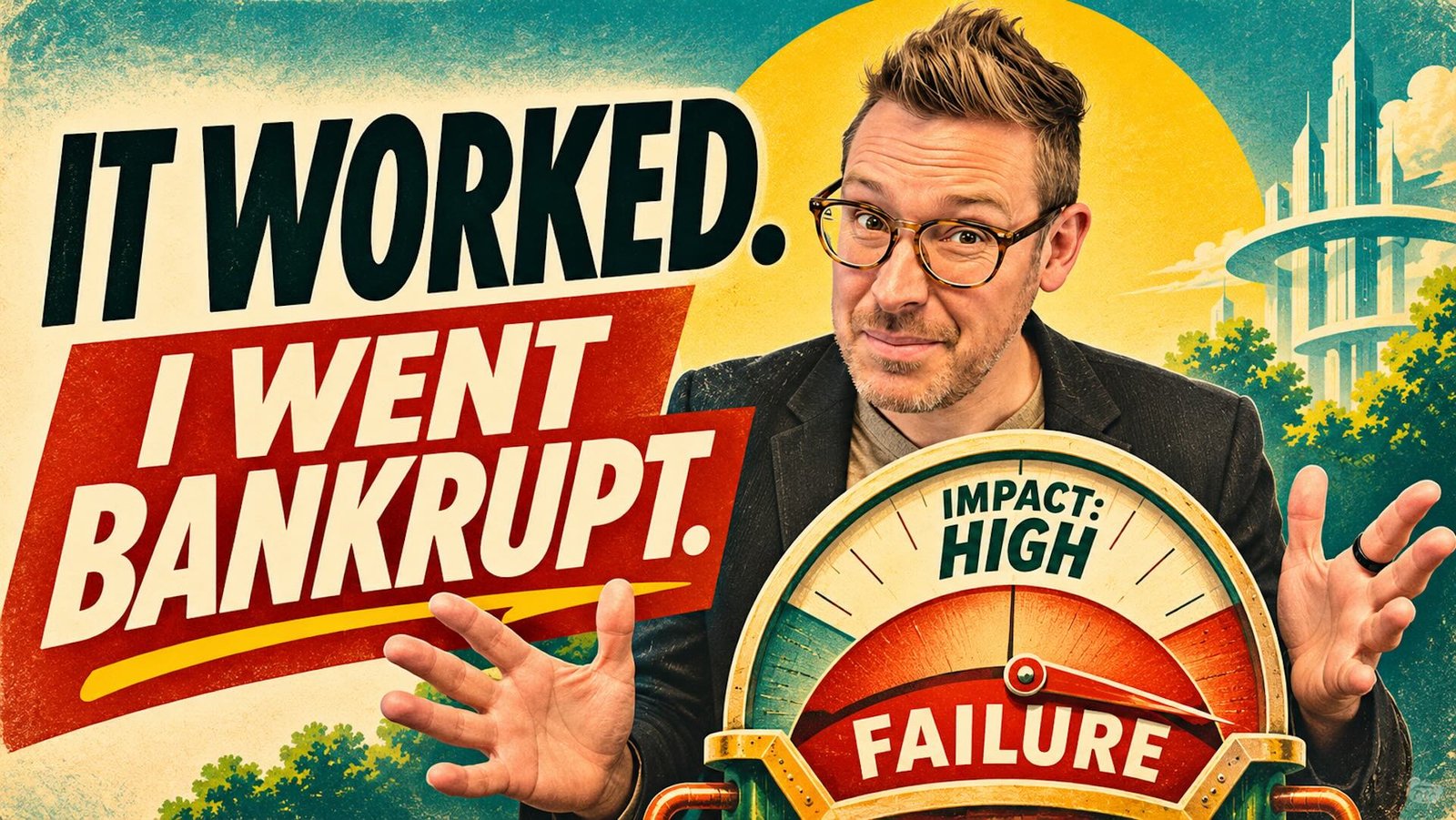
Today I want to talk about the best thing I ever built, because it’s also the thing that made me go bankrupt.
It was a company called #lovework. I started working on this project almost a decade ago, around 2018. At that point, I had been working for over a decade already on what I thought was “my purpose”: making work not suck.
Ten years in, I thought I had a pretty good handle on this problem. I’d already worked with a LOT of companies, tons of leaders, consulting, workshops, assessments… if it’s something companies use to try to make work better, I’d probably done it. So in the late 2010s I started thinking about ways to attack the problem at scale. I’ve always been a bit of a nerd — I was one of those “Apple Geniuses” at one point in my life — so I thought: tech company! Of course!
Tech also made sense because it’s the only thing that could scale to meet the global size of this problem.
You’re probably aware that work often sucks. You’ve probably got at least one personal story you could tell me about it. What you might not know is how widespread this problem is. When we do the math on working age people, we find about half of all people alive – something like 4 billion humans feel “meh,” or worse, about the work-thing they likely spend their entire waking adult life doing.
Yes, that’s billions. With a B. I’m happy to let you know how I did this calculation if you like.
That is an insane waste of human life.
So our tech company, #lovework, was directly aimed at this massive, obscene problem.
The idea was… ambitious.
Our theory was that we could “decode” enjoyment of work as a learnable skill. That we could TEACH people how to love work, IF they had the right things to practice — just like you can learn how to play a sport or an instrument or do yoga IF you know what to practice.
We spent a couple years reverse engineering a mostly universal set of practices and then got to work building it into a sequential, nudge-based team journey that would be supported and augmented with our app.
This took a long time. It took money. It took an enormous amount of energy. And it took many remarkable people who believed in this weird idea that, for a long time, mostly existed inside my head.
But eventually, we built it.
And then something incredible happened: it worked.
People actually used it. Teams started working differently. People had more agency. The principles we had spent years talking about weren’t just ideas anymore; they were happening inside real organizations with real people.
Also, we launched this thing right into the pandemic — right when companies were falling over themselves talking about flexibility and caring about burnout and using tech to help people work better together. And, the damn thing WORKED — we measured it over and over in all different industries and situations. It consistently reduced burnout, increased psychological safety, and boosted people’s energy at work!
I will tell you: I really believed we were building a Unicorn, a billion dollar startup.
I had spent my whole career thus far insisting that we could design work better, and now we could see it happening with the help of this thing we built.
There was just one small problem.
We had built a company.
And companies don’t survive because they make something good. Companies survive because they make money.
Those two things are not the same.
It seems obvious when I say it now. It was considerably less obvious when I was living through it.
As you might remember, the “winds of change” started blowing through business in 2022, and by early ‘23, it felt like somebody had flipped a damn switch. Silicon Valley Bank melted down and investors got spooked. ChatGPT was spreading like wildfire. And suddenly, all that talk about flexibility and burnout and caring about people seemed to evaporate. Now it was Return To Office, efficiency, layoffs, and people needing jobs more than the employers needed people.
Funny how quickly the conversation changes when the power shifts.
If you’re a startup, none of this waits patiently while you figure it out. The clock is always running. Payroll is on Monday. Servers need to stay on. Investors have expectations. Every day, you watch your runway get shorter and shorter.
So you try something. You change the pricing. You change the pitch. You chase the deal. You try to raise more money. You cut costs. You get another loan. You entertain selling the business. You wake up at three in the morning dreaming about proformas. You try your best to keep it together for the team.
But somewhere along the way, the same stubbornness that gave you the fortitude to build this crazy effing thing becomes something like a refusal to see that it’s not working. It becomes very difficult to tell these things apart. And you’ve read lots of great entrepreneurial stories about that “eleventh hour breakthrough,” so you keep believing that maybe you’re one new investor or one great customer away from finally making the whole thing work.
Until eventually, you realize the investor isn’t coming. Neither is the big customer.
#lovework failed.
This thing I had spent almost a decade of my life dreaming into reality, the thing that was actively helping people enjoy work more, was functionally dead. We couldn’t keep it going. Everybody lost their jobs. Investors lost money.
And eventually, I lost more than the company.
A year and half ago, on my birthday in June of 2025, I filed for bankruptcy.
Bankruptcy is a strange word to attach to yourself. There’s a whole story bundled up in this word that feels like irresponsibility and failure and bad decisions. And look, my decisions were not perfect. You want a list of things I would do differently, I’ve got one. There were moments I held on too long, there were people I trusted and shouldn’t have, there were things I misunderstood, things I thought would work that didn’t.
That’s all part of the story.
But after the company was gone… after the lawyers and the paperwork and the delightful financial autopsy that is bankruptcy, I was left with a question I couldn’t seem to shake:
What exactly had failed?
The easy answer would have been that the idea didn’t work.
Except… it did.
The product worked. The ideas worked. The team worked! Seriously, the #lovework team was the best team I’ve ever been in. The problem I had spent a decade studying wasn’t imaginary, either, and neither was our proven solution.
So why had something so genuinely good been so completely impossible to sustain?
This question sent me somewhere I did not expect to go.
By the time #lovework ended, I’d been working on this problem for almost two decades. For twenty years, I had been asking: How do we fix work?
After #lovework failed, I started asking a different question:
What if work doesn’t “want” to be fixed?
Once you start following that question, strange realizations start to happen.
You start to see things. A company is inside a market. A market is inside a legal system. A legal system determines what can be owned. Ownership determines who gets to make decisions. And above all those things are assumptions about what our economic activity is actually for.
I had spent twenty years trying to redesign organizations, but I had barely questioned the container they live inside.
That container, these systems, had always felt kind of like “gravity.” Markets. Capital. Growth. Ownership. Profit. Competition. That’s just the environment. It’s how things work. You don’t fight gravity. You calculate for it.
Except none of those things ARE gravity.
We made them.
Human beings invented corporations. Human beings wrote property laws. Human beings created markets and decided what could be owned. Human beings have built systems that reinforce what we’re working on and what our work is for.
We built this container.
Then we lived inside it for so long we forgot it was something we built.
Once I saw that, I started seeing it everywhere.
Burnout. Inequality. Climate change. Housing. Healthcare. The endless demand for growth. The panic about A.I.
That last one is especially revealing, because think about how seriously strange it is. For basically all of human history, we have dreamed about eliminating drudgery from work. Now we might actually be able to build machines capable of doing that, but we’re terrified.
Why?
Because in the system we’ve built, eliminating someone’s labor also eliminates their income. And income — you selling your work to someone else — is the thing we’ve collectively decided that determines you deserve to stay alive.
That’s not a technology problem.
That’s a system design problem.
And suddenly, the failure of my little startup didn’t feel quite so little anymore. It felt… illuminating!
I had spent years trying to build technology that would help people flourish inside their work. But the organizations themselves were operating inside a system organized around something else entirely: the accumulation of capital. Make more. Grow more. Own more.
Once I understood this as an Organizing Story, the outcomes stopped looking mysterious.
I realized, these systems weren’t “broken.”
They were doing exactly what we designed them to do.
You might think this realization made me cynical.
But strangely, it did the opposite.
Because if this were simply human nature, we’d be, pardon my language, f*cked. If inequality were gravity, we’d be screwed. If corporations and markets and ownership structures arrived alongside the Big Bang, there wouldn’t be much we could do about them.
But they didn’t.
We built this sh*t.
Which means we can build something else.
Last week on this show, I talked about how America gave up on the future. We used to build enormous world fairs around the idea that we could make tomorrow different from today, but along the way, we stopped talking about the future as something we create and started talking about it as something that happens to us.
Listen to the way we talk about Artificial Intelligence right now. What is A.I. going to do to jobs? What is A.I. going to do to the economy? What is A.I. going to do to us?
We talk about it like it’s a frickin’ hurricane forming offshore. We can track it. We can make predictions about where it might make landfall. We could board up our windows. But apparently nobody gets to decide where the monster goes…!
I don’t buy it.
Tomorrow, I’m releasing a book called Work Will Kill Us All: An Optimist’s Guide to the Future.
This book began with the failure of #lovework, with my bankruptcy, and with the uncomfortable realization that I had spent twenty years trying to fix something that’s inside a system that doesn’t want it fixed.
But this book helped me ask a new question.
If the Story organizing so much of modern life is “accumulate capital,” what would happen if we chose a different Story?
What if we organized ourselves around something like: Helping life flourish. Human life. Non-human life. Communities. Ecosystems. People who haven’t been born yet! What would we build differently? What would we own differently? What would technology be for? What would work be for?
What might become possible if all this extraordinary productive capacity we unleash every single day through this thing we call WORK actually made ordinary people more secure and more free?
That’s the book.
Or at least, that’s the question at the heart of it.
I’ll be talking a lot more about the ideas in the book on this show. If you’re somehow allergic to reading or you just prefer consuming info through video or audio, don’t worry — we’re gonna get into all of it right here.
I’ll still be here making my weekly 15-minute arguments about the future.
I’ll still be challenging us to see and change the systems.
And I’ll still be helping us wield optimism like a rebellion strategy. At least right now, I might not be able to singlehandedly build us a world’s fair, I am still rebuilding, but we will still gather here every week and imagine a better tomorrow together.
One more thing…
Something else happened while I finished writing this thing, which is, I realized this book isn’t any kind of conclusion. It’s more like the beginning.
There are a lot of ideas in the book, hopefully decent ones, but let’s be honest: ideas alone don’t do much. We need to put them to work.
The best thing I ever built made me go bankrupt. In many ways, I’d prefer that it hadn’t. Bankruptcy: Zero stars, do not recommend.
But in many ways, I am grateful for my path. I now see that the lesson of my failure wasn’t that I was stupid to believe things could be different. The lesson was that I wasn’t thinking BIG enough about everything that has to change.
The way we work isn’t inevitable. Who owns A.I. isn’t inevitable. Who benefits from more productivity isn’t inevitable. The systems we’ve inherited aren’t inevitable.
The Story around all of this is NOT fixed.
The future isn’t something waiting for us.
The future is what we, together, dare to make.
Tomorrow, I’m sharing an idea for the future I would like us to choose.
This week’s Optimistic Rebellion is to go pre-order your copy at WorkWillKillUsAll.com — it’s on Amazon, B&N, and also Bookshop if you want to support indie bookstores. I know, asking you to buy my book sounds self-serving but here’s the truth: I make less than $2 a copy so, you know, don’t write a book for the money.
What matters to me is that we start telling a new Story. And I truly just want to hear what you think. I want us to wrestle with these ideas, and I want us to work together to make tomorrow better.
We can do this. Let’s frickin’ go.
