

Today I wanna start with something that made me laugh at myself.
A few days ago, I asked A.I. to summarize an article for me. That’s not the funny part. If you’ve been hanging out with me for any length of time, you know my current perspective is that A.I. is something we need to learn. And for certain kinds of work, not using LLMs would be as silly as trying to build your house without using power tools. To do what I do, for example, I need to synthesize a lot of information all the time. LLMs are really helpful with this.
But this article I asked it to summarize? It was an article about how speed has become more important than depth.
Took me a second, but I got the irony.
I didn’t ask A.I. to help because I don’t value depth. I did it because it felt like I had to. I’ve got deadlines and commitments. I got kids to pick up from school and endless to-do list. That isn’t just me, of course. This is the environment we’re all operating in. A world where slowing down feels irresponsible. Where reading something carefully feels kind of indulgent. It feels like falling behind.
That’s when the real insight hit me.
Systems only reward what they can measure and our current system cannot measure pause. That single fact, I think, explains a lot about what we’re feeling right now.
The article that catalyzed this episode was published by tech writer Om Malik, where he names the problem with some brutal clarity: “We built machines that prize acceleration and then act puzzled that everything feels rushed and slightly manic.”
Our world, of course, is now largely governed by machines. We exist inside the containers and boxes our calendars show. We’re at the Pavlovian mercy of our phone notifications. We are, as others have pointed out, already cyborgs — emotionally, if not physically — unable to detach ourselves from our technology. For these machines, speed isn’t a side effect. It’s their organizing value.
Now let’s look at what this produces.
It looks like news cycles that reward volume over accuracy. Flood the zone. Put out ten stories in the time it takes to verify one. By the time a correction appears, five new headlines have already replaced it in the feed. Speed creates volume. Volume creates confusion.
This also looks like products that are shipped before they’re ready. Because launch and iterate is now beating test and refine. And that might be fine for a social media app, but what about when it’s medical devices or bridges or airplanes? The 737 MAX? That wasn’t a failure of intelligence, it was a failure of restraint.
This also looks like decisions that are made inside Slack threads with 47 messages in 12 minutes, because moving fast looks like competence. Move fast and break things, y’all. But “Hold up, wait a minute, I need to think about this.” That kind of looks like weakness.
None of this is hypothetical. This is just Tuesday, right? When speed becomes the goal, anything that slows us down feels dangerous.
Here’s another quote from Om: “Once velocity is the prize, quality becomes risky. Thoughtfulness takes time. Reporting takes time. Living with a product or an idea takes time. Yet the window for relevance keeps shrinking and the penalty for lateness is erasure. We get a culture optimized for first takes, not best takes.” That last line, “First takes, not best takes.”…! If lateness means you get erased, hesitation feels like an existential risk. And if our attention windows keep shrinking, nuance becomes more and more of a liability.
All right, Another line from Om. This might be his most important one for me. “When attention is fragmented and speed becomes the dominant value, media rearranges itself around that reality. Not because anyone wakes up wanting to mislead people, but because the context makes some paths survivable and others impossible.” We talked a little bit about this last week. This is how systems create outcomes without villains. There’s no conspiracy. There’s no evil masterminds. There’s just incentives that quietly reshape behavior until certain choices disappear. from view. Truth doesn’t die, it just becomes non-viable.
All right, one more thought from Om: “The cost of all this isn’t abstract. It’s the review that took three months, but no one will read. It’s the investigation that required patience. It’s the work of understanding something before declaring judgment. All of it still exists, still gets made. It just doesn’t travel. And in a system where only what travels matters, we’ve made expertise indistinguishable from noise.” Damn. That line: “In a system where only what travels matters, we’ve made expertise indistinguishable from noise.” Whew!
You know what doesn’t travel well? Patience, restraint, uncertainty, careful judgment, wisdom. All those things still exist. But remember, in a system where only travel matters, invisibility is basically irrelevance. So things like wisdom don’t travel because wisdom requires context. You can’t screenshot “nuance.” You can’t tweet “restraint.” You can’t make a viral clip out of, “I need more information before I decide.” It also doesn’t travel because wisdom takes time. A carefully considered argument takes, what, 2000 words? A hot take takes 200 characters. The algorithm doesn’t care which one is true, it cares which one moves.
Wisdom doesn’t travel also because it actually requires uncertainty. Uncertainty isn’t really optional in wisdom, but uncertainty doesn’t perform well in the scroll. “I’m not sure yet” gets crushed by “I’m absolutely certain!” even when the certain person is dead frickin’ wrong.
So the system does what systems do. It selects for what survives, and wisdom doesn’t survive this kind of velocity.
This brings me to a story. Right out of college, I worked at Mix 100.3 FM in Denver: “The best mix of the 80s, 90s and today!” I started in marketing and promotions, due to the kindness and support of a fabulous Program Director I eventually got to work my way to being on air. And in radio, if you don’t know, there’s one unforgivable sin: dead air. Silence means panic. Silence means you seriously effed something up. Silence means the audience is gone. So if you’re on air, you learn, professionally, to fill space at all costs. Talk over your thoughts. Never let a beat land too long. Always keep the sound moving.
After I told my LLM to summarize Om’s article, I realized: we didn’t just train DJs this way. We’ve trained our entire frickin’ culture. Silence now feels like disengagement. Delayed replies feel like incompetence. Pausing before speaking feels risky. We’ve built a whole world that despises dead air. And the system responds the same way radio did: FILL. IT. NOW.
This is where our society is really missing the plot. We’re talking somewhat endlessly about intelligence right now. Artificial intelligence versus human intelligence and collective intelligence, machine intelligence. But intelligence… it’s just not the limiting factor anymore. Wisdom is. And across history, wisdom has meant something very specific. Not knowing more, not moving faster. It’s about knowing when NOT to act.
As Daniel Schmachtenberger says, “Pretty much any definition of wisdom that anybody offers has RESTRAINT as an embedded concept. Wisdom involves what NOT to do… where you could have personal advantage, where you could have some near-term advantage, but it’s actually not the right thing to do.” And that’s the core of it. Wisdom = power + RESTRAINT.
Now let me be specific about why the distinction between intelligence and wisdom matters so much right now.
Intelligence is about solving problems, but wisdom is about knowing which problems to solve. Intelligence asks, “Can we do this?” Wisdom asks, “SHOULD we do that?” Intelligence optimizes for outcomes. Wisdom accounts for consequences.
If promises hold up, A.I. will make us radically more intelligent. We are building technology that can process millions of data points instantly, generate solutions we’d never think of, automate decisions at literally inhuman speed. But none of that is wisdom.
A.I. can optimize, but it can’t restrain. A.I. can solve, but it can’t know what to solve. A.I. can act, and soon it will act at scale, but it can’t know when NOT to act. See what I’m saying? This means the gap between intelligence and wisdom is about to become a chasm. And historically that chasm has a name: catastrophe.
Here’s the big system problem that’s widening the canyon. Our systems can measure movement, but they can’t measure restraint. They can’t see the email you didn’t send, the decision you delayed, the advantage you chose not to take. Those are the places that wisdom lives. But according to our speed-based system, those things get a score of zero.
Here’s what makes this moment now uniquely dangerous. We have unprecedented power, unprecedented speed, and almost no restraint. A.I. accelerates capability, but really does nothing to accelerate wisdom. So very old human temptations get amplified. Short term advantages, dominance, extraction, reaction. And all this happens at machine scale.
We’ve democratized intelligence without teaching restraint. And the gap between what we can do and what we should do has never been wider.
And this is the pattern I keep seeing. We’ve talked about this with economics, with debt, with A.I., with capitalism itself. We’re solving problems that create bigger problems, right? We’re letting the market try to solve problems that market dynamics actually make worse. We’re using more debt to dig ourselves deeper into a hole that’s going to be really hard to escape from. We’re automating jobs without thinking about what people do for income when the work disappears. Every solution becomes the next crisis. Not because we’re stupid, but because we’re intelligent without being wise. Intelligence solves a problem in front of you. Wisdom asks, “What problem will solving this create?”
We’ve completely failed to heed the warnings of the inimitable Jeff Goldblum! We’re so focused on “can we” that we’ve stopped asking “should we?” Do you remember that scene from Jurassic Park? I swear today it feels like Dr. Malcolm is talking directly to Sam Altman or somebody. Here:
Malcolm: “I’ll tell you the problem with the scientific power that you’re using here. It didn’t require any discipline to attain it. You know, you read what others had done and you and you took the next step. You didn’t earn the knowledge for yourselves. So you don’t take any responsibility for it. You stood on the shoulders of geniuses to accomplish something as fast as you could and before you even knew what you had, you patented it and packaged it and slapped it on a plastic lunchbox and now you’re selling it. You’re gonna sell it. Well…”
Hammond: “I don’t think you’re giving us our due credit. Our scientists have done things which nobody’s ever done before.”
Malcolm: “Yeah, yeah, but your scientists were so preoccupied with whether or not they could, they didn’t stop to think if they should.”
That’s the wisdom deficit! It was dangerous when resurrecting dinosaurs, and it’s even more dangerous here in real life.
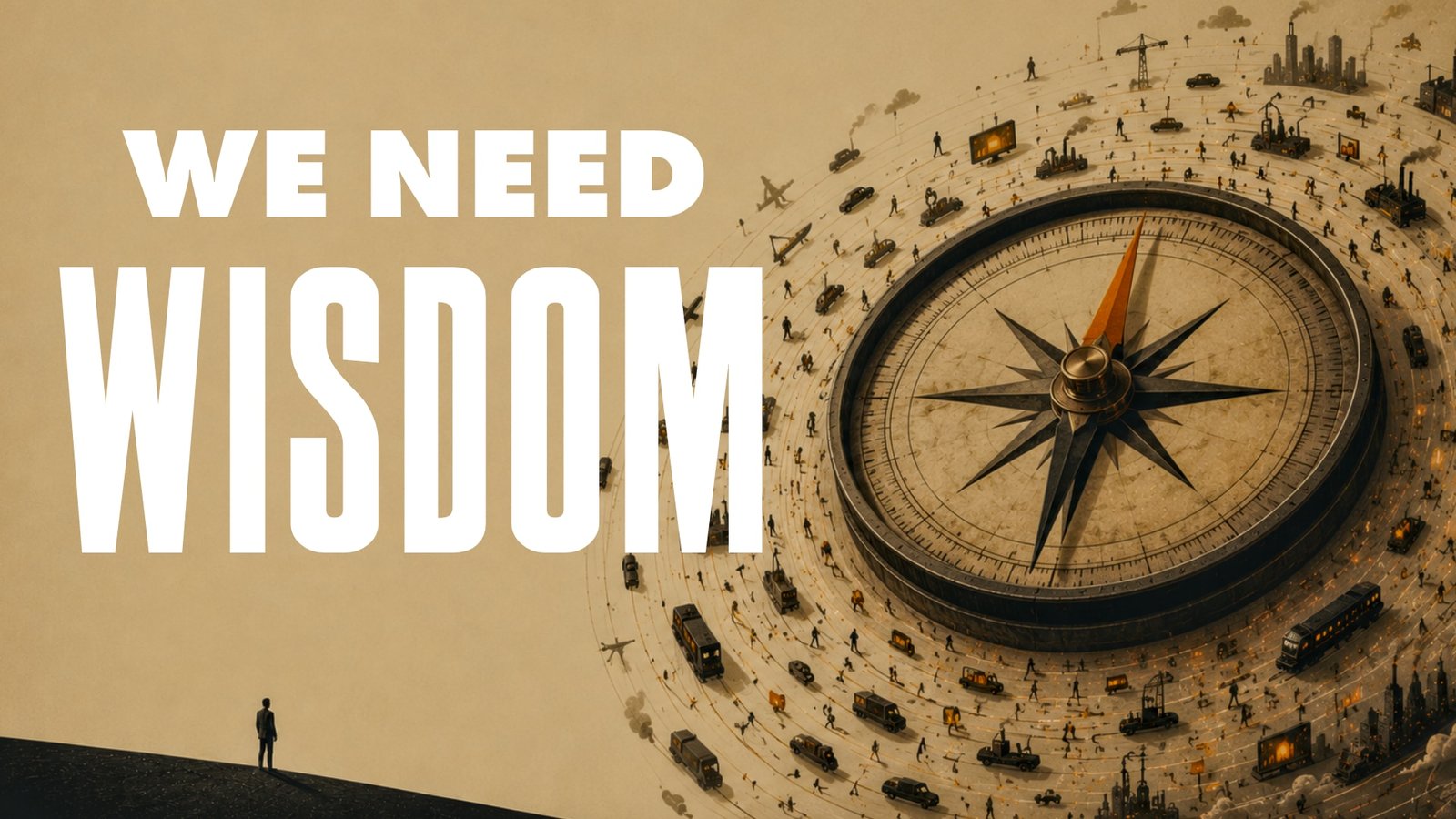
So what do we do about this? The answer? Cultivating wisdom. But how do we do that? We need more space in our lives. Here’s the hard truth. We’re unlikely to find space. The system believes space is failure. It believes its job is to fill the dead air. So space must be made. It must be cultivated like a garden, protected like an heirloom, something that really matters to you.
Here’s what I’m realizing: space is the language of the Rebellion. So how do we make space?
There’s one thing we can ALL do because it’s a micro- practice. And this isn’t theory, this is something I have seen change how people experience their days. We call this practice Pause & Get Curious. Victor Frankl said, “Between stimulus and response, there’s a space. In that space is our power to choose our response.” We can all practice this in the spaces and moments that we have throughout our day.
So what you do is in the moment before you react, you Pause & Get Curious instead. That is what building wisdom actually feels like. The impact of a pause is hard to measure, but we feel its power whenever we do it. This week, the Optimistic Rebellion is to practice Pausing & Getting Curious. In the moment, take a moment. Create space. Don’t rush. Try moving through your life just maybe 5 % more slowly. Give yourself margins. When you pause, let yourself get curious about what’s happening.
This is simple to understand, but at least for me, this takes a lot of practice. So here’s the rule. When you feel that urgency, which is exactly when the system wants you to react, give yourself 10 seconds to respond instead. Respond, not react. One breath in, one breath out, then get curious. We can practice this together.
Original post with all source links: https://joshallan.com/2026/02/03/we-need-wisdom-not-speed-or-why-space-is-the-language-of-the-rebellion/
