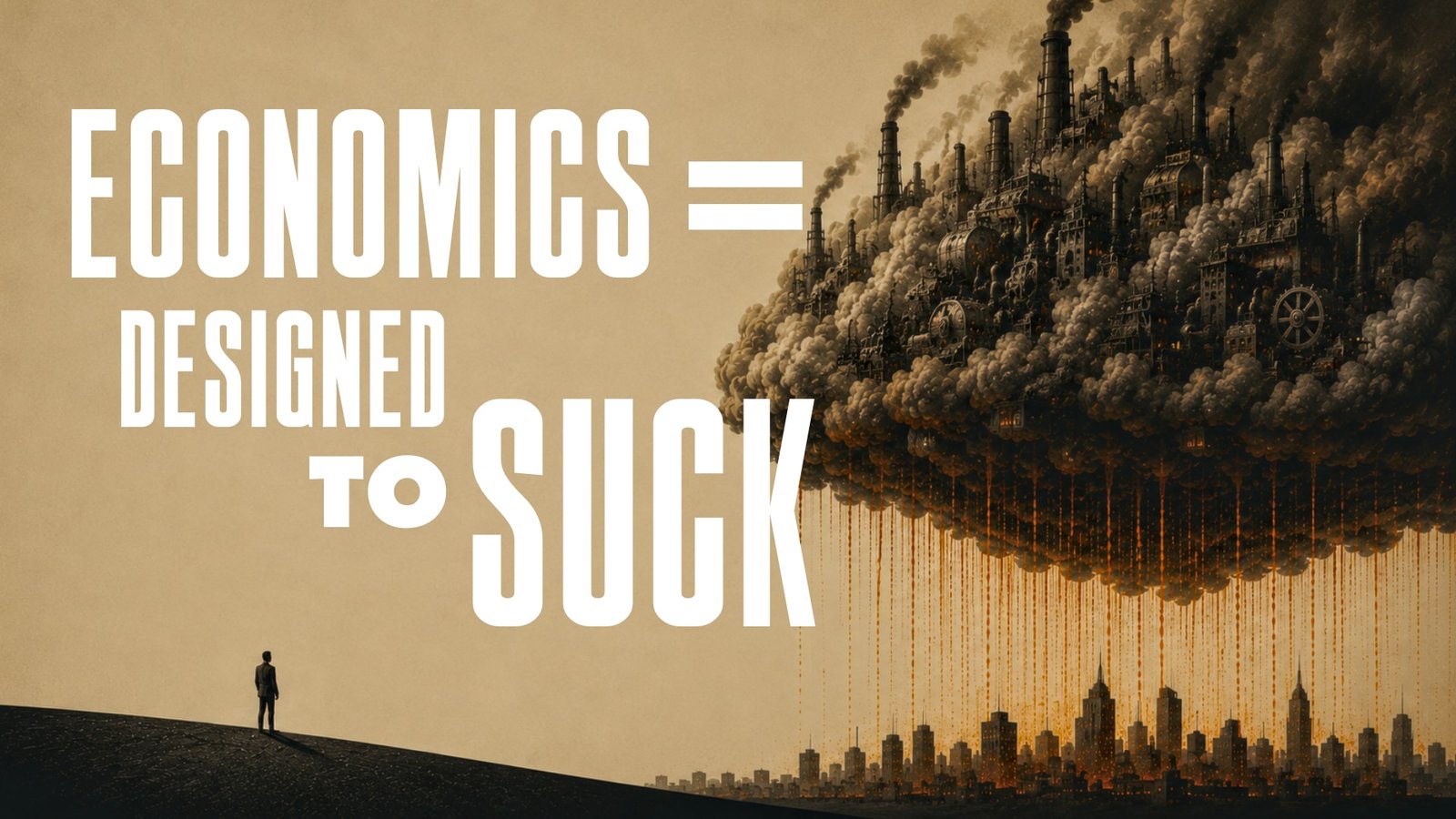
If you’ve ever wondered why work feels draining or affording housing feels impossible or health care feels deadly or debt feels endless… this episode is for you. All of our conversations… work, housing, healthcare, debt, burnout, climate, they all keep collapsing into each other, right? This is not a coincidence. It’s because all these things are running on the same invisible operating system: an OS called “economics.”
For our whole lives, most of us have been working inside this system without ever really understanding what it actually is, how it came to be, or how it really works. Here’s the definition most of us were never given: “economics” is how a society decides what matters, who gets what, and who absorbs the cost when things break. It’s not money. Money is just the scoreboard for economics. The rules are the real game.
The word economy comes from the ancient Greek oikonomia, which means the management of a household. Not the stock market, not GDP, the household. Early economic thinking was about stewardship — how to manage resources so the household could live well, endure over time, and pass something viable forward. Limits kept life bound in healthy ways.
That’s why Aristotle made a sharp distinction between managing resources for life and accumulating wealth for its own sake. He called the first oikonomia (good) and the second chrematistics (dangerous). You don’t have to be a native speaker of ancient Greek to see: these are two VERY different words.
So here’s the invitation: what if we started thinking of ‘economy’ as how we collectively manage our household — just at planetary scale? I mean, if humanity has a household, it’s planet Earth, right? Space? Really cold. Mars, super boring. Earth, pretty damn spectacular. So let’s say it. This is our collective household. Then how well do you think we’re doing at collectively managing our household? What grade would you give us?
Well, I can tell you one thing. If accumulating money is the goal, we’re definitely no longer doing oikonomia, we’re doing chrematistics, which isn’t “economy” anymore at all. It’s something else.
So how did we get here? For more than a thousand years, economics didn’t exist as a separate discipline at all. Not because people weren’t producing or trading, but because life was organized locally, visibly, within natural limits. After Rome, economies were embedded in land and obligation, tradition, religion. People lived close enough to their consequences that abstraction wasn’t possible. You don’t need models to explain limits when winter and hunger were right there. Economics emerges as a discipline only when systems scale beyond human visibility. When trade starts to expand across continents and states consolidate power and complexity needs managing from a distance. That is when economics stops being about households and starts being about a bunch of other stuff.
In the late 19th century, economics deliberately remade itself as a science. This wasn’t really an organic evolution. It was a calculated choice, driven by what critics call “physics envy.” Economists wanted the authority of the hard sciences, so they started building mathematical models that treated human behavior like predictable mechanical forces. In this new framework, humans became “rational actors.” Values became “preferences.” Nature became an “input.” This narrowing gave economics authority.
But why exactly did economics remake itself this way at this particular moment? Because If you can make your model look like physics, like gravity, then outcomes stop looking like choices and start looking like laws of nature. Inequality? It isn’t unjust, it’s just efficient. Extraction? It’s not immoral, it’s simply optimizing. Suffering? It’s not a policy failure, it’s a deeply regrettable side effect of natural market forces. This gave capital an enormous gift: moral cover. You can’t argue with gravity. If poverty is just a natural law, no one’s really responsible for it.
The timing of this wasn’t accidental. Economics became scientific in the late 1800s, right as industrialization was creating massive inequality, child labor, brutal working conditions, and very visible human suffering. Economics arrived with a convenient isn’t exploitation, it’s efficiency.” This isn’t choice, it’s nature.” If that suffering looked like a choice, people might demand that it stop. But if it looked like a natural law, well, then it’s just… unfortunate.
Here’s another important distinction. The economy is how we organize our shared global household. Economics then is like the map we use to understand how our household’s doing. Lately, we’ve been confusing the map for the house itself. Think about a map. A map can be incredibly useful, but it doesn’t include every tree. It doesn’t show how exhausted you are on the trail. It doesn’t show what it actually feels like to walk the terrain.
Imagine this hiking conversation. You say, “I’m lost and dehydrated.” The system replies, “That’s impossible. According to the map, you’re right here doing great!” That’s not a bad map, it’s a complete misunderstanding of what a map is FOR. But it also sounds a lot like a sound bite on the evening news, doesn’t it? You say, “It’s harder for me to afford things than it hasn’t been in my whole life.” The system replies, “That’s impossible. The stock market’s higher than it’s ever been!”
Here’s the other problem. Once the model matters more than our actual lived experience, anything the model can’t see stops mattering. Ecological collapse becomes an externality. Care work, or any work traditionally done by women in general, disappears from sight altogether. Extortion of customers becomes “market power” and “record profits.” Hoarding money becomes “success.” This is the lie. Modern economics makes suffering look like your failure instead of the system’s design. It treats your exhaustion as poor time management, not overwork. Your debt as bad choices, not wage theft. Your burnout as weakness, not terrible workplace policies.
We need to understand something else that’s very important. Markets are not natural. They are not gravity. They are not weather. They do not exist in the biological world. Markets are systems designed by humans. Markets feel natural because we were all born into them. No one listening to this has ever lived a single day of life without them. So they feel inevitable, like oxygen or seasons. They are not. And what’s more, creating a market economy where land and labor and money are all bought and sold requires demolishing what came before.
One example: in England, there was the enclosure movement. Land that had been held in common for grazing and foraging and fuel gathering was enclosed by fences and privatized over hundreds of years with parliamentary acts peaking in the late 1700s and early 1800s. People who had used those commons to graze animals and gather fuel and supplement their food supply suddenly lost access. Without it, they had no choice but to sell their labor to survive. That’s not a market emerging naturally. That’s a market being forced into existence. And this is how it happens.
Markets don’t arise spontaneously. They require states to enforce property rights and protect contracts and discipline labor. They’re built and then protected by power. So here’s what this looks like in practice. Prevention almost never gets prioritized. Prevention doesn’t generate profit. It just avoids future costs that aren’t on anybody’s balance sheet yet.
Here’s what else it looks like.
Burnout, spreading. Extracting more output from fewer people looks like efficiency. because the human cost doesn’t show up in the quarterly report.
It also looks like housing becoming an investment vehicle. and not just shelter. When you can make more money treating housing as an asset class than as a place for people to live, the system chooses the asset class every time.
It looks like health insurance companies creating things like “medical loss ratios.” Paying for your health care is literally called a loss on their balance sheet. The point isn’t care, it’s profit. You’re not a patient, you’re a revenue stream.
It looks like us still burning fossil fuels, even though we know better.
The system can’t see 50 years ahead. It can barely see past the next earnings call. Future collapse is yet another externality. Present profit is what counts. None of this happens because people don’t care. It happens because the system literally can’t see what caring looks like.
When the rules say “maximize shareholder value,” care is inefficient. Restraint is a competitive DIS-advantage. Long-term thinking? That’s a reason to replace you. The outcomes we keep seeing — the extraction, the exhaustion, the short-termism, the not accidents. They’re what the system was designed to produce.
How did this logic end up everywhere? Well, after the Great Depression / World War II, some people genuinely believed that concentrating power in governments would eventually slide into authoritarianism. So they concentrated it in markets instead. To them, the answer was simple. Let markets do the organizing. Governments won’t disappear, they’ll just switch jobs. Instead of providing things directly, government would protect markets, enforce contracts, privatize public goods, and generally just stay out of capital’s way.
That sounds exactly like the world I’ve lived in my entire life. That worldview where markets privatize eventually got a name: neoliberalism. For a long time, this idea lived in think tanks and universities. It wasn’t fringe exactly, but it wasn’t policy yet either. Then the 1970s hit. Stagflation, oil shocks, economic chaos, the old system seemed broken. And neoliberalism showed up with clean, confident answers: Privatize this. Deregulate that. Cut taxes. Weaken unions. Basically, just get government out of the frickin’ way and let markets do their thing.
The ideas were coherent, repeatable, and easy to scale. Politicians could explain them in sound bites. Economists could model them. Wealthy interests could fund them. By the early 1980s, neoliberalism wasn’t theory anymore. It was policy. Reagan and Thatcher led the way, but it kind of spread everywhere. Across parties, across borders, across ideologies. Even center-left governments adopted the framework. Markets became the default solution to nearly every problem.
Here’s what actually changed. Before neoliberalism, wages tracked with productivity. When companies made more, workers earned more. After neoliberalism, that link broke. Productivity kept climbing, but wages flatlined. The wealth went somewhere else (straight to the top). Before neoliberalism, unions were strong enough to negotiate. After… they were systematically broken. Reagan fired striking air traffic controllers. Thatcher crushed the miners. The message was clear. Labor was no longer a partner, it was a cost to minimize. Before neoliberalism, financial markets were heavily regulated. After, those regulations dissolved. Banks that had become separated got merged. Risky speculation that had been illegal became normal. The financial system became a casino. And when it crashed in 2008, you know who covered the losses! You, the taxpayers. Before neoliberalism, public goods were publicly provided. After, everything became a market. Prisons, schools, water systems, even parts of the military got privatized. If it could somehow generate profit, the thought was it should be run like a business. Neoliberalism didn’t invent extraction, but it made extraction feel normal, maybe even virtuous. It told us that privatization was efficiency, that deregulation was freedom, that tax cuts would lift all boats, that unions were the problem, not low wages, that the market would solve everything if we just got out of its way. And now, decades later, we’re living in the world of those ideas built.
The only idea I really care about is whatever creates a great future for as many of us as possible. So I’m here to say: look at the evidence. You feel the brokenness. This is how we got here.
I want to say something carefully now because I think I know what some of y’all are thinking. You’re thinking, “OK, time to eat the rich!” Honestly, I get it. When you’re exhausted, stuck, drowning in debt, watching obscene wealth pile up at the top, anger makes sense. It’s human. It’s not wrong to notice that the outcomes right now are wildly unjust.
But here’s the thing I find myself wanting to say over and over… I usually don’t because comment sections are terrible places for nuance… all elites are not bad people. And not all bad outcomes come from bad actors. And bad systems beat good humans every time. That doesn’t mean that nobody behaves badly. And it doesn’t mean power doesn’t corrupt. And it definitely doesn’t mean we should stop holding people accountable.
What it does mean is this: even the people at the top are operating inside a system that pressures them to behave in very specific ways. It’s a system that rewards extraction. It’s a system that punishes restraint. It’s a system where slowing down or choosing long-term care often means that you lose.
I have spent 20 years in the private sector watching this play out right in front of me. A CEO who chooses long-term investment over short-term profit gets fired. Boards replace them with someone who will deliver quarterly returns, because they think that’s their job. A company that prioritizes people over growth gets acquired, and then their culture gets gutted. Ben and Jerry’s tried to stay mission-driven and got forced into a sale to Unilever. Patagonia’s founder had to give the entire company away to a trust to escape the market’s pressure. These aren’t villains failing to be good. These are good actors being crushed by the system.
If this were a conspiracy, it’d be a lot easier to fight. You could send James Bond into the volcano lair and take out the bad guy. But this isn’t that. This is a system that works without any one person having to hold all the evil.
When the same outcomes repeat across generations, across industries… across ideologies, when inequality keeps growing no matter who’s in charge, we’re not looking at a people problem. We’re looking at a system, and system problems don’t get solved by swapping out the people operating the machine.
So let’s name it clearly. Economics, as we know it, is a lie. Not because economists are liars, but because the system pretends extraction is nature. That suffering is your fault and that markets are laws like gravity. This is also why everything feels so broken. It’s not because you’re broken, it’s because the operating system was designed to break while telling you it’s your fault that it did.
Here’s where we land for today. If the problem isn’t just greedy executives or corporate elites, then blaming individuals, no matter how satisfying it feels, will never fix the thing that’s hurting us. Systems don’t change when we swap faces. They change when we challenge the incentives.
So here’s the Optimistic Rebellion: For the next week, whenever something makes you legitimately angry — a headline, a quote from a CEO, a story about housing, a bill from a health insurance company, a demand at work — pause and ask one question. What is the system rewarding? Not who’s the villain, not who should be punished, but what behavior is being incentivized by the system? And what behavior is being punished by the system?
This approach helps us pull out of our “outrage theater” and it drops us into systems thinking and systems awareness, which is where our real leverage lives. And here’s what makes this bearable. Once you see the operating system, you’re going to start finding others who see it too. You are not crazy. You’re not alone. You’re not the first person to notice this, but the system survives by keeping us isolated, reacting individually to problems that are actually happening to everyone.
But once we see it together, once we start asking these questions out loud with each other, that is when we’ll gain enough collective will to start making a new system that can actually work for us all.
Original post with all source links: https://joshallan.com/2026/01/27/economics-is-a-lie-and-its-why-everything-feels-broken/