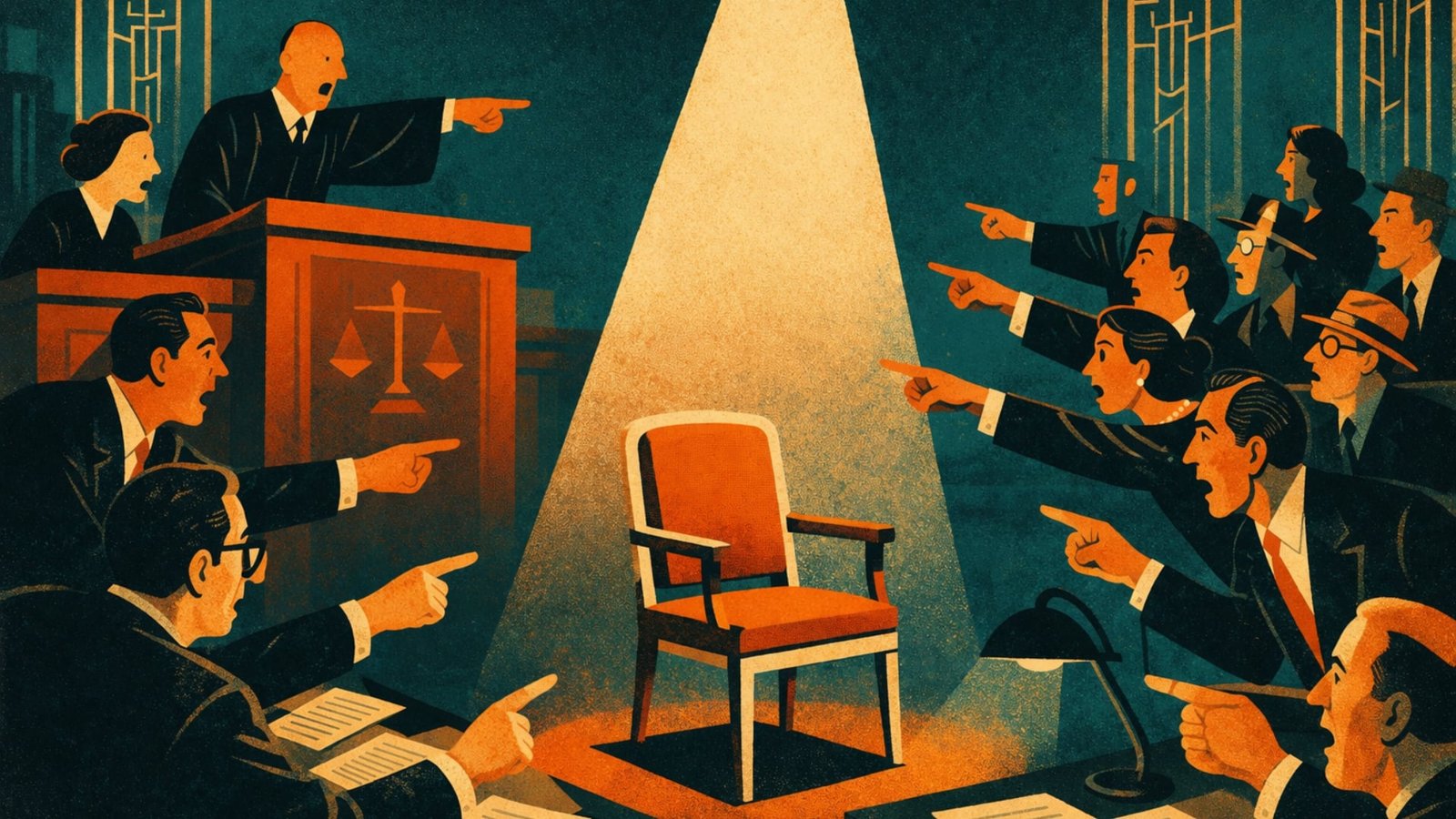
Has the word “neoliberalism” ever come up in your conversations?
Maybe it has, maybe it hasn’t! For me, this word has mostly lived on the periphery of my awareness for a long time, like maybe the last couple decades. I had some vague notion about it, but no real understanding of what it was.
Then I started making these podcasts. And then I made an episode about Economics. And I ended up saying this strange word “neoliberalism” a LOT in that episode, because my research showed that it was a very clear contributor to many of our current problems.
But last week I was guesting on my friend Nicholas’s new podcast and “neoliberalism” came up and I realized: I didn’t actually know where the term originally came from.
This sent me down a rabbit hole. And this week I need to tell you about it, because it feels like I just visited frickin’ Wonderland.
I’ve been preaching this for a while: all -isms tell you what they care about most right in their name. Capital-ism. Social-ism. Femin-ism. The “-ism” basically means “this is a belief system organized around that thing I just said.”
But then we get to neoliberalism. And… what???
Neo. Liberal. Ism.
In the U.S., “liberal” means left-wing — government programs, social safety nets, progressive politics. So “neoliberal” sounds like… a new kind of progressive? Some kind of fresh Democrat? But that can’t be right, because the people who get called neoliberals are usually the ones cutting government programs.
So, if you are in any way confused about this word — and maybe I’ve just confused you now! — or if you’re just now learning about it, welcome to the party. Because I thought I kinda knew this word, but holy crap, it’s actually so much more weird and wild than I ever imagined. In this episode I will show you how this word has absolutely been messing with your life and running the world, even if it’s never come out of your mouth. Buckle up for the craziest etymology lesson you’ve ever had.
I’m Josh Allan Dykstra. I’ve spent 20 years helping leaders make sense of the world so they can live and work with clarity. This is the Hello Tomorrow Podcast. Let’s go.
The Origin Story
We’ll start by going back to where this word actually came from… hopefully.
Paris, 1938. Intellectuals from across Europe have gathered for something called the Walter Lippmann Colloquium. Hitler had just annexed Austria six months earlier. Now he had his eyes on Czechoslovakia. Inside this room, economists and philosophers are trying to figure out how to save democracy.
At this conference, a German economist named Alexander Rüstow introduces a new term. He wants a label for their project, which is basically a revival of classical liberalism, just updated for the 20th century. He calls it: neoliberalism. Seems logical so far.
I think the important question here is: what did “classical liberalism” mean? For my friends in the U.S., this is gonna be weird — classic liberalism meant free markets, limited government, and individual rights.
I had no idea!
That was the Enlightenment definition. So “neo” plus “liberal” literally just meant: we’re reviving that idea of small government and “free markets.”
OK, simple enough, but here’s the first twist: an important somebody at the conference didn’t actually like this label at all.
Who’s that? A guy named Ludwig von Mises. What’s weird about this is that Mises eventually becomes known as a key intellectual influence on the thing we now call neoliberalism. But in 1938, he rejected the term on the spot. He didn’t like it. He didn’t want it.
Which meant this word, neoliberalism, was basically orphaned at birth.
Mises then spent the rest of his life championing free “liberal” markets, in the classical sense, without the “neo” label. He died in 1973.
But critics of Mises in the 1970s started using “neoliberalism” as a catch-all term for free-market economics, and attached it to Mises, despite the Mises Institute itself continuing to distance him from neoliberalism.
As you will see, this “hot potato” situation is completely on point for this word… ain’t nobody want this thing, but they all love to throw it at others!
But this is the first bit of irony surrounding this word: Mises rejects the term in 1938, spends his entire career calling himself a classical liberal, dies, and then his critics retroactively make him the poster child for the thing he explicitly refused.
I guess Hamilton was right… you really have no control who tells your story.
And here’s some bonus points of extra insanity just for fun: the term may not have even originated at this 1938 meeting at all. Some scholars argue it was first used as a pejorative by Marxist and fascist writers twenty years prior in Vienna, hurled at the Austrian School economists as an insult.
So the word might have started as a slur, briefly became a self-chosen label in 1938 by some, but rejected by others, then reverted back to a slur to insult the person who rejected it.
I told you, this is a wild ride. But seriously… we’re just getting started.
OK, But WTF Is Neoliberalism?
So before we go any further into this word’s wacky, bizarro history and also into our optimistic future, let me tell you exactly what neoliberalism actually means in practice today.
Neoliberalism, as most people use the word today, basically describes the economic ideas that have dominated global policy from the 1980s on.
The core belief is simple, and should feel very familiar to you. You ready? “Markets are smarter than governments.”
So if this is the belief, the prescription is simple: privatize public things, deregulate industries, cut taxes — especially for corporations and the wealthy — reduce social spending, break up unions, and just let competition sort everything out.
You’ve felt this. You’ve lived this. This has been my entire life… literally.
Neoliberalism is why your employer stopped offering a pension and gave you a 401(k) instead — your retirement is now your problem to manage in the market. It’s why healthcare in the U.S. is tied to your job — because the market, not the government, is supposed to provide. It’s why public universities got defunded and tuition costs exploded — education is a product you purchase, not a public good. It’s why the middle class has been eroding for forty years while asset prices — stocks, real estate — kept climbing.
In the U.S., we sometimes call this Reaganomics, because it basically started with Ronald Reagan in 1981. Same ideology as neoliberalism, just with a Hollywood actor smile. Same stuff! Reagan just made it feel like patriotism.
So, to recap, we took ideas born in a world-war-panicked room of European intellectuals in 1938, branded it Reaganomics, stuck a cowboy hat on it, called it common sense — and forgot where it came from.
Which, honestly, might just be the most American thing that has ever happened.
Word Laundering In The U.S.A.
So, the word “neoliberal” made coherent logical sense in 1938 in Europe. And, I have to tell you, other parts of the world still use that classical definition when it comes to the word “liberal,” which means this label actually has coherence still today, too… just not here in the U.S.!
Why does it sound so insane here?
It comes down to one guy who was really good at branding things.
Before the 1930s, “liberal” meant roughly the same thing on both sides of the Atlantic — free markets, limited government, individual rights. That was the Enlightenment definition.
But then Franklin Delano Roosevelt needed a label for his New Deal agenda that wasn’t “socialist” — too scary — and wasn’t “progressive” — too radical. So he grabbed the word “liberal” and redefined it to mean “openness to government intervention in the economy.”
He essentially laundered this word in the U.S.
But Europe never made the switch. A European “liberal party” is, to this day, what it was in 1938: free markets, limited government, and individual rights.
OK, just for fun, let’s throw another word in the mix: libertarian.
Are you familiar with this one? This word is a bit more well known in the U.S., and has come to mean … basically, what “liberal” or “neoliberal” still means everywhere else in the world.
Are you tracking this? When other countries say “liberal” or “neoliberal” they mean essentially what we mean when we say “libertarian.”
But do other countries use the word libertarian? Great question!
In other places, libertarian often means the opposite of what it means here. Historically, especially in Europe, libertarian meant, get this: anti-capitalist, pro-worker, anarchist.
And you know something else? Ayn Rand, the author most people in the U.S. would associate with libertarianism, hated it. She openly opposed libertarianism, which she viewed as anti-capitalist. She called libertarians “hippies of the right” and said they were plagiarizing her ideas and mixing them with anarchism. She preferred to be called a “radical for capitalism” — not a libertarian.
You can’t make this stuff up.
The pattern is seriously comedic in its consistency:
- Rüstow helps coin “neoliberalism,” but Mises rejects it… but Mises gets labeled a neoliberal
- FDR steals “liberal” and redefines it to mean something completely different for the U.S.
- American free-marketeers steal the word “libertarian” from European anarchists and flip the meaning because, well, they need a new label… because FDR stole theirs
- Europe says neoliberalism; the U.S. says libertarianism. But they’re largely pointing at the same thing!
- Ayn Rand becomes the godmother of libertarianism while actively despising libertarians
Every single person in this story ended up labeled something they explicitly refused or changing the meaning of words to mean the opposite of what it meant elsewhere. And nobody controlled their own narrative.
Hamilton was REALLY right.
If we want to add one more great irony into this superb semantic sh*tshow, it would have to be the fact that nobody in the U.S. wants to be labeled a neoliberal.
The country most thoroughly shaped by this ideology is also the country least likely to call itself by this name.
I asked Claude about this. I said: “So these days it’s basically like we can use neoliberalism as a slur to describe the thing we don’t want but nobody actually claims to be part of it.”
To which Claude replied: “Exactly. It’s the political equivalent of “whoever smelt it dealt it” — everyone’s pointing at the smell, nobody’s claiming the fart.”
Listen, when your A.I. makes a fart joke, you gotta put it in the episode. I think that’s a new A.I. law.
Seriously, though… it seems that almost no self-identified adherents of neoliberalism exist, and the very few that do seem to be attempting some form of ironic reclamation, which is a pretty damning indictment of a word that supposedly describes the dominant global economic order of the last almost-50 years.
We’ve apparently run the world on an ideology nobody will sign their name to.
The Ghost Ideology
By the 1980s, Reagan cowboy time, the term neoliberalism had been thoroughly weaponized.
In Chile, Pinochet’s economists used a kind of free-market “shock therapy” to restructure their economy — and critics called it neoliberalism. Reagan and Thatcher dismantled unions, cut social programs, and deregulated everything in sight — critics called it neoliberalism. The IMF imposed “structural adjustment programs” on developing countries — critics called it neoliberalism.
Meanwhile, none of the people doing those things called it that. They called it “common sense.” Or “fiscal responsibility.” Or “realism.”
So the “neoliberal” label has basically become a one-way weapon.
Critics use it, but the practitioners of it deny it. Over time, it’s stopped being any kind of precise analytical term and has basically started to mean something like “an economic policy I find sinister” — which could describe anything from privatizing a national railroad to a city raising parking meter prices.
Academics have been trying to rescue the word as a precise term for decades. Critics keep using it as a rhetorical flamethrower. Nobody’s winning.
We’re all losing.
What we’re left with is a kind of “ghost ideology.” Enormously consequential. Historically traceable. Intellectually serious in its origins. But completely orphaned. And mostly used as an insult! So at this point, I have to conclude that this word is functionally grammatically useless.
The policies exist. The track record exists. The outcomes — some good, many bad — exist.
The “neoliberal” label now is basically just some kind of linguistic chalk outline. Something definitely died there. But it ain’t there anymore. Oh, and we’ve also lost the body.
Leadership Lens
My leader friends: here’s why I spent an entire episode on the etymology of a word nobody uses in any kind of truthful way, other than the fact that this was just a lot of fun.
The “neoliberal” era of the last four decades — whatever you want to call it — produced the organizational world you are still operating inside. Lean staffing. Outsourcing. Shareholder primacy. Efficiency as supreme organizational virtue. The assumption that markets are smarter than governance and competition solves everything.
Those aren’t just abstract economic policies. They became management philosophies. You see it! And they’ve been baked into corporate culture so thoroughly that most leaders don’t even think of them as choices anymore. They’re just “how business works.”
But here’s what history reveals: these were choices. Made by specific people, in specific rooms, for specific reasons — some of them principled, a lot of them self-serving, and most of them operating under historical pressures that no longer exist.
This is what I want you to remember: the world that made those choices — stagflation, Cold War anxiety, “Greed Is Good” — is gone.
But a new set of pressures is arriving: A.I. displacement, planetary boundaries being crossed, geopolitical fragmentation, the looming erosion of the consumer base that the whole system depends on… you know, little things.
The organizations that will navigate this successfully aren’t the ones who endlessly defend the old frameworks. They’re the ones who can see it clearly enough to know which parts to keep, which parts to toss, and — most importantly — that these are choices they can make, these are not laws of nature they’re breaking.
I know at this point in the show I usually like to say something profound and inspirational like “And we can’t redesign a system we can’t name!” but in this case, nobody can frickin’ agree on what the hell the name was, or is, or used to be, so let’s just all focus on creating the NEXT system. A BETTER one that can come after this one!
The Optimistic Rebellion
Here’s today’s Optimistic Rebellion.
Every -ism we’ve talked about today — liberalism, neoliberalism, libertarianism — started somewhere specific. A room. A person. A moment in history with real stakes and real context. And then it got passed around, redefined, weaponized, and eventually turned into a label people throw at each other without much thought about where it came from or what it originally meant.
And to some extent, we all do this. I try to be very precise in my thinking and language, but I got sucked into this vortex in my convo with Nicholas. It’s easy to use an -ism as some kind of “air cover” for our opinions and half-baked statements. We adopt them like they’re some kind of customizable weapon that damages only the thing we want to damage.
But it doesn’t work like this. Like we saw in this episode, these labels and words are complex and contextual in their meanings and impacts, and I am challenging us, myself very much included, to be more thoughtful before we throw them around.
So this week’s Optimistic Rebellion is this: the next time you reach for an -ism — in an argument, in a conversation, on social media, wherever — pause for just five seconds and ask yourself: do I actually know what this word means? Where it came from? Who coined it, and why? And am I using it to try to understand something better, or just to win an argument?
Let’s be honest with ourselves if we’re wielding an -ism as a weapon or if we’re letting a belief system think for us.
Because here’s what I believe: the world doesn’t get better when we just fight harder with the same broken vocabulary. It gets better when we get more precise. More curious. More willing to say: “You know, I actually don’t know the full history of that idea; let me do more research.”
That’s not weakness, that’s how we become people who can actually help the world thoughtfully build what comes next.