

Imagine meeting someone who was completely indifferent to your suffering. Someone who would happily destroy your livelihood if doing so benefited them financially. Someone who could watch you struggle, know exactly why you were struggling, possess the ability to help you… and choose not to.
You probably wouldn’t invite this person over for Thanksgiving. You might even, quite rightly, call them a sociopath.
But here’s the thing: we’ve designed one of the most powerful institutions in human history to behave exactly this way.
We call them corporations.
Today we’re going to talk about why the corporation is a sociopath — and why that’s actually a reason for hope.
I know. Stay with me.
THE OUTCOMES WE GET BUT NOBODY WANTS
Another quick thought experiment…
Imagine you’re working for a company that just announced another round of layoffs. The company isn’t going bankrupt. It’s not even losing money. But somehow, the decision has been made that reducing labor costs will improve “financial performance.” Maybe the investors want better margins. Maybe the stock price needs a boost. Whatever the reason, people are about to lose their jobs.
Inside that company are many leaders who know exactly what this means. They know the employees about to be jobless have mortgages, children, medical bills, aging parents. They’ve maybe worked alongside these people for years. And yet, the decision still gets made, the announcement goes out, people box up their stuff, say goodbye, and everyone moves on.
It’s just another day in corporate, right?
When this happens, it’s hard not to look at the leaders and wonder if they’re ultimately to blame. But on the whole, I don’t think they are. This isn’t really speculation on my part, either. I’ve spent the last twenty years of my life among the leaders of these organizations. The organizations I’ve worked with employ over a million people. Mostly, I can tell you these leaders are wonderful humans. Kind people. Generous people. People who genuinely want to make things better, not worse. Are some leaders a-holes? Of course, but they are NOT the majority.
And yet, it would be difficult, maybe impossible, for me to name a single organization — where these tremendous people work, mind you — that hasn’t done something kinda terrible to its people. You know it’s true! Find me a big company that hasn’t ever been a d*ck to its people at some point with a RIF or a return to office policy nobody wanted or an insulting vacation policy and I’ll buy you a flying unicorn.
But really… have you ever thought about just how terribly strange this is?
How can almost all — seriously, almost ALL — the leaders I know be really good people and their companies still, sometimes, be so frickin’ BAD? How do we keep getting outcomes that almost none of us would individually choose?
What’s that about??
The answer to this question reveals something much bigger than “the leader,” and it’s even bigger than the corporation itself.
THE CORPORATION IS A SOCIOPATH
In Chapter 2 of my new book, Work Will Kill Us All, I talk about something psychologists call the Dark Triad: three destructive personality traits — Narcissism, Machiavellianism, and Psychopathy.
Keep in mind, I’m not suggesting we can literally diagnose a corporation with a personality disorder. Corporations are not people, no matter how much our legal and economic systems treat them like they frickin’ are. But this is an instructive way to see what I’m talking about.
We started the episode with part of this. A being that is endlessly selfish and only cares about itself. A being that believes that a better outcome for itself justifies any means to get that outcome. A being that doesn’t register your suffering as even mattering.
These are the three Dark Triad traits.
- Insatiable self-interest = Narcissism.
- Outcomes justify means = Machiavellianism.
- Your suffering doesn’t matter = Psychopathy.
You see it, right? My friends, these traits describe the corporation to a tee. No malice required. Just spreadsheets.
Here’s the really important part: we do not need a sociopathic person for a system to behave sociopathically. We only need a system that consistently rewards those behaviors. This explains what’s going on far better than a “bad leader” theory. This is how we consistently get outcomes almost no individual actually wants.
And it shows us why damage happens at scale, because a system, by its nature, also contains math of multiplication. A system can multiply incentivized behavior across thousands of people, across continents, across generations.
The people can, and do, change. The system continues.
PEOPLE ARE STILL RESPONSIBLE
Understanding the systems that incentivize behavior does not excuse the people inside them. If you’re a leader making decisions that harm people, you’re still responsible for those decisions. You don’t get to shrug and say, “The system made me do it.” You have agency, choices, and responsibility for the consequences of your actions.
But the individual person is only one side of the issue. Because if the underlying system rewards harmful behavior, what happens when a leader refuses to participate? Maybe they’re passed over for promotion. Maybe the board finds a new CEO. Maybe they’re replaced by someone more willing to make those “difficult decisions.” In every case, the system continues doing exactly what it was doing before.
Individual accountability and system accountability are two sides of the same coin. We need both. But replacing a harmful leader without changing the system that rewarded their behavior isn’t change that sticks. The system will simply find someone else willing to play by its rules.
THE PURPOSE OF A SYSTEM IS WHAT IT DOES
There’s a related idea from British cyberneticist Stafford Beer, often abbreviated POSIWID: The Purpose Of a System Is What It Does.
I love this because it asks us to stop judging systems by what they claim to do and examine what they actually produce instead.
Think about a company that says its people are its greatest asset. Beautiful sentiment. It’s probably painted on a wall somewhere in the building. But does that company consistently invest in its people, give them meaningful agency, and create conditions where they can flourish? Or does it sacrifice their well-being whenever doing so improves quarterly financial results?
The system that company is in usually rewards only one of those pathways. And it isn’t the one that helps people flourish.
We can apply POSIWID to almost anything. If an education system consistently produces students terrified of making mistakes, we should examine what that system is rewarding. And if an economic system consistently concentrates wealth and power into just a few pockets, perhaps we should stop treating that outcome as a mysterious accident.
Which brings us to our most important idea for today.
THE STORY BEHIND THE SYSTEM
Every civilization has what I call an Organizing Story: a collection of beliefs and assumptions that tells a society what matters, what success looks like, and how the world is supposed to work.
Here’s how it happens. Enough people over enough time start telling a Story and it becomes encoded into a system. That system produces the outcomes we experience as everyday life. Those experiences then reinforce the Story, which reinforces the system, and so on.
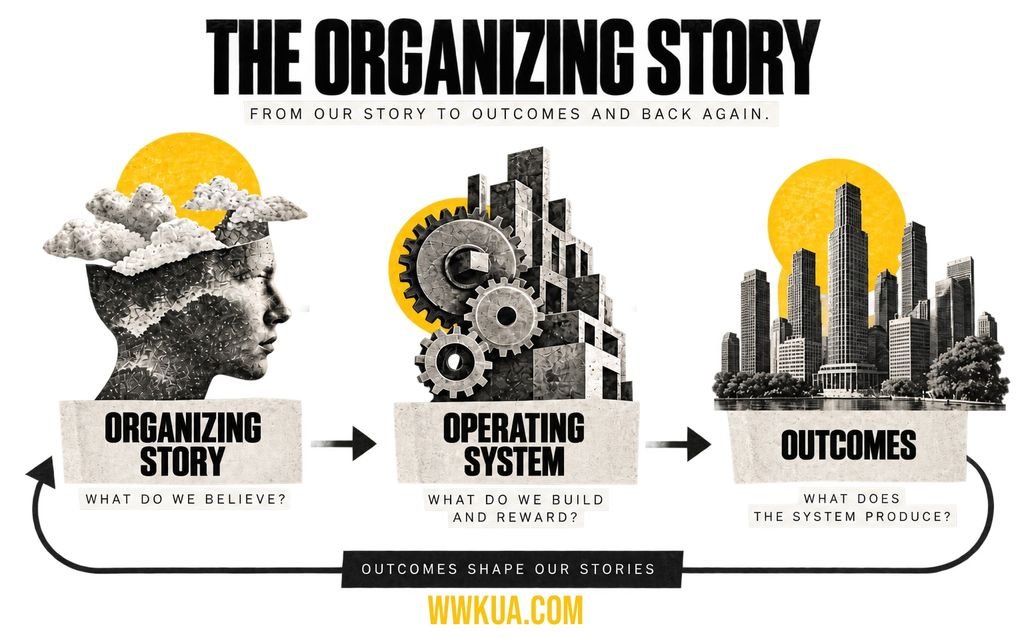
Story. System. Outcomes. Back to Story.
I know that feels a bit abstract, so let’s make it real. I want you to put your BIH, Big Imagination Hat on, OK? See if you can picture this.
Try to imagine a society that believes the highest purpose of a company is maximizing financial returns for its owners.
Yeah, not very hard to picture, right? That’s our current Story. This story tells us that greed, for lack of a better word, is good. That more is always better. You might not believe that. I might not either. But I know, and you know, that what we believe doesn’t really matter, because this is how it IS.
With this Story as our collective “boss,” we live at the mercy of ownership structures, management practices, and incentive systems that prioritize capital returns over pretty much everything else.
That part is our system. It serves the “greed is good” Story.
Then, outcomes. We reward the executives who deliver the biggest numbers, celebrate the companies that grow the fastest, and teach future business leaders to pursue those same goals. Voilà! We get a world that looks exactly like ours!
After generations of doing this, something extraordinary happens: we forget that we invented the whole thing. The Story, the system, the incentives… all human inventions. Completely made up by people no better or smarter than you and me.
But when we forget this, we start treating the system and the Story as the natural order of things. Of course corporations exist to maximize profits. Of course growth is always good. Of course shareholders should have the ultimate say. That’s what business and work is FOR!
Except… it isn’t. That’s just the current Story.
And this is why so many attempts at organizational change ultimately accomplish so little.
WE want compassionate organizations, but the Story rewards them on financial performance. WE want leaders to prioritize people, but the system evaluates them primarily on the numbers. WE want sustainable organizations, but the Story treats endless growth as the definition of success.
We’re trying to change the outcomes without changing the Story those institutions were built to serve.
It’s kind of like installing beautiful new seats in a car programmed to drive off a cliff. Congratulations on the seats, but before we drive this thing any further we should probably examine the frickin’ navigation system.
HOW I KNOW WE CAN BUILD SOMETHING DIFFERENT
Years ago, I helped build a tech company called #lovework. It operated as an entirely self-managing organization. We didn’t organize ourselves around the assumption that a few people at the top should make all the important decisions while everyone else waits for instructions. We wanted people closest to the work to have the agency and responsibility to do what they needed to do. So that’s how we built it.
Not everyone was an equity owner, but everyone had a pathway to become that if they wanted, and every person absolutely had massive ownership over their area of expertise in terms of decision making and trust.
This is how I know we can build something different: I saw it. When we change the environment people operate inside, we completely change what’s possible for them. We change the choices they can make and the responsibilities they’re willing to take on. #lovework didn’t need all of humanity to magically evolve into a more enlightened species. We changed the organizational system, and that changed how work could happen… if only for our small team.
What you might not realize is that there are organizations like this all over the world. Workplace systems that treat people like adults, distribute ownership, and share decision making aren’t common, but there’s WAY more of them out there than you think. If you want to learn more, please go visit my friends at corporate-rebels.com — they’ve cataloged more pioneers than anyone I know. We’ll talk more about this in the future.
For today, remember: the way work is typically organized isn’t the only way. And it’s not even close to the BEST way.
WHAT IF WE CHANGED THE STORY?
So here’s the question we’ve been building toward: What if we changed our Story?
You really will need your Big Imagination Hat this time!
What if the purpose of a corporation wasn’t maximizing financial returns?
Yeah, really.
What if its purpose was something like “help life flourish”?
What would our institutions look like if we started with a fundamentally different understanding of what they’re supposed to be and do?
Under a different Story, profit could become surplus we reinvest rather than wealth we extract. Workers wouldn’t be “expenses” to minimize. Communities wouldn’t be “markets” to exploit. And the natural world wouldn’t be just a pile of “resources.”
My friends, I need you to know: we don’t have to have a future where we’re endlessly fighting each other. Right now, we’re mostly fighting each other because our Story is fundamentally misaligned with the kind of life we want to live. We could have a future with systems that actually make it easier for people to do good things.
Most of US are so clearly on the same Team. We want to work on something that’s meaningful to us. We want to matter to people we care about. We want our kids to be better off than we were. We want to feel safe in our community. We want to go home at the end of the day feeling like our time on this planet meant something.
Do you see it? Other people are largely not our enemy. We want the same thing! It’s the SYSTEM and the STORY that needs to change.
THE OPTIMISTIC REBELLION
Here’s today’s Optimistic Rebellion.
This week, I want you to catch the system in the act. Just once. Bonus points if you see more!
Watch for a moment when an institution does something that seems completely disconnected from human decency. Maybe it’s a decision at work. Maybe it’s something in the news. Maybe it’s a policy that makes absolutely no sense.
Here’s the hard part. When you notice it, resist the temptation to immediately look for someone to blame. Instead, ask yourself: How is the system rewarding this behavior? What Story is it serving? (I’ll bet you that unicorn it’s “greed is good.”)
That’s it. You don’t have to fix anything this week. Just see it. Because once we start recognizing the systems shaping our lives, it’s really hard to unsee them. This is where the revolution begins.
These institutions and systems aren’t forces of nature. They aren’t inevitable or permanent. They’re all human creations.
We invented corporations. We invented the rules that govern them. We invented the stories that tell us what they’re supposed to accomplish. And if we invented those things, we can reinvent them. We can build organizations that distribute power differently, institutions that reward different behaviors, and we can tell new stories about what success means and what our work is ultimately for.
Because the problem was never simply that we needed “better people.”
We need better systems.
And a better Organizing Story around it all.

