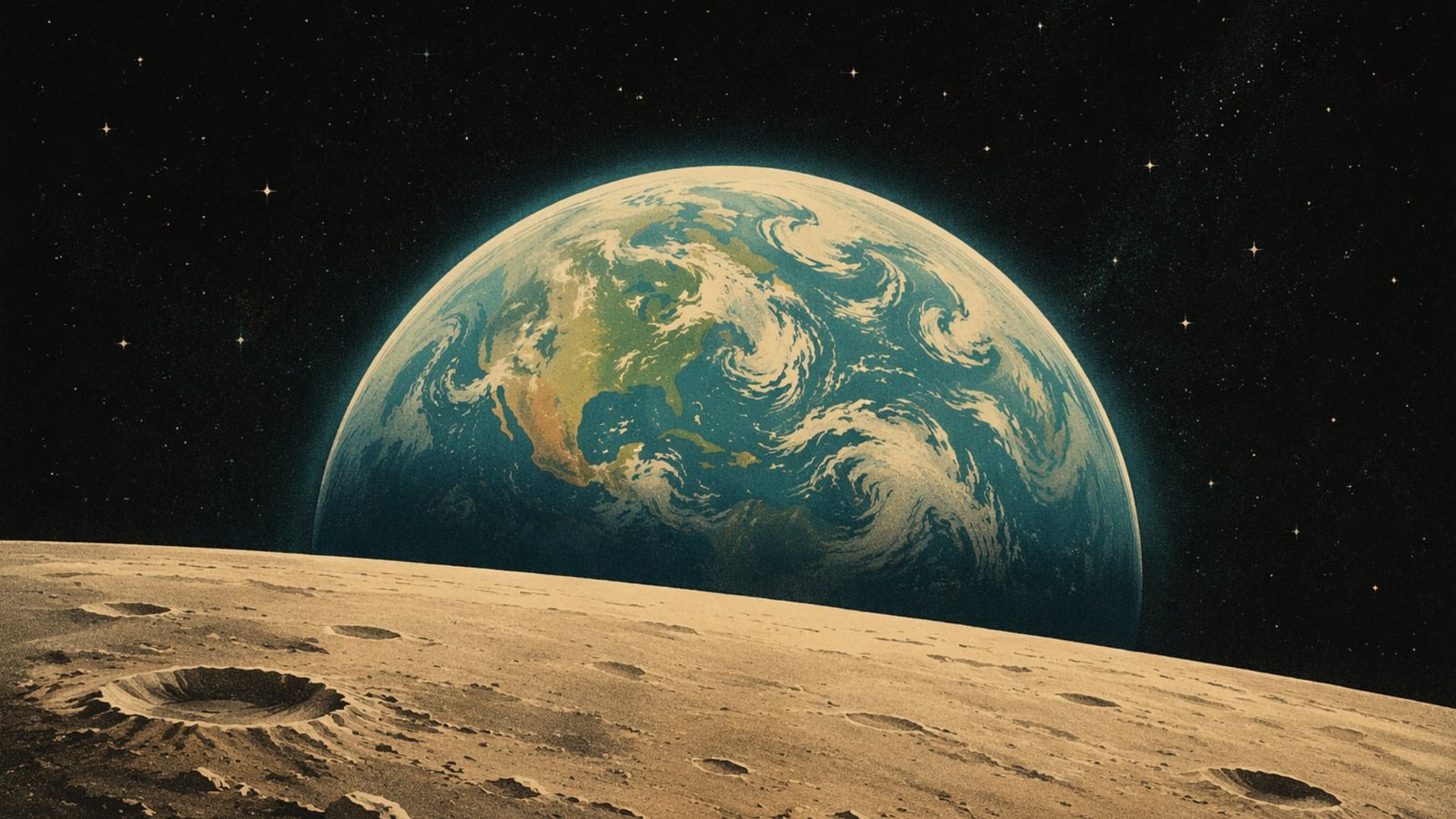
Today we need to talk about space.
I feel ontologically-conflicted about doing a piece on this topic… meaning, it feels like a crisis of my very being, because as I’ve stated, I love Star Trek. I also love sci-fi like For All Mankind (my favorite show on television at the moment) and I love the Earthrise photo and the phenomenal new images sent back from our Artemis II astronauts. The notion that we’re not alone in the universe is a powerful one when it unifies us here at “home” to do something TOGETHER.
But I’m not sure the current “space race” is doing that.
So consider this article my love letter to Spaceship Earth, and my honest reckoning with why we keep trying to leave it.
The Artemis II mission just sent astronauts around the moon — actually around the moon, for the first time in over fifty years — and I wanted to be captivated. I wanted the world to stop and stare. I wanted the collective exhale, the shared wonder, the “holy crap we did it” moment that my parents’ generation got when Neil Armstrong stepped onto the lunar surface.
And instead… it wasn’t the moment of collective awe I was hoping for.
It happened. People acknowledged it. We “liked” the photos.
But then everyone I know went back to doomscrolling.
Here’s my Fourth Turning read on the situation: we struggle to be captivated right now. Not because we don’t want to be. But because our attention is buried under the rubble of collapsing institutions, eroding trust, and the latest insane Truth Social post.
During the Second Turning — the post-WWII boom, the original Space Race — we had the social cohesion and collective confidence to look UP. Right now, in the middle of a Fourth Turning, we are desperately trying to figure out what the hell is happening DOWN HERE.
And that, my friends, is actually the first piece of evidence for today’s argument.
Because if we can’t even emotionally afford to be moved by real humans orbiting the moon — something genuinely pretty miraculous that our scientists and engineers pulled off against enormous odds — then maybe, just maybe, this isn’t the right moment to be betting civilization on getting to Mars!?
Today we’re going to talk about space. Why parts of it are genuinely wonderful. Why parts of it are being catastrophically misused. And why the sequencing of our current “space race” might be one of the most expensive mistakes we’re making as a species.
Space Stuff That Doesn’t Suck, At All
Before I seriously piss off my space-loving nerd friends, I want to talk about some genuinely amazing things about space exploration, because there are a few things about space that don’t suck, at all. In fact, there are some things that are mind-blowingly awesome.
First, I am not really arguing against NASA. NASA has given us weather satellites, GPS, water purification technology, and some badass telescopes that take pictures that make astrophysicists cry at their desks. That’s magnificent and I want more of it.
Second, I am not arguing against satellite infrastructure. Starlink — whatever you think of its founder — is providing internet access to genuinely underserved communities around the world. Satellites are monitoring our climate, tracking deforestation, coordinating disaster response. That is space serving Earth. Thumbs up.
Third, I am not arguing against planetary defense. The “Don’t Look Up” scenario — an asteroid on a collision course with Earth — is a real category of existential risk, and having eyes in the sky and the capability to do something about it is legitimate and important.
Fourth, I am not arguing against the scientists, engineers, and astronauts who made Artemis II happen. Those people are extraordinary, and the fact that their achievement got approximately two minutes of news cycle attention before being buried under the latest political catastrophe is, frankly, a damn shame.
Here’s my actual argument, and I want you to hold it in your head for the rest of this episode:
Space FOR Earth? Beautiful.
Space INSTEAD OF Earth? That is when space gets stupid.
This episode was inspired by a recent episode of Nate Hagens’ podcast, The Great Simplification, called “The Fantasy of Space Colonization,” where a physicist and an environmental scientist spend two hours systematically dismantling the biophysical realities of space colonization. It’s one of the most clarifying things I’ve listened to in a long time, and I’ll be referencing parts of it throughout this episode, but you should go listen to the whole thing. Seriously.
That episode inspired me to push on something they didn’t quite name, and that’s the question of sequencing. Not whether we can go to space. But whether we should be trying right now, given, you know… everything else.
Spoiler alert: I don’t think we should.
Let me explain why.
The Great Genius Misallocation Problem
Here’s the first part of the problem.
Right now, somewhere on Earth, there is an engineer with a physics PhD and twenty years of experience in fluid dynamics and complex materials science. She’s brilliant. She could be designing next-generation carbon capture systems. She could be engineering drought-resistant food systems for Africa. She could be building resilient energy grids for the world’s most grid-impared places… you know, like… Texas.
Instead, she’s optimizing fuel efficiency for a rocket that will carry six ultra-wealthy tourists to the edge of space for eleven minutes.
This is what I call “genius misallocation.”
It’s not just a money problem — it’s a human energy problem. We are aiming our smartest people at the wrong freaking frontier. The people capable of solving Earth’s most pressing systems failures are being recruited, at enormous salaries, to work on problems that — as I’ll share with you next — might not even be solvable at all.
The opportunity cost for this isn’t abstract. Every moment we spend pointing our best engineering talent at Mars is another moment we’re not pointing it at the problems that will determine whether our civilization makes it to the next century.
Space Would Prefer To Kill You
OK so let’s say you’re not moved by the philosophical argument. Here’s the second part of the problem.
I suspect most of us have seen enough movies to know that living in the vacuum of space is, you know, kinda hard.
Let’s say you’re a “Yeah but we’ll just science the sh*t out of it” person. I kinda get that, it’s an intoxicating worldview. I mean, Matt Damon planted potatoes on Mars and it worked out great. How hard can it be?
Turns out, pretty hard. Like, biophysically-this-is-not-happening hard.
Why? Because nothing complex lives in space. Not you. Not me. Not anything with more than one cell, really. Maybe tardigrades. But that’s about it.
The physics of space are brutal. The radiation alone during a Mars transit would essentially guarantee premature cancer death. If you make it to the surface, Mars then takes its turn: bone loss, eye degeneration, a 95% CO2 atmosphere, and soil laced with toxic chemicals that would kill your crops before the radiation finishes killing you.
Please… don’t eat the Martian potatoes.
Space is not a place we can love, not like Earth. It is a place that would prefer to kill us.
But here’s an even better argument for why this problem might be currently unsolvable. We already tried it. And we failed miserably.
In the early 1990s, a group of brilliant scientists sealed eight people inside a $200 million, 3-acre facility in the Arizona desert. Maybe you’ve heard of this, it was called Biosphere 2. They had recreated seven distinct Earth biomes — rainforest, ocean, savanna, desert — with three thousand species of plants and animals. Biodiversity. Room temperature. Earth gravity. A support team right outside the door.
Their mission: demonstrate that humans could survive in a genuinely closed ecological system. They couldn’t.
Within sixteen months, oxygen levels had dropped to the equivalent of living at 15,000 feet altitude. Most vertebrate species went extinct. All the pollinators died — which meant the plants couldn’t reproduce. Cockroaches and ants took over. The crew started smuggling in supplies. They had to pump in outside oxygen twice just to keep the people alive.
On Earth. In Arizona. With unlimited resources and the best scientists available.
And since then, we have never — not once, not anywhere — successfully maintained a closed ecological system capable of supporting human life for any meaningful length of time. The largest one ever attempted needed emergency oxygen pumped in and most of its species went extinct. On Earth. In Arizona. And now we want to do it on a planet 140 million miles away with a toxic atmosphere and partial gravity? C’mon.
The International Space Station, by the way, is not a counterargument to this either.
The ISS costs roughly a million dollars a day to operate and requires constant resupply missions from Earth. It is not “living in space.” It is camping with a very expensive extension cord. Tom Murphy’s phrase from Hagens’ podcast is perfect for this: he says it’s a straw sucking Earth resources at an alarming rate.
So, “We’ll just science the sh*t out of it” is not a plan, my friends. It’s a lame, hand-wavy mentalist trick designed to get you to look the other way.
Look anywhere, I guess, as long as you Don’t Look Up.
What We’re Missing About Star Trek
Here’s the third part of the problem: we’re getting the order of things wrong.
I believe we could go to space someday. I hope we go to space someday. I want humanity to be a multi-planetary, multi-stellar civilization! If there are other species out there we could learn from and get to know and hopefully NOT do Klingon battle with, I am seriously on board for this. I want a Star Trek future so badly it’s… kinda embarrassing.
But we’re missing something vitally important about Star Trek: Earth is beloved in that universe.
Star Trek is, of course, about being out among the stars. But there’s a reason why this show is set multiple centuries into the future.
Why?
Because nobody in Star Trek went to space to escape Earth. In the Star Trek universe, earth in the 23rd century is a frickin’ paradise — a post-scarcity, post-money, treasured home base that people return to with reverence and love.
The Federation didn’t launch the Enterprise because Earth was failing and they needed to get away. They launched it: after a massive global crisis, after fundamentally transforming society over a century of hard work, after solving energy scarcity, after reorienting collective human desires toward exploration and cooperation instead of extraction and domination.
Space in Star Trek is the next chapter. It’s not a coping mechanism. It’s not an escape hatch. It’s not a lifeboat for the people who broke the current damn ship.
Any good entrepreneur, any good creator or builder, understands the importance of sequencing. They know that sequencing isn’t everything… but it almost is. Getting the order of operations right is frequently what separates a successful project from an expensive catastrophe.
For example, you don’t build a product before confirming a customer needs it, that’s business suicide. You don’t hire a hundred salespeople before you have a solution that works, that’s ridiculous. You don’t build the top-floor penthouse before you pour the foundation, that’s… stupid.
And right now, societally, with the space nonsense I’ll describe to you next, we are trying to build a penthouse while the foundation is crumbling.
We have:
- Climate systems destabilizing faster than our governance structures can respond
- A global debt crisis that is consuming the productive capacity we need to actually create solutions
- Food and water systems under compounding stress
- Democratic institutions eroding across the developed world
- And we haven’t been able to create a single successful closed ecological system
Going to space someday isn’t stupid.
Going to space now, instead of fixing our spaceship, Earth, first, IS.
Billionaire-Itis + Space Race = Expensive Stupidity
So what’s going on with the current space race?
Well, it’s mostly a circus of billionaire-itis.
Jeff Bezos has been selling approximately a billion dollars of Amazon stock per year to fund Blue Origin — a company whose most visible contribution to human civilization is a rocket that looks like a penis, and a space tourism business charging up to $1.3 million per ticket for eleven minutes of weightlessness. At $250,000 a ticket, that’s $25,000 a minute. I should remind you: it takes an average American family four MONTHS to save as much as this per MINUTE cost. This is the most expensive theme park ride in history. It is not exploration. It is not science. It is not advancing the human species.
Then there’s SpaceX. Sometimes doing useful work, remember: reusable rockets are helpful and Starlink has real benefits for the citizens of Earth. I’m not lumping those things in with Bezos’s carnival ride. But Elon Musk’s stated goal — a self-sustaining city on Mars, explicitly framed as “F*** Earth” — is a catastrophically wrong sequence. It’s not good ambition, it’s Elysium. Or the delusional thinking of a James Bond villain.
And his latest plan — merging SpaceX and xAI to launch a million orbital A.I. data centers — sounds innovative until you do about two minutes of math. Replicating a single large data center in space requires a solar array the size of 500 football fields. And here’s the real problem I don’t hear being addressed at all: A.I. hardware has an upgrade cycle of 18 to 24 months. On Earth, swapping chips means sending a truck. In space it means launching a rocket at thousands of dollars per kilogram of cargo just to get the replacement hardware into orbit.
Meanwhile, NASA, the agency that’s supposed to represent the public’s interest in space, is now completely dependent on billionaires. NASA literally cannot land on the Moon without Musk’s rocket working on schedule. Seriously! When someone at NASA tried to hold SpaceX accountable for delays, Musk publicly attacked them on his personal megaphone, Twitter. I mean, X. Whatever. A lot of X’s around this guy. That’s not just a conflict of interest, it’s a conflict of everything.
And now NASA wants to spend $20 billion building a permanent moon base, on a surface with no atmosphere, radiation 150 times Earth-normal, and dust so abrasive it destroyed Apollo equipment within hours. The stated rationale for this per NASA’s own administrator, isn’t science. It’s beating China. Or, as I like to call it, a casual $20 billion game of “capture the flag.”
The Artemis II astronauts who just orbited the Moon deserve celebration. The scientists who pulled that off are genuinely brilliant. But the phallic rockets, the $25,000-per-minute joyrides, the genius engineers optimizing Mars madness while Earth’s systems crumble — that’s not courage. It’s not even good ambition. It’s really, really expensive denial.
Billionaires, please: get some therapy. (NOTE: this isn’t a flippant statement; I believe this is a real disorder and consensus is building.)
And the rest of us: let’s demand we fix our Spaceship Earth first.
Leadership Lens
Here’s today’s Leadership Lens, and I promise this space romp is more relevant to your work than it might seem.
The first question for you is about sequencing.
As leaders, we do this constantly. Sequencing project tasks is a huge part of what you get paid to do and how you create value. But it’s easy to get distracted and find ourselves chasing the “Mars moonshot” while the foundation cracks. Don’t do that.
I want you to honestly ask yourself: what’s your “Mars?” What exciting, ambitious, prestigious initiative are you currently pursuing that might actually be a distraction from the unglamorous foundational work that needs your attention? The penthouse is more fun than the foundation. But deep down, you know which one needs to go first.
The second question for you is about your people.
Where are you pointing your best talent? The “genius misallocation” problem isn’t just a space issue, it’s an organizational epidemic in almost every organization I’ve ever been in.
This is why wisdom is so important. Your most capable people are a finite and precious resource. Are they working on the right problems in the right sequence? Or are they optimizing a rocket that, honestly, nobody should be building yet?
The most expensive mistakes leaders make aren’t usually about money. They’re about sequence and misdirected human energy. Fix those things and you’ll be ahead of NASA, Elon, and Bezos.
That’s genuinely good work.
The Optimistic Rebellion
For all my friends, here’s today’s Optimistic Rebellion.
First, don’t let the billionaires colonize your sense of wonder. Space is genuinely, breathtakingly miraculous. The Earthrise photo is one of the most important images ever taken. The Artemis astronauts who just flew around the Moon are extraordinary human beings doing an extraordinary thing. That awe is real and it belongs to all of us. Life is incredibly rare, and we’re getting to live it right now. Our Optimistic Rebellion is reclaiming that sense of wonder from the vanity rockets and the fever dreams and the escape hatches and pointing our imagination and brilliance at the right problems.
Second, and I want to be really clear about this, I am not saying never. I still believe a Star Trek future is possible. A multi-planetary, eventually multi-stellar human civilization is still possible. I want that future. But the Optimistic Rebellion is refusing the false choice between “space now” and “space never” and insisting on the version where we actually get to have both because we did the work in the right order. We fixed the ship. We earned the next chapter.
Third, I want you to consider something DJ White said in Nate’s episode: we are already on a spaceship. Right now, during this episode, you and I are hurtling through the cosmos at incomprehensible speed, on a vessel so perfectly tuned to human life that we barely notice it. There are even alien minds on our ship: whales singing complex songs under the ice, dolphins that can learn to use computers as fast as children can. There are ecosystems of staggering complexity that we’ve barely begun to understand. The adventure isn’t just out there. It’s right here. We’re already in space. Looking up is important, but it matters most when it reminds us to look down and see the miracle we’re standing on.
P.S. Right after I hit “publish” on this, I went to see Project Hail Mary. Please go see this delightful and heartwarming film. To my eyes, it makes a picture-perfect case for why “space FOR earth” is beautiful.