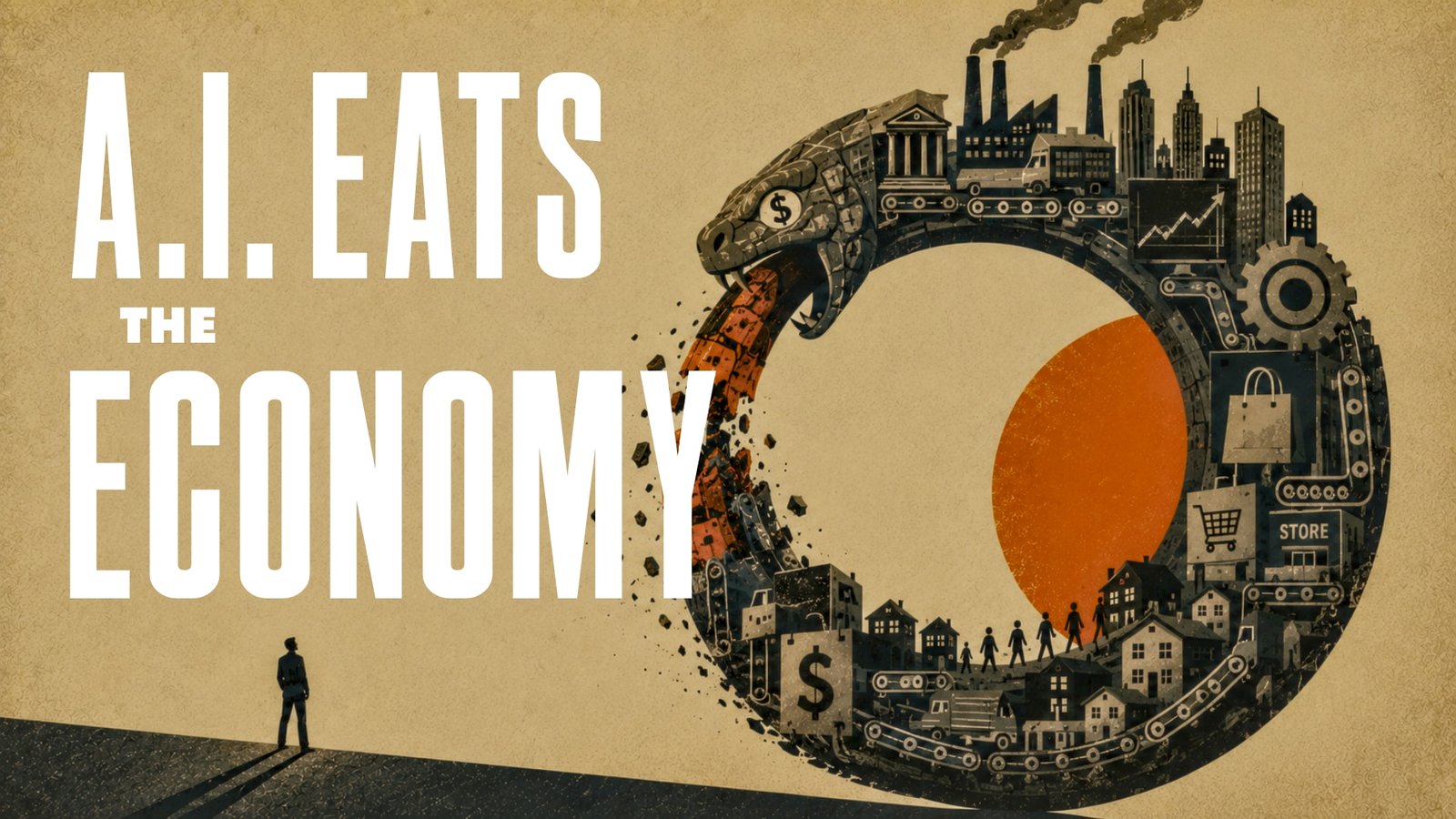
Let’s start with the wrong question. Everybody keeps asking, “Will A.I take my job?” I get it. That question’s terrifying because it’s personal, but it’s also incomplete. There’s a better question lurking in the background, namely this: “What kind of economic system tries to eliminate human labor without replacing income and yet still expects the world to keep functioning as is?”
Here’s the crux of it. If A.I. works the way capital hopes it will, capitalism won’t break because A.I. fails. It’ll break because A.I. succeeds. Why? Because if you’re running a business, you can’t fire your customers and then expect them to buy your stuff. It doesn’t work like that!
There’s a simple loop that runs the modern economy. Labor → wages → income → consumption → revenue… and then back to Labor.
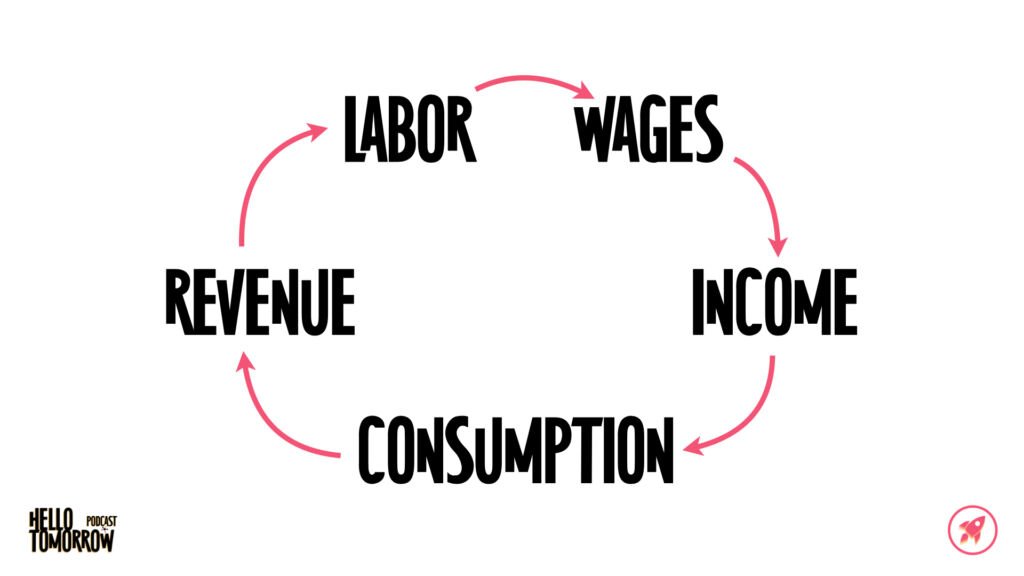
A company pays Labor, that’s you, in Wages, which become your Income. You have some leftover, so you buy things, Consumption, which is another company’s Revenue, which they use to pay their Labor. Feels familiar, right?
In the way that modern life currently works, This Loop is not optional. It’s what we might call load-bearing. It’s holding up the house. When we break or pull out one part of the Loop, things are not gonna function the way they do now, period. We’ll call this The Loop That Holds Up The World. For most of the last century, we’ve treated this Loop like a law of nature. It’s not. There’s nothing natural about this Loop. It’s not a law of physics. It’s a system we built.
So when a technological innovation like A.I. comes around, everything reorganizes. Here’s something we don’t really ever talk about: capitalism does not guarantee INCOME, and it never has, ever. Markets are phenomenal at allocating resources through price. When something’s scarce, markets are quite good at sorting out who can get that thing. But markets are terrible at ensuring most people can afford to live.
The reason modern capitalism hasn’t already collapsed in the 20th century wasn’t because markets suddenly became humane, it’s because we wrapped markets in governance containers. What do I mean by this? Governance containers are things like minimum wages, child labor laws, labor protections in general, unions, even public education. None of these things came from markets. All of those things actually constrain markets.
Here’s the sentence that should make us shift in our seats a little bit… what we know as the middle class was not a market-based outcome. It was a governance project. Early industrial capitalism did exactly what our version of capitalism’s doing now — generated incredible gains for a few while making huge swaths of the population slaves to industry. Eventually, governance structures were created to make sure people got paid. Not because the market’s heart suddenly grew three sizes, but because unpaid people don’t stay peaceful.
But this only happened after it destabilized our societies. Strikes, riots, labor movements, revolutions. Income as we know it didn’t appear because markets wanted it to. Income was forced into existence because it turns out systems collapse when people can’t frickin’ live. That is the historical backdrop we’ve conveniently forgotten. Income wasn’t really part of the package. It became a survival necessity.
So back to now. Losing our jobs wouldn’t be so scary, of course, if we had another way to get income. The problem is most of us don’t. Our labor is what we trade to get income. As in all technological disruptions, Capital’s gonna use A.I. to eliminate labor, because labor is inconvenient. We humans are dreadfully biological. But without labor, people don’t have income, which means they can’t participate in consumption, which means Capital is also in danger of automating itself out of relevance, because this time, the goal of the technology is quite literally to do everything a human can do. This is probably the most generally accepted definition of AGI.
So we all see the problem, right? If nobody has any money, who actually buys the stuff your robots make, Capital?
The strange irony here is that this happening wouldn’t actually be capitalism failing. It’d be more like capitalism completing its own logic, like the snake that kills itself by eating its own tail. It’s just an animal doing exactly what it was designed to do. In this case, make more capital.
But why doesn’t capital just stop? Why keep feeding a creature that’s inevitably going to eat itself? I think this must be it: because “income stability”… is not priced into executive incentives. are, market share is, stock price is. “System survival five years from now”…? Bummer, not on the dashboard. Capital doesn’t concern itself with things like “collective survival.” It’s already concerned entirely with competitive advantage!
Markets correct prices. They do not preserve societies. Sorry, capital’s just not in that business. Here’s the deeper story under all of this. And it brings us back to the Loop. As much as we’ve been told that it is, capitalism is not really a growth system. It’s a system that feeds on growth. It can only function while The Loop That Holds Up The World keeps spinning. And what keeps it spinning is continual growth. But continual growth only happens when there’s something continual to extract.
Here are the 5 most common ones: labor, energy, land, attention, or debt. For the last century+ it’s been completely understandable to confuse capitalism with growth, because we had those five things in great abundance to extract from. For example, when labor stops being cheap here, you just go to another part of the world. When people stop watching TV commercials you can capture them through an endless scroll on Facebook. When your 30- year mortgage doesn’t cut it take a 50- year loan instead? Seriously, doesn’t it feel like we are reaching the natural limits of extraction? Aren’t you tired of the endless extraction parade? That exhaustion you feel, it’s not personal. It’s systemic.
So in a nutshell, here’s the problem. In the very near future, A.I. will catalyze a massive identity crisis for a huge group of people while also devouring their income engine by pulling their labor (and therefore their income) out of The Loop That Holds Up The World. Oh, and also, these people have disproportionate access to the way our systems function.
So what the heck do we do with all this?
I think you know, I am obsessed with really just one question: “How do we create the future we want?” For today, I do have a few thoughts about what we do when the panic signals start appearing. And I actually think they might matter even more now before the panic signals begin. Because, who knows, maybe our collective energy and conversations and action can shift this in a different direction.
So First: we need to keep the conversation about income. Keep our focus on income. The architects in power are going to desperately want to talk about “re-skilling,” “new careers,” “jobs of the future.” It’s comforting… and kind of irrelevant. Right? Jobs are just a delivery mechanism for income. Income is the thing that keeps people housed and fed and sane. So every time the conversation drifts toward identity and aspiration, pull it back to the most simple question: on the table. How do people get money while this is shaking out? We can and should start asking this now. Keep the conversation focused on income.
Second, we need to watch who’s getting protected and who’s not and say it out loud. When the panic hits, protection will not be evenly distributed. Some groups will get carve-outs, exemptions and bailouts. and “moral cover” with narratives like, “These are our new ‘essential’ workers who will protect us from the A.I.!” right? Everyone else is going to be just told to adapt. The most powerful move here isn’t outrage. It’s clarity. We need to quietly, persistently name this asymmetry before it becomes normal. This is one of the few things that could change the outcome here. We can do this right now. Start watching who’s going to get protected and who’s not… and say it out loud.
The third thing: don’t let panic become your go-to operating system. We can’t let panic become our operating system. Remember, transitions like what’s happening don’t just disrupt economies. They scramble our psychology. Fear pushes people towards speculation and scapegoating and authoritarian shortcuts. Staying human under pressure, that’s not passive. It’s stabilizing for everybody around us. Slow down decisions. Refuse zero sum thinking. Keep your moral frame intact. This is how we avoid making our worst choices at the wrong moments. We can practice this now too. Don’t let panic become your go-to operating system.
I think right now that’s the work. It’s keeping the conversation focused on income. It’s watching who’s get protected and who’s not and speaking out about it and not letting panic become our go-to operating system. It’s not about predicting the future. It’s not about out- hustling the machine. It’s about noticing when fear starts making our decisions and refusing to let it be the smartest voice in the room. It is not. Speak up. Stay calm. Be courageous, my friends. Together, maybe we can nudge this in a different direction. Thanks for listening. See you next week.
Original post with all source links: https://joshallan.com/2026/01/13/the-real-ai-problem-no-one-is-talking-about-who-buys-your-stuff-robots/