

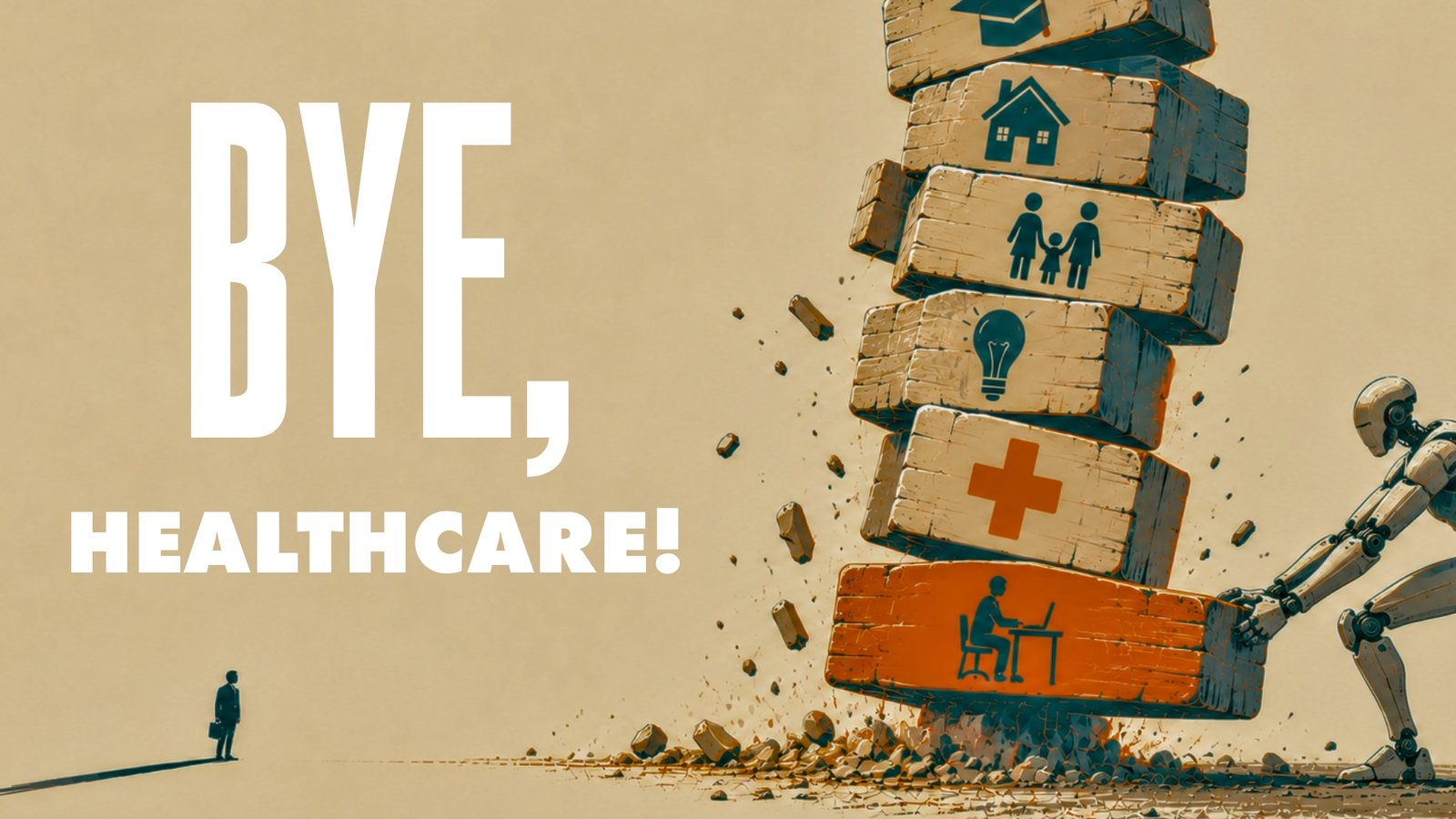
Did you know the U.S. is the only developed country in the entire world where losing your job also means losing your healthcare? Seriously, brings a new meaning to American exceptionalism, doesn’t it? No other developed country on earth looks at the thing that keeps you alive and says, “Yeah, we should run all that through your boss!” I hope we can agree, that’s a remarkably, almost unbelievably stupid idea, even though in the U.S., it’s the most “normal” thing in the world.
And did you know this arrangement happened mostly by accident? Here’s how. During World War II, the government froze wages. Companies couldn’t compete for workers with bigger paychecks, so they started offering health insurance instead. The government said thumbs up and even added tax benefits for both employers and employees. Then the war ended, the wage freeze lifted, but the tax break stayed. So companies kept doing it. Not because it was the right system, but because it was cheaper than paying equivalent wages, incentives. And let’s be honest, if your healthcare is attached to your job, you’re a lot less likely to quit. Congratulations, here’s your leash, sir. And the kicker is, nobody really designed this at all. A wartime accounting rule became a tax loophole, which became corporate retention, which became the foundation of the American social contract.
For the last 80 years, the U.S. has built its entire social safety net on this rickety foundation. Not as a public system like the rest of the developed world, but as a private system delivered through your employer. You want healthcare here? Get a job. You want retirement security? Get a job. You want to be able to afford your bills when you have a baby? Get a job… maybe. Better hope it’s a good job with a company that likes babies and make sure you don’t tell them YOU like babies before they hire you… it’s a whole thing.
The W-2 / full-time employment / FTE, became the U.S. delivery mechanism for a functioning social contract. I’m going to use those three terms interchangeably in this episode, by the way: W-2 / full-time employment / FTE = same thing. And remember, the U.S., is completely and utterly ALONE in the world in doing things this way.
Now to make our social contract worse, let’s bring in neoliberalism. If you caught the episode two weeks ago, you know this is the ideology nobody admits to liking, but has somehow still ruled the last almost 50 years of our economy.
Starting in the late 1970s and accelerating through the 80s and 90s, the dominant economic logic became: markets are efficient, government is not. So we privatize everything, deregulate everything, and just trust that the “invisible hand” will sort it out. Right? You’re familiar with this playbook. This is the world of my entire life.
One of the quieter effects of this era has been the systematic weakening of the institutions that could have provided some alternatives to this employer-based social contract. Unions, for example, might have helped, but they were being actively undermined by Reagan and others. Private pensions could have helped, but they were quietly replaced with 401ks. Public housing was deliberately stigmatized and then pretty much demolished everywhere, leaving the market to “solve shelter” for working people. And a LOT of propaganda — including the creative use of some powerful bogeyman “-isms” like “socialism” — helped ensure universal healthcare has never gotten traction in the U.S. (You might notice some of this is still happening right now, today.)
The logic was, and in many ways still is, “The market will handle it.” “Your employer will handle it.” “You’ll be fine.” But my friends, we are clearly NOT fine. Look around… I don’t think I know anyone that feels like things are “fine.” To me, it seems clear… the invisible hand is giving us the invisible middle finger.
Almost a hundred years ago, an economist named Ronald Coase wrote a paper asking “Why do companies exist?” In a market economy, theoretically, you could just contract everything out. Hire a freelancer for this and a specialist for that. Just negotiate every transaction separately. Why bundle all that into a single organization with employees in the first place?
His answer: because transaction costs inside an organization are cheaper than outside it. Managing, coordinating, trusting people you’ve hired to be there all the time is ultimately less expensive than renegotiating every task with a new contractor every time. So we bundle, we build firms, we create employers and employees.
Coase’s insight basically explains the entire architecture of the modern corporation. Companies exist because coordination is expensive and centralization makes it cheaper. But A.I. seems poised to potentially destroy this logic. If A.I. agents can coordinate workflows and manage communications and handle back-end logistics and string tasks together automatically, the complex transaction costs that justify a company collapse.
Peter Diamandis, entrepreneur and futurist, recently called this the “organizational singularity.” He argues that one person with A.I. can now out-compete a traditional firm with dozens of employees, that companies will shrink to a fraction of their current size while solo operators run entire operations. He even cites Coase directly in a, “I’m reporting on a murder” kind of way. He’s basically saying, “Coase’s law is now dead. You must become an entrepreneur now!”
This might be directionally correct. I largely think it is. But here’s what Diamandis and everyone I hear making this kind of argument just breeze right past: in the U.S., a company isn’t just an “economic coordination unit.” It’s the delivery vehicle for our social contract.
If, or probably when, “Coase’s Law” dies, my friends, the W-2 / FTE arrangement will die with it. Now this is what we ought to call “a big-ass problem” because the W-2 was never just a paycheck here. It’s also a bunch of other stuff that makes your whole life work.
At this point, all of my US based entrepreneur friends listening to this are like, yeah, duh, Josh. Because I’m basically describing the reasons why being an entrepreneur really frickin’ sucks.
I’ve been an entrepreneur for the last 16 years — just that; that’s my only job — and we entrepreneurs, we have always had to like, jury-rig some kind of social infrastructure around ourselves like a Rube Goldberg machine. We’ve always had to pay out the nose for health insurance that covers mostly nothing and then pray to the gods of Pfizer that we won’t ever need a prescription for anything. No one has ever matched our retirement or paid us to take time off. We don’t get paid every two weeks. In fact, it’s perfectly legal for Gigantic McCorporation to hold our money for TWO FULL MONTHS after we complete work BEFORE they pay us. This is called Net 60. It should be illegal for large companies to use on small businesses, but it’s not.
All that said, I’m quite certain we have folks listening to this who have primarily had full-time employment roles their whole lives. This episode is really for you. Y’all need to hear this because it’s really, really important. That invisible middle finger I mentioned a moment ago, that’s actually aimed at YOU.
Companies have been quietly dismantling the FTE structure for a while. You probably noticed that with Uber, Lyft and DoorDash… right? They didn’t build “workforces,” they built “platforms,” which legally meant their drivers weren’t employees, but independent contractors. which meant no health insurance, no sick days, no unemployment.
But did you know in 2019, Google reportedly had more contractors than full-time employees? Seriously, 121,000 contractors working alongside 102,000 FTEs. Same offices, similar jobs, but very different agreements. Contractors got no health insurance, no job security, no seat at the table, a shadow workforce hiding in plain sight. From my research, it seems like Google was not an outlier as much as a typical scenario.
But this isn’t all companies do to save money. When companies aren’t optimizing costs through employee classification, they’re just straight up taking away benefits from FTEs directly. Deloitte,one of the most prestigious employers in the world, a firm that reported $70 billion in revenue last year, up 5%, announced it’s cutting parental leave in half for a segment of its workforce from 16 weeks to 8.
I mean, how much adorable baby time do you need? 8 weeks is the answer, it’s 8 weeks. They’re also eliminating pension accruals, cutting paid time off, by up to 10 days and scrapping fertility assistance and adoption reimbursement. Take note, this is a company that apparently doesn’t like babies.
Their revenue’s growing, but their cuts are accelerating. Why? A professor at Wharton explained it with remarkable candor: “Because with the job market slack, they feel they can.”
Here in the U.S., we use a peculiar word to describe these services offered to employees: benefits. I’ve always found this word a bit odd, but it’s all making sense to me now. They aren’t rights. They never were. They’re not seen as things that humans NEED. They’re a “benefit,” which means they’re gifts that can be returned to the giver.
Now, let’s zoom out. Deloitte is doing this BEFORE the full wave of A.I.-driven workforce restructuring hits. This is just the PREVIEW. my friends. The actual “Feature Presentation” — when firms shrink to 20 % of their current size, when the “gig” model extends into white- collar work, when “Congratulations, you’re a contractor now!” becomes standard — that is when the W-2 erosion goes from “trend” to “new normal.”
I want you to notice: A.I. isn’t creating this dynamic. A.I.is just going to remove the last reason companies had to hire you full-time in the first place. All right, so what happens when you lose full-time employment in the U.S.? There’s a whole litany of social contract items that come with full-time employment that often go unnoticed if you’re an FTE. Retirement savings, paid time off, parental leave, regular paychecks, quick paychecks, HR departments, support and resource groups, unemployment pay, and so on. But the biggest one, of course, is health insurance. Or as people in other parts of the world call it… wait, they don’t call it anything! They don’t have this abomination in other parts of the world. Nobody else has this kind of mechanism for covering basic healthcare.
We’ve got a system where almost all of us in the U.S. are either one job loss away from a healthcare crisis, or we’re already in some version of one. Medical debt contributes in some way to two-thirds of bankruptcy filings here. And remember, medical debt, this is a concept other developed countries wouldn’t even comprehend. And now we’re about to dramatically accelerate the disillusion of the full-time employment social contract that makes all of this somewhat livable for the rest of us. Why are we not connecting these dots?
The entire architecture of U.S. healthcare access is built on the assumption that most adults have a full-time employer. What happens to that architecture when the employment relationship becomes optional or fluid or short-term or just gone? I am not hearing any good answers to this yet.
If the W-2 is the delivery mechanism for the U.S. social contract, and A.I. is probably killing the W-2, what replaces it? Well, the problem is, at its core, we’ve been running two fundamentally different kinds of things through the same system — The Market — and pretending that made sense. It doesn’t. The market is genuinely extraordinary at certain things. Novelty, variety, driving down costs through innovation, making weird snacks at Trader Joe’s. All that is great. But The Market has one prime directive: maximize capital. That’s just what the system is built to do. And it works fine for certain things: things we don’t NEED.
The Market works terribly — catastrophically, actually — for things we need to survive. Housing, childcare, clean water, education, energy, healthcare… the things where if The Market decides you can’t afford it, you just don’t get it. And then you die, or your kids don’t learn, or you stay in a dangerous situation because you have no alternative. We’ve made our life support systems work like slot machines, and then we act surprised when a whole bunch of people lose.
What I’m proposing and developing in much more detail in the upcoming book is a structural separation: two economies running in parallel. The Market keeps doing Market-y things: innovation, disruption, fun socks, rock and roll everywhere our future ISN’T on the line. The Commons is the second economy, the one we need to build. It covers everything required for a good life in the modern world: healthcare, housing, childcare, energy, education, public transit, and so on.
The organizing principle of The Commons is simple: if a thing is required for life, it should not be for profit.
I’ll be going deep on this in the book. (Available November 11!)
Here’s what makes The Commons more than just a “nice idea” — it delivers a system- level solution for a system- level problem. Right now, most people work because they have to. Not because they’re passionate about it. Not because the work is meaningful, but because the alternative is impossible. Not having a full time job means no healthcare. It means losing your housing. It means losing your emotional support scaffolding. I didn’t even really talk about that aspect in this episode. It basically means the floor underneath you, holding up your whole life, disappears.
The Commons is a “floor” for everyone to stand on. The Commons is the infrastructure we need to land the coming transition away from full-time employment without our society crashing and burning. And A.I. is making this timeline a lot more urgent than most people realize.
In addition to fleshing this out in my upcoming book, I’m also in the very beginning stages of setting up a project to help create the Commons in real life. If you have ideas or things we should think about or want to participate in some way, let me know in the comments or shoot an email to future [at] hellotomorropodcast.com.
The Commons is the thing we need to establish a new social contract in the U S that will genuinely work for everyone. The kind of “forced entrepreneurship” moment we’re entering could be liberating. More autonomy, more flexibility, more people building things they actually care about. That probably sounds nice to you… and it should. That future is worth wanting. But I think we have to build the floor first.
Entrepreneurship with a floor is freedom. You could take risks, try things, leave bad situations, build something new without gambling your family’s health on it. But this will require the creation of a new social contract. To get there, we must stop accepting that the “Full Time Employment” model is some kind of “Law of Nature.”
The era of stable employment in its current fashion may genuinely be ending, but that doesn’t have to be a tragedy. It could be the moment we finally replace the accidental, rickety, World War II- era workaround with something we actually designed on purpose.
Let’s create the floor. And then we can all exhale and get excited for what we can build on top of it.
Original post with all source links: https://joshallan.com/2026/04/28/how-ai-is-killing-full-time-employment/

