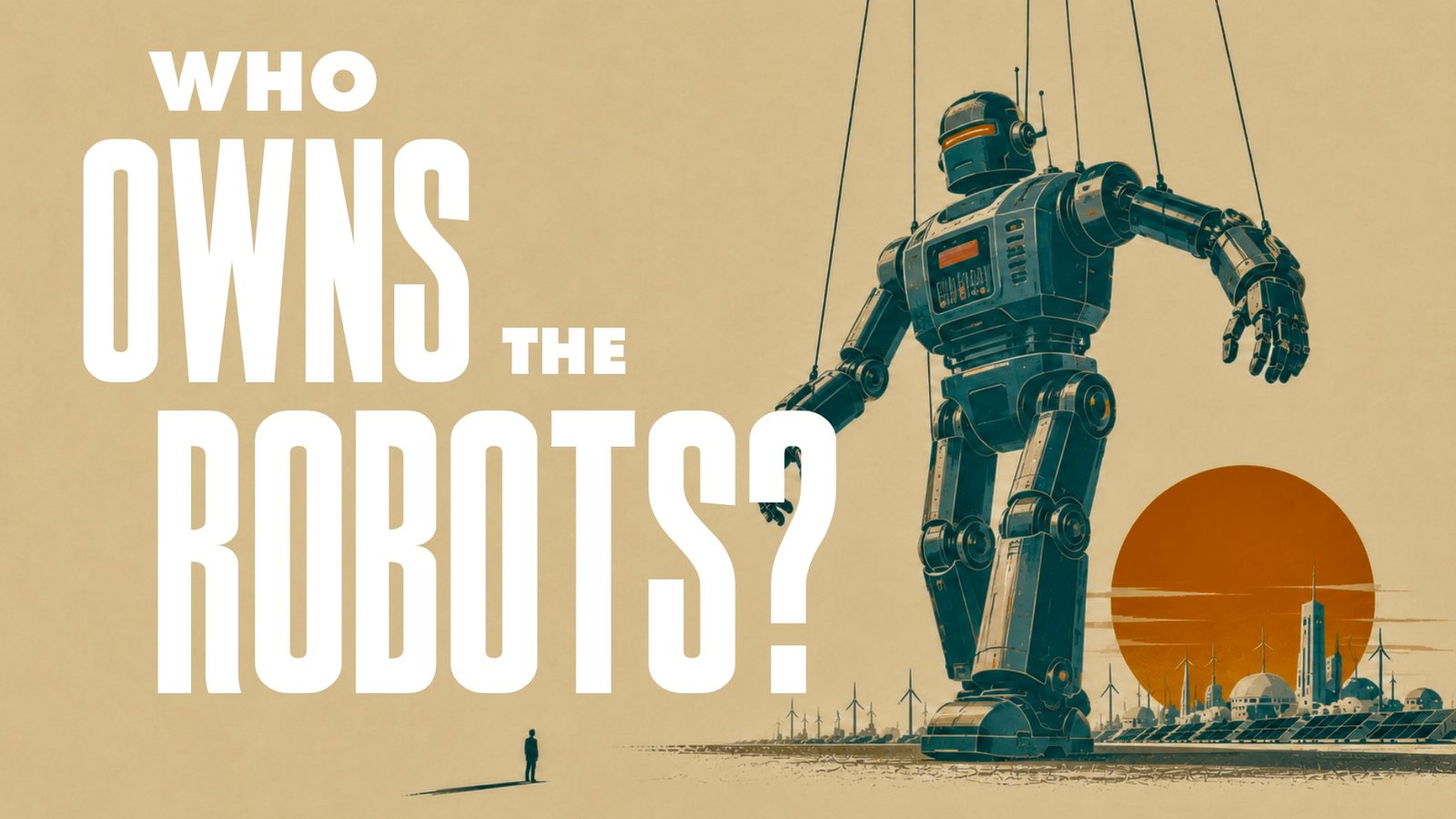
Here’s what I’ve come to believe after spending the last several episodes going deep on money, debt, and the global financial system: we don’t really have a choice about whether A.I. works.
A.I. HAS to work because we need it to.
We’ve talked about how money is a promise and how the promises we make with government- created money only hold up if we create real value with them. I called these “apple-making investments” versus “apple-wasting investments,” because we created a fictional town with 10 apples to learn about inflation… it’s a whole thing. If you haven’t listened to the Money episode, please do.
So what are “apple-making investments?” Well… roads, schools, clean energy, healthcare. They’re things that grow productive capacity and make the future substantively better.
What are “apple-wasting investments?” Tax cuts for people hoarding money (ahem, billionaires), endless wars, interest payments on old bad debt, excessive global military empires. Those are real resources consumed, real money created, but ZERO new productive capacity.
Here’s the sad reality about the last several decades of the American economy. We have been spectacularly, historically, almost heroically good at “apple-wasting.” The U.S. has spent roughly $8 trillion on post-9/11 wars. We’ve cut taxes on the billionaire class repeatedly while wages for the rest of us stagnated. We spend nearly $1 trillion every year on a bloated military-industrial complex that hasn’t passed an audit. We’ve accumulated nearly $40 trillion in national debt, much of it funded by promises about future productivity that haven’t yet materialized. Meanwhile, the petrodollar, the invisible architecture that lets us export dollars instead of dealing with the consequences, is showing some serious cracks. All of it is pointing to a world where our free lunch is ending. The bill is coming due.
The most plausible path out of this, without a catastrophic reckoning, is a genuine, significant step change in productivity. Higher taxes, spending cuts, debt restructuring would work too, but none of those are politically-survivable at the scale we need, which is why everybody, whether they admit it or not, is quietly betting on a productivity miracle.
Which brings us to A.I.
A.I. is the most plausible candidate we’ve got for this kind of productivity leap. Look around. What else is big enough? Clean energy? It’s transformative, but it wouldn’t be a productivity multiplier across every sector simultaneously. Biotech? Promising, but probably too narrow.
A.I. is the only option in sight that has the potential to multiply productive capacity across essentially every domain at once. Medicine, law, engineering, education, logistics, science, software, manufacturing… and it could do it simultaneously and possibly within a decade. That’s not hype, it’s just the actual scale of what general purpose technologies do when they mature.
We’ve seen a few things like this before. The printing press changed the entire world. The steam engine restructured the entire economy. Electricity was the operating system of the 20th century. A.I. is that kind of general purpose technology. The legitimate question isn’t whether it will be transformative. It’s how transformative will it be, how fast will that transformation happen, and most importantly, who will reap the benefits.
Now that last part is where it gets complicated. History teaches us some important things about these kinds of productivity step changes. We know they work, we know they generate enormous new wealth, and we know that usually that wealth flows almost entirely to whoever owns the technology.
The Industrial Revolution was the greatest productivity leap in human history so far. It also created the most miserable working conditions humans had experienced in centuries. Child labor, 16-hour days, dangerous factories, criminally low wages, while a small class of owners accumulated unprecedented fortunes. It took decades of labor organizing, regulation, and political struggle before the productivity gains of industrialization reached workers in the form of shorter hours and safer conditions and rising wages.
The computing revolution of the last 40 years followed a similar pattern. Productivity gains were real and enormous, but wages for most workers decoupled from productivity in the 1970s and have never reconnected. The gains went to Capital, to shareholders, to the people who owned the software and the platforms and the data.
There’s two examples. Third time’s the charm, right?
Let’s hope so, because this time, the productivity step change is potentially bigger than both previous ones combined. And we’re starting from a position of already historically extreme inequality.
If A.I. follows the historical pattern and gains flow to Capital and workers get the disruption without the dividend, we won’t just get more inequality. We’ll get the complete economic collapse I talked about in “Who Buys Your Stuff, Robots?” because nobody can afford anything.
If A.I. eliminates or even substantially degrades tens of millions of jobs while the productivity gains accumulate at the top, the consumer base the entire economy depends on gets hollowed out, the billionaire’s foundation becomes a sinkhole, and the system destroys itself. That is not a distant theoretical doomsday scenario. That is just the logical endpoint of the current trajectory.
Now let’s put this back in the context of finances. The U.S. has nearly $40 trillion in national debt. We have a petrodollar system under pressure. We have a military empire that costs almost a trillion dollars a year to maintain… if you’re curious, that’s more than what the next nine countries on earth spend on their militaries combined. And by the way, the interest payments on our debt now exceed that insane defense budget.
The most plausible path out of genuine financial disaster is productivity growth. Real, sustained, significant productivity growth that expands the economy faster than the debt grows. A.I. could deliver that. The model suggests it could add trillions in global GDP growth.
But, and this is the part that stresses me the F out, if those gains concentrate at the top, they won’t help with the actual problem.
A billionaire’s wealth going from a hundred billion to five hundred billion doesn’t expand the consumer economy. It doesn’t pay down public debt. It doesn’t rebuild the middle class. It doesn’t grow any new apples at frickin’ all.
So, for the purpose of filling the hole we’ve dug, concentrated productivity gains at the top are as economically useless as NO productivity gains. What we need are DISTRIBUTED productivity gains. Gains that flow through the economy broadly enough to actually expand the consumer base, increase tax revenues, and stabilize our financial system.
Which means The right question isn’t: “Will A.I. work?” The right question is: “Will A.I. work for EVERYONE?” Right now, nothing in our current system guarantees that it will. In fact, everything in the current incentives points the other way.
So what could we possibly do about this? My argument here is actually conservative in the original sense of that word, meaning it conserves the system rather than blowing it up.
The first thing to understand is that the public, you and me and our parents and their parents, WE funded the research that made A.I. possible. I’m not being rhetorical. This is literally true. The internet: DARPA. The foundational neural network research: public universities and government grants. The training data that cracked open modern deep learning: an NSF-funded researcher at Stanford. Voice recognition: we funded the thing that became Siri and every A.I. assistant that’s followed. DECADES of publicly funded basic research, handed to private companies to privatize the gains. That’s been the playbook of Capital for a while. I get it. But we have to realize A.I. is DIFFERENT.
Past tech revolutions were sectoral. They killed specific job sectors while creating new adjacent ones. The printing press hurt scribes but created publishers. The railroads killed canals but built new industries and whole new cities. The pattern held for two centuries. Disruption always also brought creation. Every previous disruption created an adjacent labor market to absorb the displaced. You lost your job but you learned a new skill, crossed the street, got a different job. The previous sector may have died, but you survived. None of that happened overnight and it was still painful, but it has been working this way.
A.I. is the first disruption where the adjacent labor market is itself being automated simultaneously. We’ve never seen a tech revolution that is this omni-sectoral. This one is coming for everything, everywhere, all at once. Well, white collar first, but robotics are coming faster than we think for blue-collar jobs, too.
When we combine these facts, there’s one logical conclusion: the public needs to have a shared ownership claim on some portion of A.I. returns. Alaska already figured this out with oil. Every Alaskan resident receives an annual dividend from the Alaska Permanent Fund, a share of the state’s oil revenues. It’s not charity, it’s a dividend as a citizen from a commonly owned resource. Norway built the world’s largest sovereign wealth fund on the same principle. Over a trillion dollars in there, owned by the Norwegian people, generating returns that fund public services and retirement for every citizen.
The precedent exists. The logic is sound. The only thing missing to do this with A.I. is the collective political will. An A.I. dividend, some mechanism by which the productivity gains of A.I are partially distributed to the citizens that funded the foundational research, isn’t redistribution, it’s a dividend on a public investment. And more importantly, economically speaking, this might be the only thing that prevents the consumer collapse that makes the entire system unravel.
The math is simple: distributed gains keep the economy circulating, concentrated gains don’t. If we want A.I. to actually fill the hole our leaders have dug, we now need those leaders to create a mechanism to distribute the gains. A shared wealth fund is the least radical version of that mechanism I can imagine. We all helped build this thing, and we should all own parts of it.
Regular listeners know I think about the future in terms of three Paths.
Path Zero is the one we can’t let happen. That’s the one where we just keep going on the current trajectory. Incentives never change, extraction wins. This path sucks. We can’t allow it.
Path A is survivable, simpler, more local, lower complexity, but genuinely brutal for a lot of people on the way there.
Path B is our path to Star Trek. Abundant clean energy, A.I. coordinating complexity at scale, a civilization organized around flourishing rather than extraction.
At this point, some people ask me: “What if A.I. is a bubble?” Well, historically, what you need to know is that general purpose technologies have never been killed by their bubble.
Railroads survived their bubble. The internet survived dot-com. Electricity, automobiles, radio. The financial fantasies collapsed, but the tech infrastructure remained. The technology always survives. Somebody picks it up and keeps building.
So “will A.I. work?” is actually the wrong question for another reason. It’s not just wrong because of the stakes. It’s also the wrong question because the answer is almost certainly “Yes.” At least in some form, to some degree, A.I. is GOING to work.
The research and the capital and the infrastructure are too far along for the technology itself to disappear. This means the real variable for our three different Paths was never the technology itself. The real variables are DISTRIBUTION and OWNERSHIP. Who owns the gains when A.I. delivers? That is the question that decides which path we get to be on.
A.I. that works but concentrates gains at the top, that’s Path Zero. The consumer base collapses, the system destroys itself with A.I. just accelerating the race to the bottom.
If we’re forced into simplification before the gains can be distributed, that’s Path A. The technology survives, it always does, but the disruption reshapes the economy faster than the dividend gets to you. I know for those of us who have time to listen to podcasts, “simpler” sounds really nice, but we have to remember: this path is remarkably difficult for potentially billions of people.
Now, if we have A.I. that works AND distributes gains broadly, that’s the accelerant for Path B. The productivity step change actually solves the hole we’ve dug. The consumer base stays intact. The system doesn’t eat itself. This path also allows us to create infrastructure to help lift, I’m going to say, the REST of the globe out of poverty.
So here’s the reframe: We don’t need A.I. to work. We need A.I. to work for EVERYONE.
Those aren’t the same thing. And right now, nothing in our current system guarantees the second one. In fact, everything in our current system, the incentive structures, the ownership patterns, the quarterly earnings, obsession, all points the other way.
So it turns out the people dismissing A.I. as overhyped aren’t wrong that there’s hype, but they’re very wrong about the “over” part. The importance of A.I. in our current global story is actually UNDERhyped. We need A.I. to work and we need it to work for everyone.
The technology is coming, the disruption is coming, the gains are coming. The only question is coming for whom?
The way all this is going to work with A.I. has not yet been decided, but that’s not a reason for comfort. It’s a reason for urgency. The promises that hold the world together are being renegotiated right now, monetarily, geopolitically, technologically, all at once. Whether we participate in that renegotiation or not, it is happening. But to get a future we actually want to live in means we must show up with a vision for what the new promises need to look like.
That starts with us demanding that A.I. works for ALL of us, not someday — now — while we still have time to build the new systems that make this possible.
Original post with all source links: https://joshallan.com/2026/04/07/who-owns-the-robots/