To understand this very weird moment we’re living through, the confusion, the exhaustion, the constant energy that feels kind of like a face palm, we need to zoom out, way out, like centuries out. Because I believe what we’re experiencing right now actually isn’t that weird. It’s patterned, maybe even predictable. And honestly, it’s right on schedule.
Let’s talk about Bill Strauss and Neil Howe. You maybe haven’t heard their names, but you know an output of their work. almost certainly. These are the guys that coined the term “Millennials.” in their book, Generations, which was back in 1991. Then In ’97, these two historians released another book called The Fourth Turning. which introduced a theory that’s either the most interesting generational framework ever created or a beautifully structured hallucination. Spoiler alert, I lean toward the former, mostly because it’s been wildly accurate.
Here’s the theory in a nutshell. Societies move through four repeating 20-something year eras called Turnings, which together make up a roughly 80 to 100 year cycle. It’s basically the length of a long human lifespan. There are also four different generational archetypes, Prophet, Nomad, Hero, and Artist. Society progresses through all four of those as well, and then the cycle starts over. And what creates the generational types? That’s the Turnings. Each 20 year period has a different kind of flavor, a different zeitgeist, which shapes the young people in that time period to the point where we can say, “You’re in this generation” or “You’re in that generation” with some sort of coherence. So we’ve got Turnings that create a certain type of generation, which helps birth the next Turning, which helps create the next generation.
The four Turnings also reflect our physical seasons. I love this part. Spring is called the High. This is when institutions are strong. Individualism is low. Everybody’s bought in. We just rebuilt after the last crisis and things actually work. right. Summer is the Awakening. This is when institutions start to get challenged. A focus on individual identity becomes really important. Fall is called the Unraveling. This is when institutions weaken and individualism peaks. Trust erodes. Everybody’s in their own corner. Things still kind of work, but barely. Now Winter is the crisis. Trust is gone. Systems collapse. A crisis occurs. This is the moment of institutional breakdown.
Pop quiz… What season do you think we’re in right now?
Let’s go through them again. I’ll orient you. Spring, the High. This happened in the period after World War II, when the middle class was strong and we all seemed to believe in a great big beautiful tomorrow. Summer, the Awakening. This happened in the cultural revolution period of the 60s and 70s. when institutions were being seriously questioned. Fall, the Unraveling. This happened in the time period I was born into. The famous “greed is and leaves, you guessed it, Winter, the crisis, happening right freaking now.
According to this model, we are deep into what Strauss and Howe call a Fourth Turning, the Winter phase. This is when political systems break down, economic models wobble, and trust evaporates. Old methods stop working because the structures built in the last spring just aren’t working anymore. Does this sound familiar? Winter is the era when societies must reinvent themselves.
And here’s the real kicker: Winter is not a mistake. Winter is the assignment. Now There are also four stages of Winter. In the interest of simplicity, I’m not going to go into the names of those stages today. Here’s what you need to know. Neil Howe would say the first stage of Winter started around 2008 with the Great Financial Crisis. The second stage started in 2016 with Trump versus Clinton. This is when people started to wake up and realize things were really broken. The third stage of Winter is a big organizing conflict. This could be a war, a domestic breakdown, a financial collapse. It’s something major. This conflict does not have to happen on our shores. Remember the last one was World War II, which was mostly elsewhere, but this conflict will be something massive that forces us all to choose what kind of future we want. Neil believes, and I agree, that we haven’t had this conflict yet, but it’s coming. After the conflict, we’ll get a clear sign that Winter is ending. For World War II, this was D-Day. It’s the moment when a different future becomes much more visible and actually possible. Howe predicts this happening around 2030.
So, if you buy into this theory, right now we are in a predictably weird space between knowing stuff is seriously broken and biting our nails, waiting for the big conflict.
Now, before you dismiss this as just an interesting theory, let me tell you about a guy named Peter Turchin. Turchin is a Russian-American complexity scientist. He’s a mathematician and evolutionary biologist who initially studied insect populations and what he found studying beetles led him to study human societies along with a wild realization: human history follows mathematical patterns. In 2003, he founded a field called Cleodynamics, named after Cleo, the Greek muse of history plus dynamics, how things change over time. For any Isaac Asimov fans out there, yeah, this is basically Psychohistory from the Foundation series, except, you know, not sci-fi.
Here’s what Turchin does: he uses big data models full of historical information like wages and wealth distribution and political polarization and government debt and so on. He feeds it all into mathematical models. Then he runs tests and simulations. Guess what his models predict? Political violence and social instability peaking in the 2020s with a climax around 2030. Different method, same timeline.
Turchin isn’t looking at demographics or generations or archetypes. He’s tracking a boatload of data points around things like elite overproduction, which is too many credentialed people competing for too few elite positions. And what happens predictably throughout history when something like that occurs. His 2023 book, End Times, uses pure data to arrive at pretty much the same exact timeline conclusion Howe and Strauss reached using historical patterns. Two completely different roads, same destination.
You are obviously welcome to make up your own mind, but this makes me pay attention because when the demographic pattern matchers and the mathematical modeler both say Winter is here, to my ears, Winter’s probably here. And beyond that, to me? Right now, things just feel chilly! My spidey sense is saying, yeah, something like that is exactly what’s happening.
Basically, our operating system is outdated and it is unable to handle the complexity of what’s happening. The U.S. Constitution, as innovative as it may be, was designed in an environment with 13 small colonies. No real national bureaucracy, no 24-7 media, no global supply chains, definitely no nuclear weapons or artificial intelligence. Yet we’re still mostly using that 18th century OS to run a 21st century superpower.
Our governance operating system needs a massive overhaul, my friends. I don’t think this is a surprise to you. You might not remember everything from your seventh grade civics class, but I don’t think you really need to. You can feel that the current operating system is buckling under the weight of tomorrow with any quick doom scroll during your bathroom break at any moment of the day. This is exactly what Howe and Strauss describe. Well, not the bathroom part, but everything else.
Late in a Fourth Turning Winter, institutions lose legitimacy, factions harden, systems that once held society together become brittle under the weight of accumulated contradiction. Winter is the season when the scaffolding we built during the last High, in the Spring season after World War II, collapses. This is simply the nature of seasons. The systems built at the beginning of the last life cycle have reached the end of their usefulness now.
In a Fourth Turning, three things happen at once.
One, the old stories stop working. People no longer believe in the institutions they used to rely on. Congress, banking, media, academia… pick your fighter. The old stories have stopped working.
Two, the old identities stop holding us. The narratives we use to organize society become too narrow. Left versus right is feeling absurdly insufficient, isn’t it? The old identities can’t hold us anymore.
Three, the old systems stop producing stability. The mechanisms that kept us functioning begin to break. This looks like polarization, cynicism, zero trust. The old systems have stopped producing stability.
These three things aren’t random. They’re the symptoms of a cycle reaching its end. Are you seeing it? This is the stuff we talk about every single week.
I know it’s a lot. I know it’s intense and it’s heavy. This is a truly bizarre time to be alive in this particular season. And I’m guessing people who lived through past Winter seasons felt this too.
And this is why I’m spending so much time on this: I want you to zoom out with me and remember that Winter always serves a powerful evolutionary purpose, which is to clear space for the next societal operating system. It’s entropy, but with a mission. It’s destruction with direction.
Every incentive pulls us backwards towards the past high or outwards towards the extremes. Tomorrow will easily be sacrificed for today. Those in power will happily externalize all costs either onto citizens or into the future. But these aren’t really things to bemoan or wonder “Why are they happening?” This is just late- cycle behavior. Institutions in Winter shift from serving society to an obsession with their own survival. And that isn’t just why they fail, it’s why they MUST fail.
Strauss and Howe are sometimes read as “doom prophets,” but I believe they’re offering us something much better: a blueprint for renewal. Yeah, Winter is harsh, but Winter is also the season before rebirth. Always. As far as we know, no culture, none has ever made it to spring without going through Winter. This is the moment in the cycle when the next civic imagination begins to germinate, when new systems and new norms and new institutions and new values begin to form.
But here’s the kind of uncomfortable part… Winter demands our participation. If you care about the future, you don’t get to sit this out. You don’t get to wait for the thaw. You don’t want to let someone else build the new architecture. Winter is when we decide what will come after Winter. That’s the whole point. If Winter is the season of breakdown of endings, exposed fragilities and systems like shaking themselves apart, then our job is not to cling to the past or pretend we’re in another season. Our job is to see Winter clearly, to recognize the patterns, to understand the moment we are actually in. Our job is also to dream boldly. This is when new civic futures get imagined. Our job is to design intentionally. All future systems begin as stories told in Winter. Our job is to prepare for Spring.
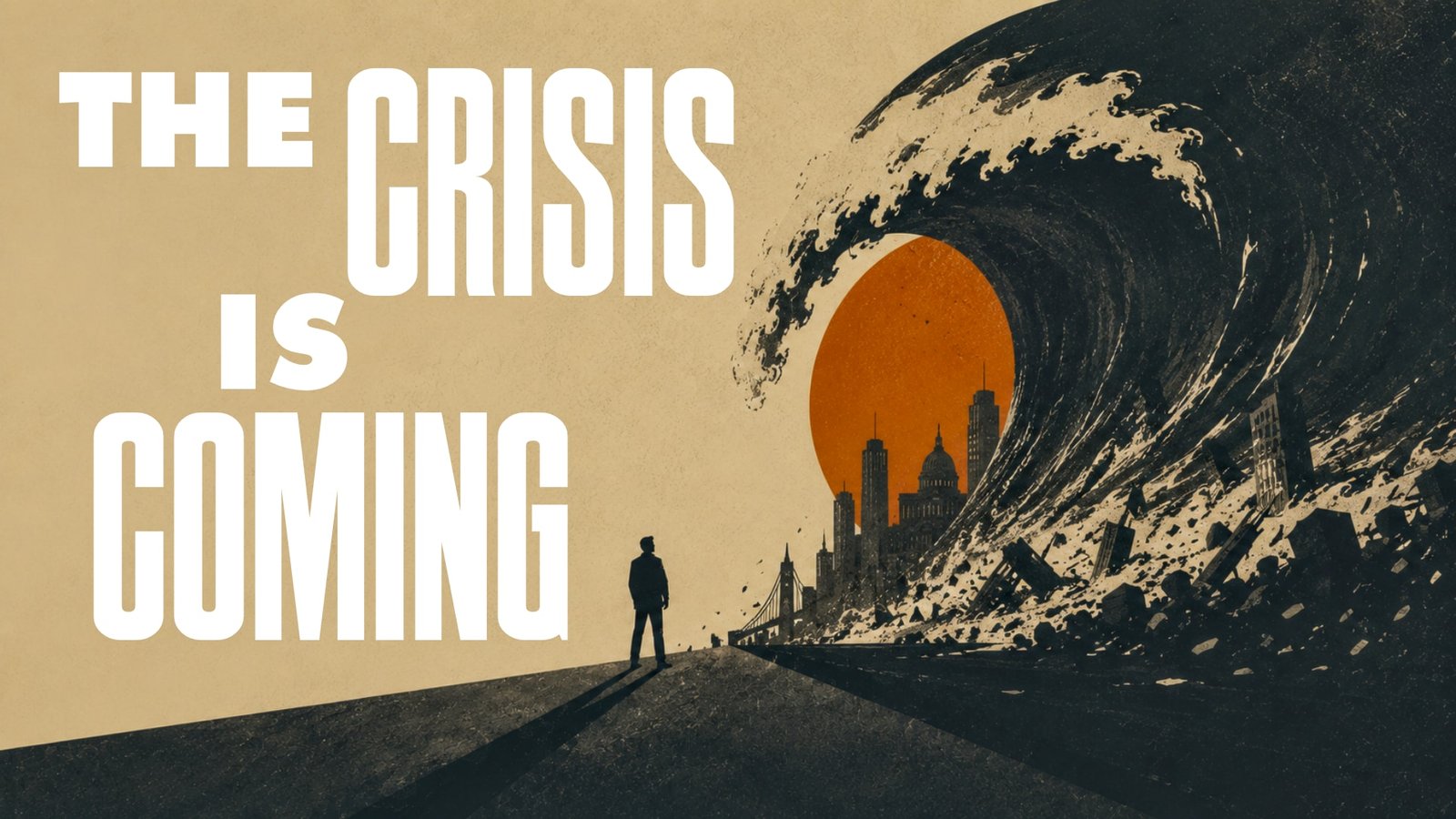
The other day, my partner said to me, quite earnestly, “Why are you so optimistic?” And I said, “Because there’s a crisis coming.” They looked at me for a moment like I’d lost my frickin’ mind, but this is what I mean: the crisis is the thing that forces the rebuild. The big organizing conflict, whatever it is and whenever it comes, will be the moment when we can’t keep pretending the old system works. When we have to actually build something new. Spring plants the seeds, but first Winter clears the ground.
So if we’re between a renewed awareness of brokenness and this big organizing conflict, how do we prepare? What do we do? Here are three things we can do right now.
Number one, stop trying to fix what’s destined to break. The system, it isn’t broken. It’s working exactly as designed. It’s optimizing for capital, not for humans. Capitalism going to cap y’all. Stop exhausting yourself trying to repair it. Stop trying to fix what’s destined to break.
Two: invest in what comes next, not in what’s dying. We’re in the destruction and decay phase. So put your energy into building the new system, not propping up the old one. Invest in what comes next. not in what’s dying.
And three, lead with optimism as a strategy. Optimism is not naïve. It’s rebellion strategy. The people who thrive in a Fourth Turning are the ones who see opportunity in spite of the chaos and build toward what’s emerging. Lead with optimism as a strategy.
We are living through a Fourth Turning, a Winter season in the long arc of life. And while Winter is uncomfortable and disorienting and cold, and often lonely, it’s also thoughtful and contemplative and steely. It’s the hard season that makes Spring possible. Winter’s the moment when the universe hands us the tools and says, “OK, it’s time; build something better!”
We might not love Winter, but we are absolutely undeniably right on time.
Original post with all source links: https://joshallan.com/2025/11/25/why-im-optimistic-about-the-coming-crisis-the-fourth-turning-explained/