

🚨 If you’d rather WATCH or LISTEN TO this article, you can!
📺 YouTube // 🎧 Spotify // 🍏 Apple
Hello Tomorrow is also now on Substack! If you’re on Substack, click here.
Today’s wrong question is: “So Josh… which future will we get?”
Here’s why that’s the wrong question: it assumes the future is like a map with a singular destination point and we’re all just kind of hurtling towards it.
But that’s not how the future works at all.
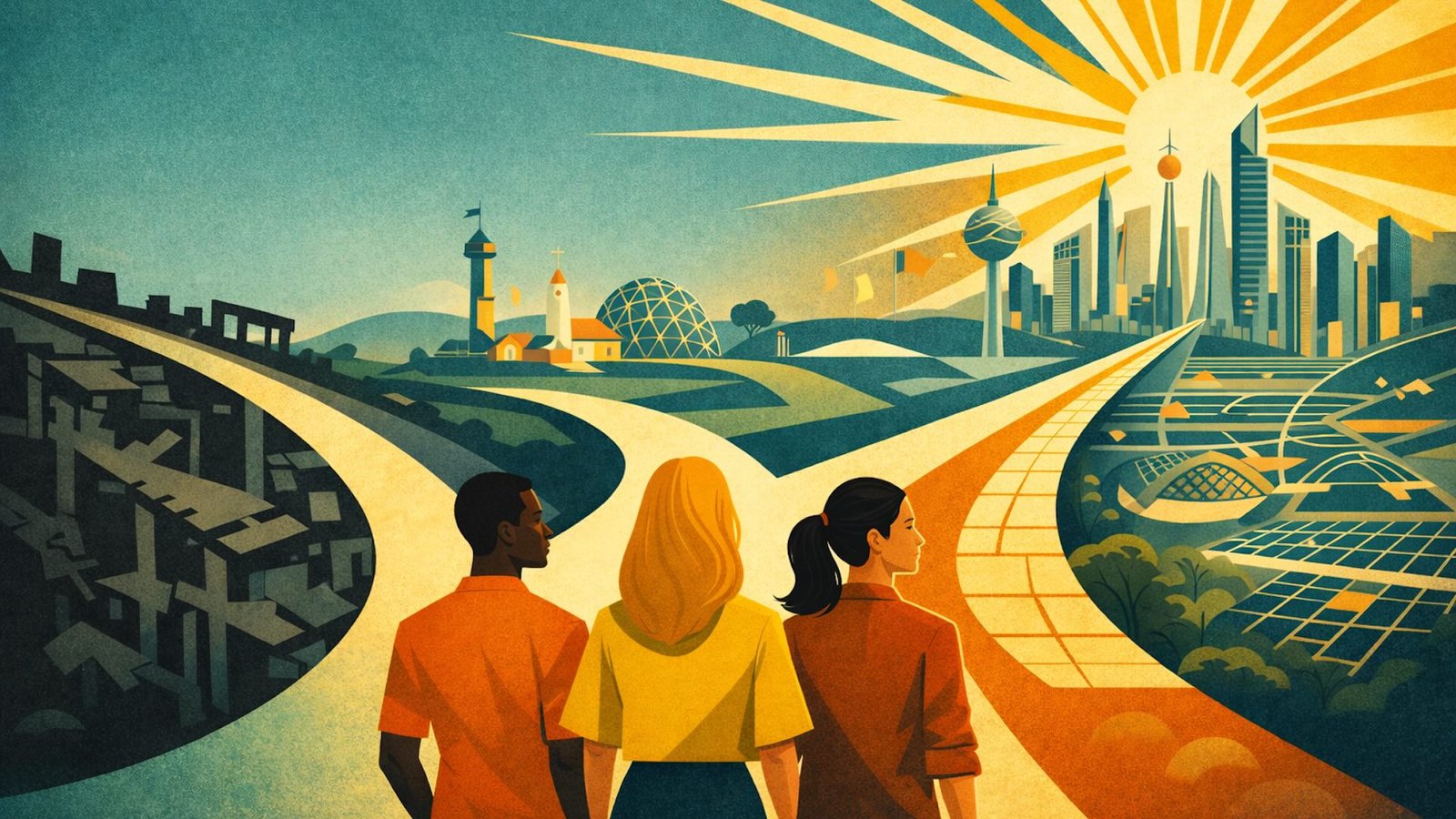
Here’s what I know after 20 years of helping leaders navigate change: the future is not a map. There is no set route. There is no predetermined destination. The future is a blank page. And right now — in this strange and turbulent moment — WE are holding the pen.
Today I’m going to show you our three most possible futures. One of them completely, ruthlessly sucks, two are worth fighting for, and one gets on the path to Star Trek. I’ll also tell you exactly what it’s going to take to get us to the good ones. But all these paths require one very important thing: YOU.
Where Are We In The Chaos Window?
Last week we talked about why we probably can’t prevent the A.I. Crisis but we CAN shorten its Chaos Window.
Quick reminder on what that means, using Fourth Turning language.
We’re in Winter, and Winter has four stages.
Stage 1 started around 2008 — the Great Financial Crisis.
Stage 2 started around 2016 — Trump vs Clinton. That’s when a lot of us woke up and realized things were seriously broken.
Stage 3 is the Chaos Window — a catalyst plus a big organizing conflict. Think Pearl Harbor and the U.S. joining World War II. We haven’t hit that moment yet, but we’re getting close.
Stage 4, Winter ending (D-Day) — this is projected to be sometime around 2030.
So right now we’re in Stage 2, heading into Stage 3. The calm before the storm. Things feel… weird, certainly, but not quite yet like “chaos.”
Last week I mentioned I would share with you the two most possible future paths. Well, there are actually three, but only two of them have any kind of reasonable outcome, so we’ll call the first one “Path Zero” because, quite simply, it sucks and we cannot allow it to happen.
Path Zero: The ‘Don’t Look Up’ Future
This is the one where we just… keep going on the path we’re on. It’s the “Don’t Look Up” future.
Capitalists keep optimizing everything for more capital. The importance of “quarterly earnings” beats long-term survival. The incentives never change, because the people making capital decisions today won’t be around for the worst consequences anyway, so, you know, who frickin’ cares!
Here’s what happens: global average temperatures increase 2 degrees. Coral reefs, which support roughly 25% of all marine species and contribute to the food security for at least half a billion people, are basically defunct. Another degree of warming pushes tropical agriculture into collapse. Hundreds of millions of climate refugees stress every political system on earth simultaneously.
When this happens, the complexity that’s produced all our modern miracles — medicine, food distribution, global communication — starts unraveling because our endless extraction has destroyed the biological systems it all depends on.
This isn’t speculation. This is simply the path if current trajectories continue.
Johan Rockström’s planetary boundaries research identifies nine Earth system boundaries we need to stay within to maintain a stable biosphere. We’ve already blown through seven of them.
But Path Zero, pardon my language, doesn’t give a shit.
I’m not willing to accept this path. I hope you aren’t either.
So let’s talk about the other two.
Path A: The ‘Simplification’ Future
What if we collectively decided to want less? Deliberately reduced complexity, localized supply chains, built regional resilience before the system forces it on us?
This sounds radical until you realize it’s already happening — not by design, but by markets.
Anthropologist Joseph Tainter showed that complex societies collapse when they can’t sustain the energy needed to maintain their own complexity. I mentioned this briefly last week when we talked about the Roman Empire dis-integrating into feudalism.
When energy can’t be sustained, systems become what Tainter calls “nearly decomposable,” meaning they break into simpler, more independent units. This is what happened when the Roman Empire fragmented into feudal Europe — the same land and people, but far lower complexity.
Accenture surveyed major global companies and found 85% are actively planning to regionalize their supply chains by this year, 2026. GE is investing three billion dollars to move appliance production to the southeastern United States.
The language of “near-shoring” has gone from academic to standard corporate vocabulary in a very short amount of time.
The system logic is simple: complex systems require ever-increasing energy and coordination costs to maintain themselves. When those costs exceed the returns, systems simplify because the math stops working.
We may already be at that inflection point for parts of the global economy.
What does a simplified world actually look like?
Think less “apocalypse” and more like a different organization of human life. It would look like more regional food systems — which, by the way, are already growing rapidly. More distributed energy generation. Less hyper-specialization and more communities that can actually function if the global supply chain hiccups.
Some of you listening have already noticed this direction in your conversations or your intuition.
The historical analogue here isn’t Rome collapsing; it’s what happened AFTER Rome in the regions that adapted well. For example, in that period, parts of what are now France and Spain developed remarkably resilient local economies, local governance, local food systems.
The emotional truth of Path A is this: there is genuine beauty and peace available in a simpler, more local world. You might feel it as I’m describing it. To me, it almost feels like an exhale.
Life right now is not just complex, but complicated, and even the idea of simplification feels… nice.
Also, the research on human wellbeing consistently shows that strong community relationships, meaningful work with visible outcomes, and connection to place are among the most powerful predictors of life satisfaction.
A world that’s less globalized and more locally rooted serves human flourishing better than the one we have now in many ways, but there’s also a big challenge.
Path A also contains an incredibly dangerous Chaos Window for our most vulnerable populations. Why? Because these folks depend most heavily on the complexity of the current system… and have the least ability to opt out of it.
Think about someone who relies on a global pharmaceutical supply chain for life-saving medication. Or a family in a food desert whose grocery store depends entirely on long-haul distribution. Or communities in the developing world whose economic progress has been built on participation in global trade.
Local resilience is great… if you have the resources and geography to build it.
It’s a crisis if you don’t.
And too many people don’t. This is why I prefer…
Path B: The ‘On The Way To Star Trek’ Future
I have a deep love for Star Trek that, somehow, I haven’t talked about yet.
Star Trek is the most sophisticated vision of optimistic futurism I’ve seen in pop culture. It doesn’t pretend the hard stuff didn’t happen. It assumes we got through a Eugenics War, contact with other species, a post-money transition… all Fourth Turnings, probably.
What makes this sci-fi remarkable is that Star Trek’s future requires FAR more complexity than we have now, but it works because they adopted an organizing story that provides for everyone’s basic needs.
Path B gets us on the road to Star Trek sooner, so naturally, this is my favorite one.
So what does Path B actually look like?
It starts with energy.
Remember the energy conundrum: additional complexity requires additional energy, but producing more energy the current way kills our biosphere. Seems like we’re stuck, right?
But this trap has a side door.
Our constraint isn’t energy production itself — it’s our current super old school METHODS of producing it. And we already have better methods.
A solar panel installed today produces 50% more electricity and costs 90% less than a decade ago. Wind turbines installed today produce nearly five times the power of turbines from the late 90s, and they keep getting bigger, cheaper, and more efficient every year.
Great clean energy technology exists. It works. None of it is experimental.
And the constraint isn’t money, either. To keep our global temperature rise under 2 degrees, the International Energy Agency puts the price tag at $4.5 trillion a year spent on clean energy investment. That sounds enormous — until you know we’re already spending $7 trillion a year propping up the system that’s killing us. Seriously… that’s the full environmental cost of our current fossil fuel subsidies!
We are literally paying more to maintain the problem than it would cost to solve it.
The truth of Path B is this: if we use our Chaos Window to get the energy transition right, the ceiling for human civilization gets dramatically higher.
Not just survivable… genuinely extraordinary.
Energy so cheap it stops being a constraint. A.I. coordinating supply chains at a level of sophistication no human institution could match. A global economy organized around entirely different physics: not combustion, the controlled explosion of ancient carbon, but sunlight and wind directly converted into work. No exhaust. No debt to the atmosphere.
This is a world that truly prepares the soil for our descendants to build something Star Trek worthy.
Y’all know I’m no techbro hype machine. I’m just looking at the tech that’s currently available and saying, “What if we had an Organizing Story that pushed us in a Star Trek direction?”
THAT is worth fighting for.
But here’s the challenge of Path B.
As we discussed, the constraint isn’t technology or money. It’s something far more difficult: collective will and current incentives.
I don’t think we’ll get to Path B by convincing capitalists to become environmentalists. The “you can’t do business on a dead planet” argument fails on timeline because they believe their fiduciary duty is to quarterly earnings, not 2075.
I think we need to make a better capitalist argument, specifically: whoever builds the new energy infrastructure wins.
Energy is the ultimate input cost for every business that exists. Control cheap, abundant, clean energy and you get an oversized influence on the cost structure of the entire global economy for the next century. I think China understands this, and it’s why they installed 329 gigawatts of solar power in 2024 alone — more than the rest of the world combined. That wasn’t environmentalism, it was the biggest competitive advantage play in our lifetimes.
Here in the U.S., we’re still doubling down on fossil fuels. Even if you only care about business and not the planet, this is a stupid and uncompetitive strategy.
So, how do we get Path B going?
History suggests Path B will require a catalyst moment; a crisis or competitive threat large enough to break political paralysis and authorize mobilization-scale investment. This is why I lean on the Fourth Turning so much. This kind of “step change” catalyst has happened before, many times… and it’s ready to happen again.
Before December 7, 1941, the U.S. had the industrial capacity, the technology, and the workforce to build a war machine. What it lacked was the collective will and incentives to do so. The attack on Pearl Harbor changed that overnight. Within two years, war production was 40% of our national economy.
What could provide that kind of catalyst today? Honestly, the kindling is so dry right now that several things could ignite it.
See if you could picture any of these happening…
- A global trade war that fractures our supply chains and makes the cost of fossil fuel dependence suddenly, viscerally untenable.
- Escalating Middle East conflicts that spike energy prices high enough to make the “cheap oil forever” assumption collapse overnight.
- An extreme weather event on a scale like we’ve never seen, like a category 6 hurricane hitting a major city.
We don’t yet know which spark lights the fire. But the conditions for ignition are already here.
I won’t lie to you: even once this mobilization happens, the Chaos Window in Path B is still real and painful.
There will be workforce displacement as A.I. restructures the economy. We’ll have an Organizing Story evolution as the old “growth and consumption” narrative breaks fully. There’s the excruciating work of redesigning global institutions built for a different era. Historical analogues tell us this path is probably ten to twenty years for the full shift, with the most acute chaos in the first five to ten.
I will not minimize the painful parts of a transition like this. And, if we are smart about it — if we prepare well and commit ourselves to helping those around us — I think we will find many opportunities for joy and even celebration in the midst of the difficulties.
Our thoughtfulness now will help determine how long our Chaos Window will be. Shortening that Window is why we do this every week.
A New Organizing Story Requires An Alive Planet
Before we close for today I need to call out something really important.
We desperately need a new Organizing Story for humanity.
An Organizing Story that only exists to create more capital is a Story that will fail us all (including the holders of Capital!).
Furthermore, the current Story — grow, consume, compete, accumulate, privatize everything — is breaking. We feel it everywhere. And I’ve spent a lot of time on this podcast planting seeds about ideas for what could come next. But here’s what we haven’t talked about yet: we can’t install a new Organizing Story in a dying biosphere.
The new Story needs an alive world to take root in.
What we’re doing RIGHT NOW — in this Winter, in our Chaos Window — is survival and foundation work. We’re not planting the garden quite yet. Right now, we’re putting out the fire so we can plant ANYTHING.
Redirecting capitalist energy toward clean infrastructure isn’t the New Story.
It’s clearing the ground so the New Story actually has somewhere to grow.
It’s sequencing.
The new Organizing Story is what we’re building at Hello Tomorrow.
This particular article is about us surviving long enough to get there.
The Leadership Lens
Today I’m introducing a new section called the Leadership Lens. It answers a simple question: so what? What does all this mean if you’re a leader inside an organization right now?
Here’s your Leadership Lens for today:
Inside your organization, you’re making the same bet every world government is making, just at a smaller scale. Which future are you preparing for? If you’re a leader, I’d argue you need to be doing two things right now.
First — look at your supply chains, your energy costs, and your geographic dependencies. The companies that are already regionalizing aren’t doing it because they read Tainter. They’re doing it because the math is changing. Path A isn’t theoretical for your procurement team — it’s already showing up in your cost structure.
Second — this is the one many leaders miss: your people feel the Chaos Window, too. They’re anxious. They’re confused. They’re getting whiplash from every new headline about A.I. and the economy and the future of their jobs. Your job as a leader isn’t to have all the answers. Your job is to replace panic with clarity.
Here’s what I know from working with organizations employing over a million people: confusion has a cost. When people don’t understand the world they’re operating in, they freeze, they disengage, they burn out.
Clarity is the leadership advantage we’re not talking enough about right now.
You don’t have to know which scenario “wins.” You just have to help your people understand that both survivable paths require the same things from them — adaptability, community, and the resilience to navigate uncertainty without losing themselves in it.
That’s what great leadership looks like in Winter.
The Optimistic Rebellion
OK, now here’s what I want to leave us all with.
We are not passengers in this story. We are not watching history happen to us. We are IN it — making choices right now, today, that will echo forward in ways we can’t yet fully see.
Path Zero is only inevitable if we accept it. And I refuse to accept it. I hope you do, too.
Our Optimistic Rebellion for this week has three options; I challenge you to pick one of these three and actually do it!
If you want to fight for Path B: Find one place where your money is still funding the old system and move it. One investment. One utility choice. One purchasing decision. Capital follows signals — be one of the signals. And if you’re a leader with real capital allocation authority? That conversation needs to happen in your next planning cycle. Not eventually. Next cycle.
If you want to prepare for Path A: Have one real conversation with one neighbor you don’t know well enough yet. Not small talk. A real conversation. Ask them what they’re good at. Borrow their lawn mower. Just kidding. But seriously, tell them what you’re good at. That’s it. You just started building the community infrastructure that matters more than anything you could stockpile.
If you want to tend to your inner life: This is also a great choice, and honestly might be the most important one: Sit quietly for ten minutes tomorrow morning before you look at your phone. No agenda. Just sit. Because the people who navigate the Chaos Window best won’t necessarily be the richest or the most prepared materially. They’ll be the ones who built enough inner stability that they don’t need the world to stay the same in order to be okay.
Refuse Path Zero. Fight for Path B. Prepare for Path A. Tend your inner life.
And remember: nothing about this is inevitable. The future is not something that happens TO us. It’s something we design together.
