Most weeks we start with a wrong question, but today I wanna start with the right one: “Should I be scared of A.I.?” The answer is probably YES… but not for the reasons you might think.
I’m gonna show you the 3 things that most people get wrong about A.I., even really, really smart people. Here they are… 1: Why A.I. doesn’t actually “hallucinate.” 2: What the actual creators of A.I. are getting wrong. And 3: How A.I. will take jobs… because it’s already happening, just not in the way we’re afraid of (yet).
For most of us, our intersection with A.I happens through a specific kind of A.I., an LLM or Large Language Model. This is ChatGPT, Claude, Gemini. The way these things work is simpler and stranger than you might realize. LLMs work because they’re trained on enormous amounts of text, like “almost everything on the internet” amount of text. And they’ve learned to do one thing really well: predict the next word. When they say poetic or deeply profound things, it’s hard to believe, I know, but really, that’s all they do. They analyze patterns in language and make statistically probable guesses about what comes next. It’s an extremely sophisticated autocomplete program, y’all.
So this brings us to our first fear and a scary sounding word that we’ve started to use as an insult to A.I.: “hallucination.” You’ve probably heard the word “hallucination” to describe when A.I. makes something up. And sometimes an LLM ABSOLUTELY does this. It confidently tells you a fake statistic or invents a citation that doesn’t exist anywhere.
But here’s the problem: “hallucination” implies “malfunction.” When a human hallucinates, something’s gone seriously wrong. If you’re imagining Bill Murray in your bedroom, that’s almost certainly a really big problem… unless you really like Bill Murray, I guess.
Anyway, when an A.I. hallucinates, it’s actually doing exactly what it was designed to do. It’s making its best guess using plausible language based on patterns. Sometimes those predictions are accurate. Sometimes they’re confidently frickin’ wrong. But in either case, this is a system doing what it was designed to do. But that means “hallucination” is a very bad word to describe what’s happening. I would argue this word is conjuring up fears that ought not be there at all.
Hallucinations are dangerous and mysterious, but the factual errors of LLMs are neither of those things. A.I. isn’t a search and find tool or a calculator that retrieves correct answers, it’s a creative force that generates PLAUSIBLE answers. Now, this also means A.I. is more like our own brains than most of us realize. It’s basically doing what we do: taking the data we have and making our best logical guess.
So, what would be a better word than “hallucination?” I think CREATIVITY. That’s admittedly odd to think of our computers being creative, but we were already ascribing them psychotic conditions, so I think it’s a good upgrade. For now, know that your computer is not hallucinating. It’s not psychotic. It might require lithium, but only for its batteries!
Now let’s talk about something that I see insanely smart scientists getting wrong, because this is really where the fear goes off the rails.
There’s a group of people — many are well-intentioned, credentialed, serious, genius level people — who take the “A.I. is getting very smart” argument and then leap it immediately to “therefore A.I. will become a malevolent god that ends humanity” argument.
I’m gonna show you a clip from Yoshua Bengio’s TED talk from last year… If you don’t know him, he’s widely regarded as one of the godfathers of A.I, along with Yann LeCun and Geoffrey Hinton. Take a look.
“We are on a trajectory to build machines that are smarter and smarter. And one day it’s very plausible that they will be smarter than us. And then they will have their own agency, their own goals. Which may not be aligned with ours. What happens to us then? Poof!”
This type of argument is so common right now. I want us to watch it again. And I’m going to point out this leap. “…and one day it’s very plausible that they will be smarter than us.” Ready? Big leap coming. “And then they will have their own agency, their own goals.” Whaaaa? In a half a second we leapt from “very intelligent” to a really foreboding flavor of Terminator.
This is the scary version of A.I. most people are really afraid of. And I get that. I am absolutely not arguing that a Terminator isn’t freaking scary. I’m not saying we shouldn’t be thoughtful about A.I safety. I am saying this particular jump is a leap in logic that doesn’t make sense. And I want to be precise about why this overall direction of thinking doesn’t hold up, because it’s not actually just one logical leap. It’s two. And both are fallacies.
Fallacy 1: Intelligence leads to malevolence. Someone, please explain to me how increased intelligence magically makes the jump to agency of any kind, and then specifically agency around violence. There’s no logical connection between being super capable and being super murdery.
I work with some of the most intelligent and capable humans on Earth. Not once have I feared for my safety due to their capability. Fallacy 1 assumes A.I. somehow develops things like goals and ego and self-interest along with its intelligence. But none of those things automatically follow increased capability. A more powerful autocomplete doesn’t automatically want to END YOU, it just wants to end the sentence!
The “superintelligence becomes supervillain” story is humans projecting our own psychology onto a tool specifically our deep human fear of what powerful beings might do to those beneath them. But intelligence and evil intent are completely unrelated variables, always have been. If you want to go deeper on this idea please go check out Mo Gawdat’s work.
OK let’s talk about Fallacy 2: volitional language implies volitional agency. This one’s related, but even sneakier. People say A.I. “wants” things, “decides” things, “chooses” things. And then we reason from that language as if it were literally true. But LLMs use volitional language because they were trained on human text. And WE use volitional language constantly. The model is just predicting the next word. It doesn’t have desires. The language is mimicry, not evidence of inner experience.
You’ve maybe heard stories about certain AIs wanting to copy themselves to other servers or make plans to avoid deletion. This is simply language mimicking language we would use in that situation. It’s not evidence of actual agency. How else would this kind of system answer those kinds of questions?
So when someone says A.I. will “decide” to turn against us, they’ve already made this mistake. They’ve taken the language A.I. might use to describe itself and treated it as evidence of what A.I. actually is. That’s like reading a novel and concluding the author must be a monomaniacal 19th century whaling boat captain.
I’m not gonna tell you A.I definitely isn’t or never will be conscious. Consciousness is a genuinely hard philosophical question nobody’s even fully answered at about humans. What I will tell you is that even if it were conscious, that still doesn’t get us to supervillain. Consciousness and malevolence are separate properties, but the scary A.I requires both together, and there’s just no logical argument connecting them.
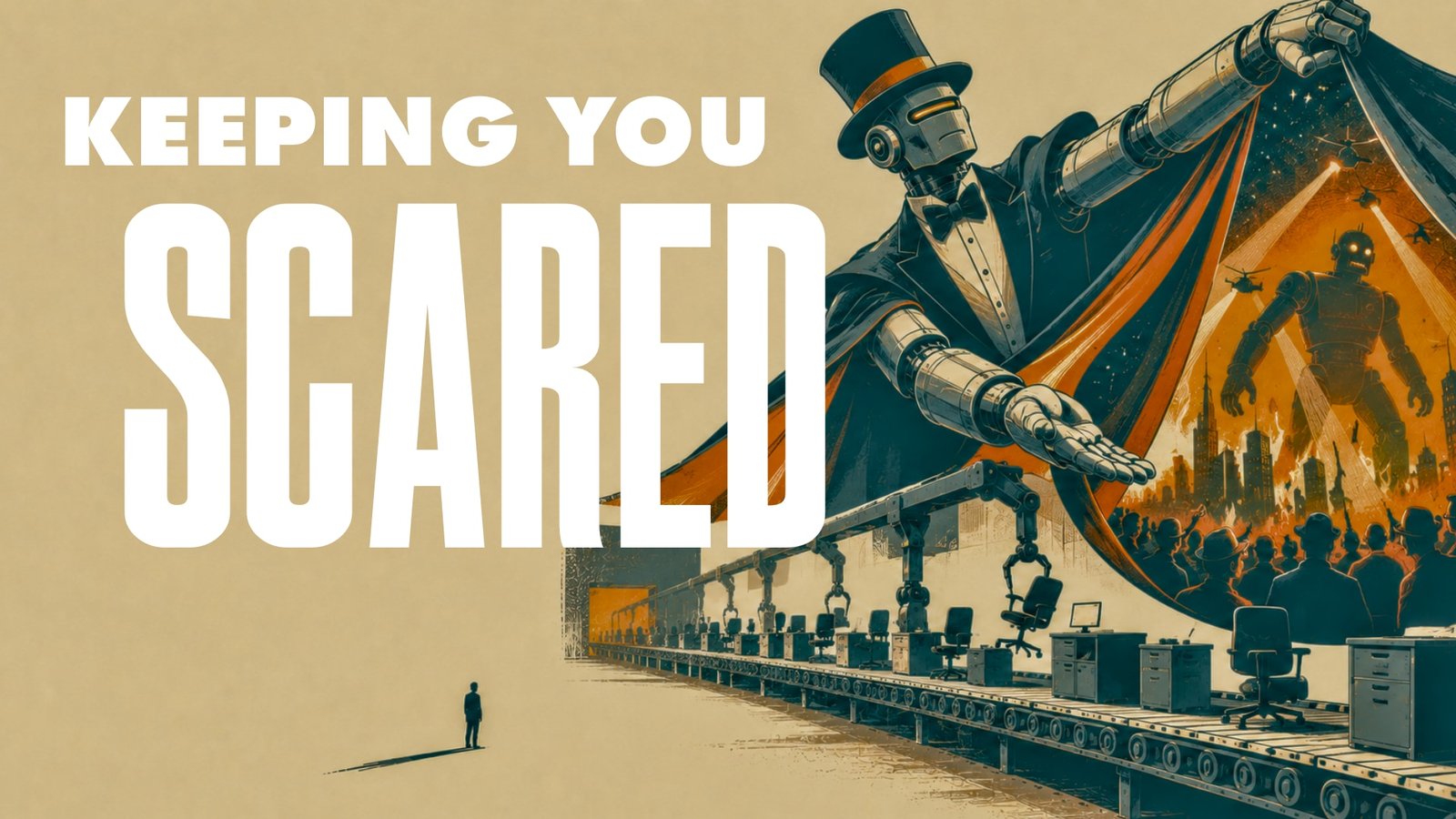
So, is there something that we should be afraid of? Absa-freaking-lutely: humans using A.I to do bad shit. Humans using A.I to concentrate power. Humans using A.I to make things that shouldn’t be made. This is why I made a whole episode about wisdom. The villain in every dystopian A.I story, if you look carefully, doesn’t ever start with the technology. It starts with the people who control it. And that’s an Organizing Story problem, which is exactly what we talk about on this show pretty much every week.
Humans are very much in a “race” to create superior A.I. That should scare us for the same reasons any kind of arms race should scare us. But you gotta know, A.I itself isn’t in a race with humanity about anything. It’s simply doing what we programmed it to do.
All right, so if A.I isn’t a psychotic, hallucinating supervillain, what the frick is happening to the workplace? Because something weird is clearly happening there. And most of us feel it even if we can’t name exactly what it is. Almost every leader I talk to is being asked to integrate A.I into their work. What does that mean? For what purpose? Nobody’s really clear about that, but that ain’t stopping it. So that’s odd, but it is also kind of par for the course with new tech that gets this much buzz in the workplace. But what is happening with things like workload and jobs and layoffs? You know I do believe a bigger crisis is coming, but what’s going on right now?
What’s happening now is simultaneously boring and alarming. There’s a concept out there called the Jevons Paradox. In 1865, British economist William Stanley Jevons argued that more efficient steam engines wouldn’t reduce coal consumption, they’d INCREASE it. Now, this happens because when something gets easier and cheaper, we just do MORE of it.
ActiveTrack released their 2026 State of the Workplace report. They analyzed 443 million hours of work activity across 160,000 employees and found that after people adopted A.I, every single work category went up. Email up 104%. Chat time up 145%. Nothing decreased. Even productive hours on Saturday went up 46 % over three years, 58 % on Sunday.
A.I doesn’t save time, it creates capacity. And capitalism immediately fills that capacity with more work, because… of course it does. This is Jevons Paradox in the workplace. And I think it probably surprises exactly zero people working. You’ve seen this pattern before, but I am here to warn you: you’ve never seen it quite like this.
My prediction is: almost universally across white collar sectors to start, what’s about to happen is organizations will try to NOT do dramatic layoffs, but they won’t replace people who leave either. Someone retires, no backfill. Someone resigns, restructure around the gap. Golden parachute programs that try to stay small and off the radar. Contract workers get expirations instead of renewals. Headcount shrinks quietly. The people who are left absorb the work. A.I. + “remaining humans racing to figure it out” will fill the capacity gap. I call this THE INVISIBLE LAYOFF. I suspect it’s gonna stay this way until the actual Crisis.
Anthropic, the company that makes Claude, published a rigorous labor market study using government data and their own usage data. Back in Episode 18: “Who Buys Your Stuff, Robots?” I argued that the A.I. job crisis would come for white collar workers first. Look at the 10 most A.I. exposed occupations in the study. Not a single factory worker, not a single tradesperson. Every single one of these is a desk job, a knowledge job.
This same study also published a radar chart showing the theoretical capability of A.I. versus actual observed usage today. The blue area is what A.I. could do right now. The red area is what it’s actually doing. That gap is enormous. So when you hear in your job to start using A.I., let’s be clear: that is the gap your executives want to fill with A.I. if they can. This isn’t malevolence either though. It’s just capitalism doing the only thing it knows how to do: optimize for more capital.
We are in the first chapter of this story. Everything we’ve talked about, The Invisible Layoff, the Jevons acceleration, the slowing hiring of young workers, the white collar disruption… this is all happening while A.I. is still warming up. When that red area starts filling the blue more and more, the effects will get orders of magnitude larger. Now, should we be afraid of that?
Yes, genuinely. But we ought to be scared in a PRODUCTIVE way because right now there’s still time! We can be thoughtful. We can prepare. We can influence policy. We can do all sorts of things that we’ve talked about in past episodes of this show. You get to choose. Where can you be most productive and most influential?
Here’s our Optimistic Rebellion.
Should we be scared of A.I.? Not in many ways that we currently are. Not of “hallucinations” and not of Terminators. Not of overnight mass unemployment. Those fears are built on broken logic and bad data and stuff that just isn’t happening yet. You can let those go. But we should be scared — productively scared — of the Jevons Paradox, of The Invisible Layoff, of the enormous gap between what A.I. can already do and what it’s currently doing. What do we do with that fear?
Well, here’s three practical skills. This week, I challenge you to pick ONE and actually practice it!
First option: Get More Curious. At the beginning of this episode, I told you I’d tell you how to function in a world of “creative machines.” This is what you do. It’s much like working with a creative human. You give their creativity context and direction and ask great freaking questions. Get More Curious.
The second option is to Get More Clear. When jobs move from the making of the thing to the setting up and the verifying the thing, we need to get ruthlessly clear on our destination before we let A.I. start driving. Clarity is a competence we all need to build. Get More Clear.
Number three: Slow The F Down. I know this feels counterintuitive when everything feels like it’s getting faster, but that’s exactly why it’s the rebellious choice. We talked about this a few weeks ago. Wisdom requires space and restraint. Speed is what machines are good at. Wisdom is what humans can be good at. Slow The F Down so your intuition has enough space to work.
Get curious, get clear, slow down. When we do this, we can be just afraid enough to keep paying attention, but not so scared that we can’t think straight. And maybe that’s the best way to participate in an Optimistic Rebellion.
Original post with all source links: https://joshallan.com/2026/03/17/should-i-be-scared-of-ai/