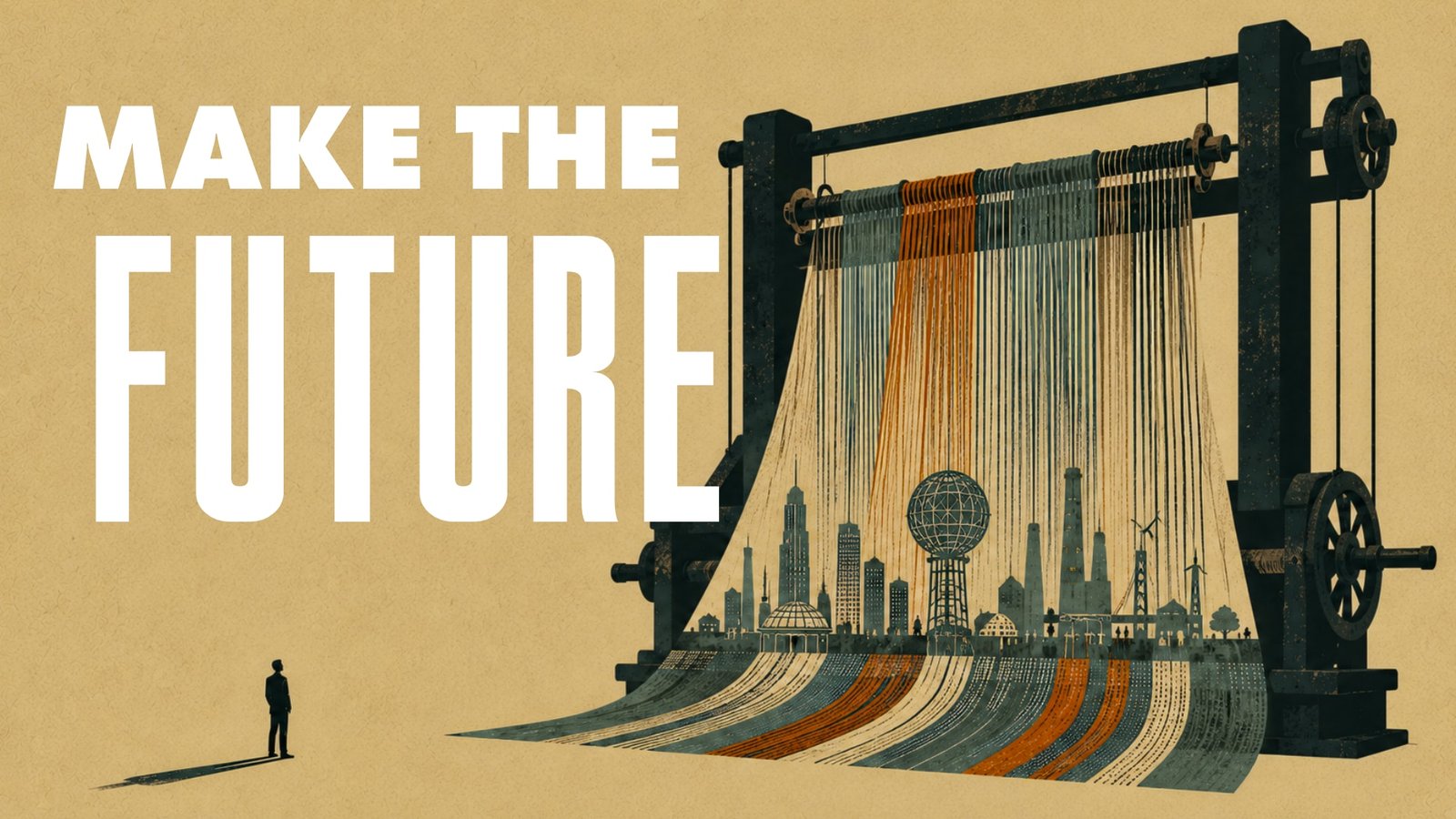
“Is the future already decided?”
I keep hearing two very different groups of people who answer this question the same way.
One group emphatically says, “Yes, and it’s going to be a dystopian hellhole. Billionaires plus A.I. inevitably equals techno-feudalism.” The other group, just as energetically, says, “Yes, and it’s gonna work itself out. This has happened before. New technology inevitably creates more jobs than it destroys.”
Very different futures, of course, but the exact same assumption: inevitability.
Let’s be honest, inevitability… it’s kind of comforting. If techno-feudalism is inevitable, I don’t have to do anything. If abundance is inevitable, I don’t have to do anything. Either way, I’m off the hook. But that relief… that’s a lie we tell ourselves because inevitability is surrender disguised as sophistication. It sounds intelligent, but historically and anthropologically speaking, neither of these positions make any freaking sense.
Human beings, we’re not a species that survives by passively accepting dominant power structures. We adapt, we organize, we resist, we redesign. If inevitability governed social systems, we’d still be living under the first empire that figured out how to consolidate power. We’re here now precisely because inevitability has never been the final word. And history has made that painfully clear. I want to go through three examples today.
First, let’s talk about child labor. At the turn of the 20th century, children were basically industrial inputs. Eight-year-olds in coal-breaking plants picking slate from moving chutes. 10 year olds working 12 hour shifts in textile mills. Small fingers — useful for fixing jammed machines! It wasn’t hidden, it was normal.
Then, a man named Lewis Hine walked into those factories with a camera. Factory owners despised him. He sometimes had to pretend to be a Bible salesman to get inside. He asked the kids their names, their ages, their hours, and then he photographed them. These photos helped detonate something that arguments never could.
But even with this brutal truth, reform didn’t gracefully glide in. Federal child labor laws were struck down by the Supreme Court twice in 1918 and again in 1922. Industrialists fought, states resisted. It took the Great Depression, mass adult unemployment, and FDR’s New Deal before Congress finally passed child labor protections that stuck.
An entire generation of children worked in those mills while lawyers argued in courtrooms about whether the government had the authority to protect them. Child labor didn’t just disappear. It wasn’t an inevitable outcome. It was exposed. It was resisted. And THEN it was forced into exile.
Second, let’s talk about women’s suffrage. I’ve heard this story told like it was some sort of inevitable civic maturation, but it most certainly was not. This was a multi-generational war of otherworldly persistence. The fight for women’s suffrage lasted over 70 years. longer than the average lifespan of that time period. Women marched and organized and petitioned; they were mocked as hysterical, jailed, beaten and tortured.
In November of 1917, 31 women picketed the White House. All of them got arrested and the superintendent ordered his guards to “teach them a lesson.” What happened next became known as The Night Of Terror. Lucy Burns had her hands shackled to the top of a cell, forcing her to stand all night. Dorothy Day the future founder of the Catholic Worker Movement, was slammed down on the arm of an iron bench twice. Dora Lewis lost consciousness after her head was smashed into an iron bed.
When the women were finally released, many were too weak to walk, but news of the Night of Terror spread and the public was horrified. In January of 1918, a year after they started picketing and two months after The Night Of Terror, President Wilson announced his support for women’s suffrage. In June of 1919, Congress passed the 19th Amendment giving women the right to vote. And It was ratified the following summer, 72 YEARS after Seneca Falls.
This amendment didn’t pass because time passed. Systems don’t eventually just “yield.” They yield when the pressure becomes unbearable, not because the change was “inevitable.”
Third, let’s talk about workplace safety. On March 25th, 1911, a fire broke out at the Triangle Shirtwaist Factory in New York City. Employees tried to escape, but couldn’t. Why? Mostly because the exits were locked. 146 people died, mostly young women. Some perished from the fire itself, some from smoke inhalation. Some got trampled in the too small and too dark stairwell. Some died when the fire escape collapsed underneath them. And some jumped from the windows to their deaths on the street below.
Max Blanck and Isaac Harris, the factory owners, were later fined… $75. Not per death, total. Two years later, Blanck was caught locking exit doors again in his new factory location. You gotta know, this wasn’t just one jerk boss. This was the perfectly standard practice at the time.
But public outrage did help reshape labor law. A few months after the fire, New York created the Factory Investigating Commission. They rewrote New York’s entire labor code: fire drills, sprinklers, unlocked exits, building codes, sanitation, and limited hours for women and children.
You’re hopefully seeing how this works. Just like child labor and women’s suffrage, workplace safety wasn’t born out of inevitable progress or enlightenment. It was born out of catastrophe. It was written in smoke and ash. And it wasn’t the fire that actually changed things, but the collective public response after that. That’s what made change possible. A week after the fire, people marched, 100,000 strong down Fifth Avenue in the rain.
If you’ve been listening to this show for a while, you’ve heard me talk about the pattern of “gradually, then suddenly.” Change compounds quietly for years, sometimes decades, before it becomes visible. Child labor reform didn’t explode overnight. It simmered. Women’s suffrage didn’t erupt from nowhere. It endured. Workplace safety didn’t emerge smoothly. It built pressure until it broke through. These things happen gradually, slowly, often painstakingly.
But here’s what’s fascinating… when the “suddenly” finally happens, we look back and call it, you guessed it: inevitable.
Of course women were going to get the right to vote!
Of course child labor was going to end!
Of course factories were going to get safer!
But during the gradual phase, it didn’t feel inevitable. It WASN’T inevitable. It was fragile, contested, uncertain, but a better future prevailed because people demanded it.
Let’s return to the 2 futures we started with.
Future 1, remember: techno- feudalism. A.I. replaces labor, wealth concentrates, the owners of machines become the new aristocracy. Have you seen a movie called Elysium? It’s kind of like that. It’s uncomfortable to say, but under our current rules, that trajectory is plausible. If capital owns A.I. and robot productivity explodes and ownership remains concentrated and tax structures and labor protections remain untouched, wealth will continue to concentrate.
We’re already seeing it. The top 1 % of Americans now own more wealth than the entire middle class. 1%. But that wasn’t inevitable either. That didn’t happen by accident. It happened because the rules — tax policy, labor law, antitrust enforcement — changed to allow it to happen. We are living in the world that neoliberal policies built. So an extension of the trajectory we’re on now could very well lead to a techno- feudalist dystopia. That’s where current incentives lead.
But THAT is my point. It’s not inevitable. It’s currently incentivized. Techno- feudalism would not be an A.I. outcome. It would be a governance failure.
Now let’s talk about future 2. Remember this one? It’s the “abundance” future. “Relax. The market adapts!” This group points to history. “New technology always creates new jobs!” they say. That’s not entirely wrong, but they are leaving out all of the FIGHT, and they’re making a huge assumption that some other things will somehow magically happen, specifically:
- Companies will start to invest in human development.
- Displaced workers will get retrained for new roles.
- Governments will fund transition programs and
- Education systems will rapidly adapt their curriculum.
The big problem with this possible future is none of those things are currently incentivized.
Under current rules,
- Companies get rewarded for cutting labor costs, not retraining workers.
- Shareholders get rewarded for automation and efficiency gains, not for workforce transitions.
- Our government’s current tax policies reward capital investment, not human investment.
- Our current education system doesn’t rapidly do… anything.
So no, the market is not “adapting.” It’s following incentives.
And yes, in the past, industrialization has eventually created new jobs… AFTER decades of strikes and regulations and antitrust enforcement and public education expansion and labor law battles. The market has never calmly self-corrected when it comes to protecting workers, reducing inequality, or addressing systemic harms. Society eventually restructures around disruptions — but historically, that’s required governance intervention.
So when someone says “It’ll work itself out,” what they’re really saying is that they trust the structural and institutional redesign will happen again. But this kind of redesign… it doesn’t happen automatically. It happens when people INSIST on it.
Both of these “inevitable” futures also make assumptions about the rules.
Future 1 assumes the current rules will stay what they are. I don’t know a lot of people who want that. Future 2 assumes the current rules will change drastically. History says that won’t happen without people who ACT.
The real question isn’t which future is “inevitable.” It’s who will care enough to shape the next set of rules. We’re not in a maintenance era, my friends. We are in a redesign cycle. Technological foundations are shifting. Economic structures are wobbling. Institutional trust is eroding. These are the times when rules get rewritten. Believing in inevitability during a redesign cycle is like watching wet cement harden and saying, “Well, I guess that’s just how it sets.” No! It sets based on how it’s shaped.
And here’s the part that matters the most. This isn’t about guilt. It’s about inheritance. Yours. Every “human right” that you now enjoy exists because someone before you refused a belief system of inevitability. They too, I’m certain, we’re told the system was natural, permanent, fixed, unchangeable. They refused to believe it.
If progress were inevitable, it wouldn’t require courage or fight or rebellion. So when someone tells you that collapse is inevitable or techno- feudalism is inevitable or abundance is inevitable, remember this. The future is not written by technology. It is negotiated by people. And the only thing that becomes inevitable is what we refuse to shape.
This week’s Optimistic Rebellion is pretty simple. For the next seven days and hopefully beyond, I challenge you to replace the word “inevitable” with the phrase “currently incentivized.” A.I. inequality isn’t inevitable. It’s just what’s currently incentivized. Wealth concentration isn’t inevitable. It’s just what’s currently incentivized. Collapse isn’t inevitable. It’s just what’s currently incentivized.
The question isn’t whether the future is already decided. The question is whether you believe you’re just watching it or you believe you can help build it. Either way, you’ll prove yourself right. But always remember, if something is incentivized, that means those incentives can change IF enough of us care to make it happen.
Original post with all source links: https://joshallan.com/2026/02/24/is-the-future-decided-why-ai-doesnt-decide-it/