

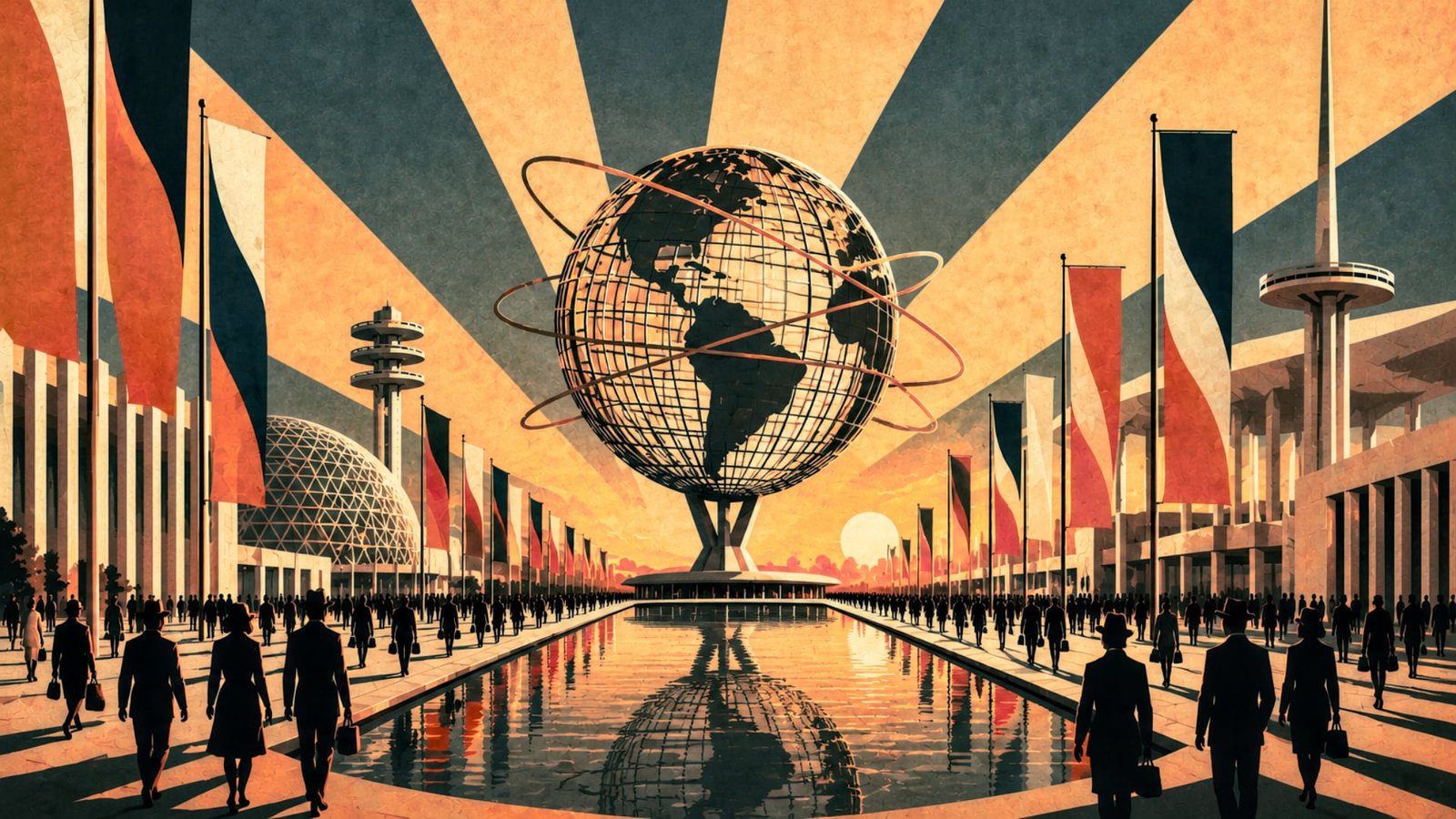
Today’s wrong question is: “Is optimism a luxury we can’t afford?”
This question often gets asked in indirect ways.
“Shouldn’t we focus on the real problems?”
“That’s a nice idea, but be realistic.”
“I’m just trying to get through the week!”
It’s a reasonable instinct. It usually comes from a good place, often from the kind of person who actually gives a damn about wellbeing in the here and now.
But in the long run, thinking of optimism as a “luxury we can’t afford” ends up being a very wrong question, because it sets us up in a kind of “false binary” that eventually limits what we can create.
Today we’re going to dig into the topic of optimism through the lens of World’s Fairs, a topic that’s been fascinating me since I started focusing on optimistic futurism.
The White City
A couple weeks ago I was in Chicago to support Kali as they gave a keynote on the topic of their upcoming book at the Culture Impact Lab conference. Kali was a partner in my last tech company, and you’ll definitely be hearing more about this remarkable human.
We arrived a day before the conference and had a little time, so we decided to go up to the Skydeck in Willis Tower — skyscrapers are kinda my thing — and it turns out there’s now a mini-museum exhibit about Chicago you wander through before going up the insanely-fast elevator.
We’re wandering through the exhibit, it’s a dark section of the tour, and I notice Kali stopped ahead of me, looking at the wall and pondering something deeply.
There’s some text written about a “White City.”
I’d never heard of this.
It’s 1893. On the South Side of Chicago, activist and reformer Jane Addams is running Hull House, a community of university-educated women providing social and educational opportunities for working class people. Children in the surrounding tenements are earning four cents an hour. Immigrants are stacked into buildings with no sanitation, no heat, no future.
And a few miles away, on the lakefront, they’re building what everyone will come to call the White City.
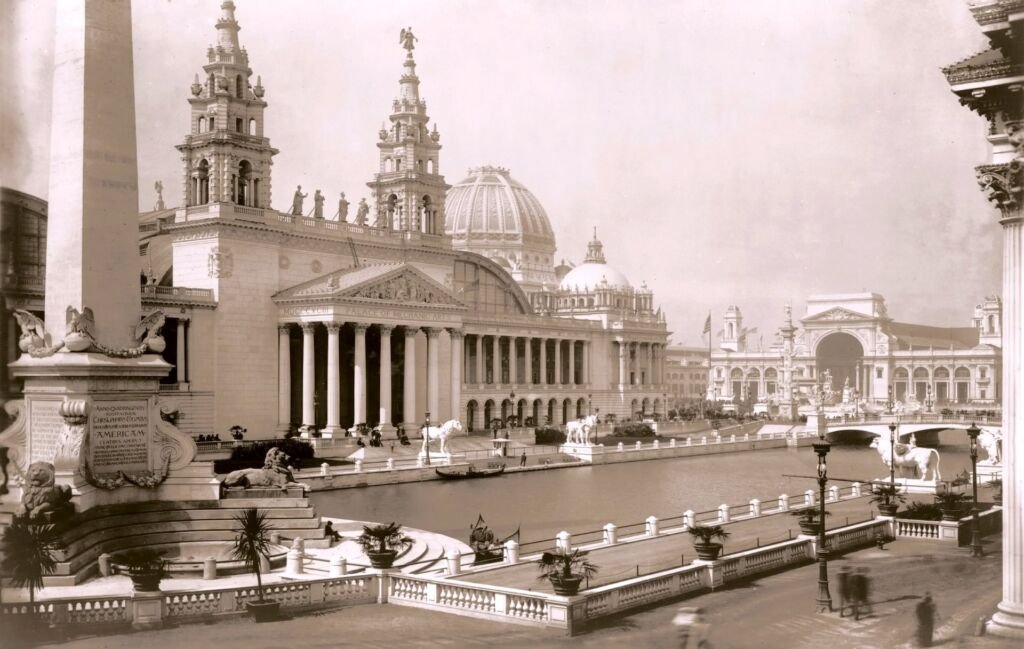
It’s a World’s Fair. 686 acres. 200 buildings. All coated in a gleaming white mixture of plaster and hemp fiber that catches the sun like a city from another planet. And at night — lit by electric light, which, at this point, most Americans had never seen at this scale — the city glows across the water like something out of a dream.
27 million people will come to see it; that’s 40% of the U.S. population at that time! On one single day — October 9th, designated Chicago Day — 751,000 people show up.
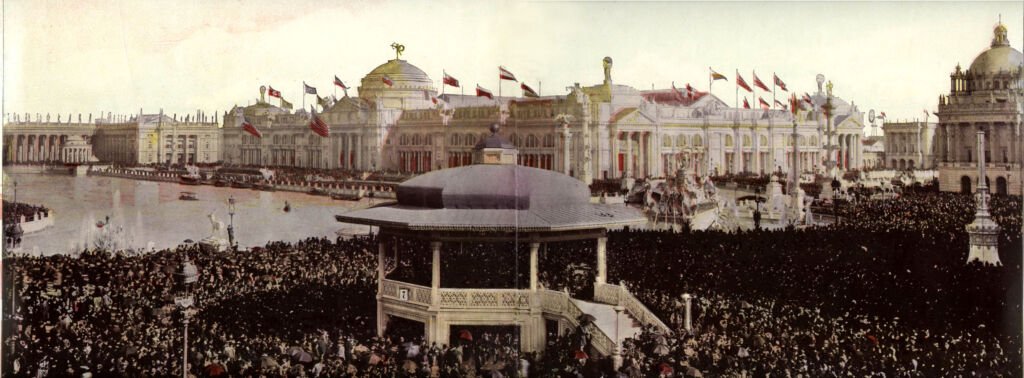
The official name of this gathering is the World’s Columbian Exposition, because it marks the 400th anniversary of Columbus’s arrival in the Americas. This name itself contains many layers of irony, of course, but in general I suppose a celebration with this much arrogance could really have only been named after Columbus.
In other words: the White City was both glorious and grotesque.
Spoiler alert: as we study optimism, we’re going to see this kind of polarizing side-by-side contrast over and over.
The White City gleamed while the actual city nearby rotted.
Jane Addams didn’t boycott the Fair, by the way — she actually spoke there — but her life’s work, a few miles away, was the living critique.
And yet, the White City did generate something… truly good.
It lit up the imaginations of millions of Americans who had never seen what a city could be, what a public space could feel like, what shared human achievement looked like made real. It influenced American architecture for decades. It sparked the City Beautiful movement. The Museum of Science and Industry in Hyde Park — still standing, still one of the best museums in the country — was built for that fair.
The White City illuminates the first thing for us to notice about optimism on our journey through World’s Fairs, namely: optimism isn’t really a clean, sanitary thing.
It doesn’t get delivered in some kind of hypoallergenic box.
Optimism is messy and complex and often arrives just to the left or right of dirt and grit and even corruption.
The White City wasn’t an either/or. Jane Addams didn’t choose between the slums or the spectacle, she did both. The Fair’s existence didn’t prevent her from fighting for the people living in the 19th ward. And in fact, the civic energy the Fair generated — the pride, the sense of shared possibility, the argument that Chicago could be something extraordinary — that energy was arguably part of what made Hull House’s ongoing work possible.
It’s part of what made continuing reform possible in general, because it helped people believe change was worth attempting.
In other words, I’m not talking about inequality itself — I’m encouraging us to look at a mechanism that can help us make inequality better.
Defiance In A Depression
Fast forward forty years.
It’s 1933. The Great Depression is three years deep. Unemployment is somewhere between 20-25%, depending on how you count it. Banks have collapsed. Farms are being foreclosed. People are hungry and food is scarce.
And Chicago is opening another World’s Fair.
This one is called The Century of Progress Exposition. Right there on the lakefront. The theme: “A hundred years of scientific and industrial progress.”
Again, on the surface the audacity feels hard to process. One of the most celebrated stories of American life — “hard work leads to prosperity” — has just catastrophically failed. Everybody is still reeling from it. And Chicago is… throwing a party.
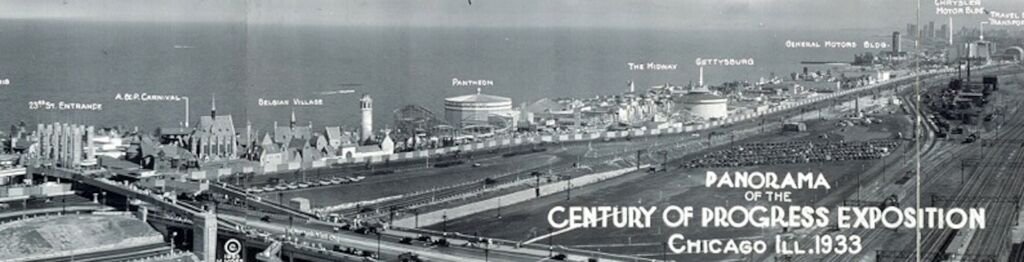
Critics thought it was obscene. Tone-deaf. A celebration of the system that just destroyed millions of lives.
But, like the White City, this tale isn’t that tidy.
Here’s what actually happened.
First, we need to note that the Fair was not paid for by public funds. Before making this episode, my assumption was that these Fairs were publicly-funded projects, but they quite often weren’t. They often required partnership with civic entities — in a moment I’ll describe what happens when this partnership disappears —but they weren’t primarily publicly-funded projects.
Chicago 1933 raised its money through bond issuances, exhibit rental fees, memberships, and ticket sales — no municipal, state, or federal subsidies. It had to stand on its own. And it did more than stand… it turned a profit. Because 39 million people came. 12 million more people than saw the White City!
Second, it’s important to double click on this event’s amazing popularity. In the depths of the worst economic catastrophe in American history, 39 million people chose to spend a day imagining what the future could look like. FDR was so taken with the Fair’s effect on consumer confidence and economic activity that he encouraged them to reopen it in 1934.
So, once again, we see this bizarre juxtaposition: the immense suffering of the Great Depression alongside a vision for something better.
I don’t think this is just escapism, and I don’t think it’s frivolity.
I think it’s defiance.
I think it’s a people refusing to let their capacity for hope be destroyed along with their savings accounts.
Together, these two World’s Fairs teach us something important: collective imagination is not the thing we do after we fix suffering.
No, collective imagination is a vitally important part of what makes fixing suffering tolerable in the moment, and might even be the thing that makes something better conceivable in the first place.
The Unisphere
Fast forward another 3 decades and we get to my favorite World’s Fair.
It’s 1964. New York City. Flushing Meadows in Queens.
In general, this World’s Fair was a mess in a lot of ways.
Robert Moses, the controversial autocratic urban planner of New York who ran it, was a disaster of a human being by most accounts, and the Fair ended up $40 million in debt. The Bureau of International Expositions refused to sanction it because Moses insisted on charging exhibitors rent, and he responded to their objections by calling them “a bunch of clowns in Paris.“
So… there’s that.
But this Fair, too, produced good things.
Beyond the mid-century artistic styles of the time — and holy crap, do I love the art, posters, furniture, and architecture of this era — this Fair produced The Unisphere.
Standing in the middle of Flushing Meadows Park right now, still there today and still remarkable, is a 140-foot stainless steel globe on a pedestal. Orbital rings around it. The whole Earth rendered in gleaming metal. It was commissioned by U.S. Steel… yes, a steel company paid for a monument to global unity and human progress. And at least to me, it is genuinely, achingly beautiful.
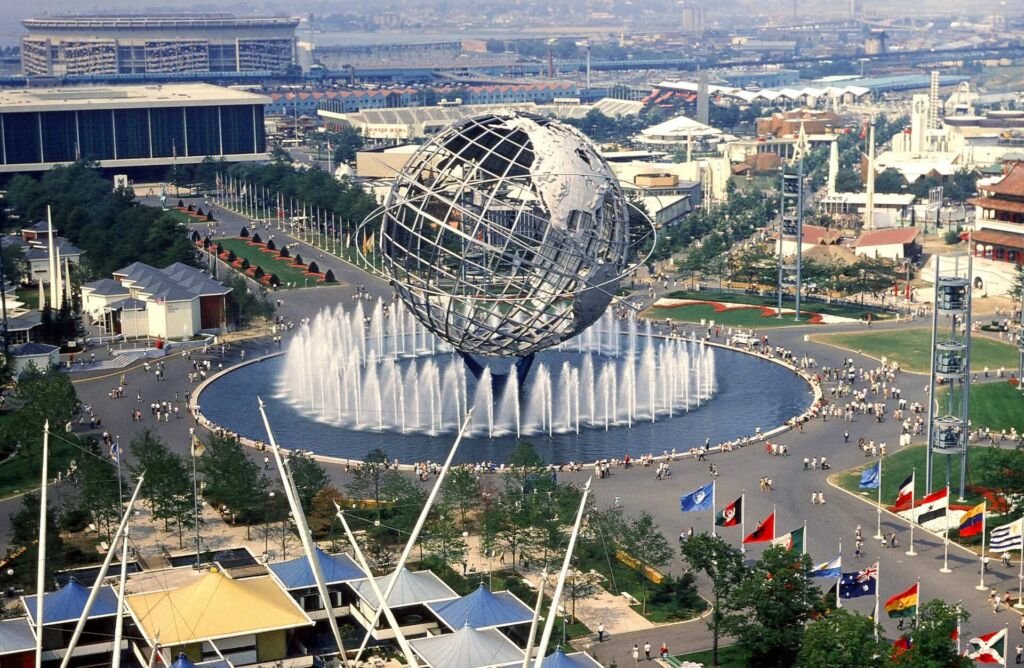
The theme of the 1964 Fair was “peace through understanding” and the Unisphere was designed to represent global interdependence. More than 51 million visitors saw the Unisphere over the course of two World’s Fair seasons.
Because of Moses’s design, this Fair was primarily filled with corporate exhibits. GM’s pavilion alone drew more than 29 million visitors, the most-visited single exhibit in World’s Fair history. Ford spent $30 million and hired Walt Disney to design their attraction. Disney actually used the fair as an R&D lab for four different exhibits, all paid for by corporate sponsors, with the creations ending up in Disney parks afterward.
The corporations got their brands showcased. The rest of us got “It’s a Small World” stuck in our heads until the end of time. Win-win!?
Seriously though, once again we’ve got corporate money side-by-side with genuine civic meaning.
Both/and, not either/or.
But this Fair teaches us something differently profound about optimism.
In 1964, we were still inside what economists call the “post-war consensus.” The top marginal individual tax rate was 70%. The corporate tax rate was 48%. Unions represented a third of the workforce. Corporate power existed, but it existed inside a governance container.
The social contract was still very real.
So when GM built a pavilion about the City of Tomorrow, yes, it was a car ad — but it was a car ad made by a company that paid its workers a living wage, contributed to the tax base, and existed inside a society that still broadly believed in shared prosperity.
Compare that to if Exxon, Amazon, or Meta built a “City of Tomorrow” pavilion today. We wouldn’t believe a word of it. In 2025 alone, 88 major U.S. corporations paid zero federal income tax. Zero! The future used to be funded by the people profiting from it. Now they’ve figured out how to opt out of shared prosperity entirely.
What we see here is: the social context matters.
I think this World’s Fair teaches us that healthier social-governance structures produce a healthier relationship between company and community.
That may seem obvious in a way, but at the same time I don’t think it is obvious to many of us right now.
The unraveling of our social contract over the last 40-50 years of neoliberalism has left most of us deeply jaded if not outright cynical about government being able to do anything positive at all.
Here’s my theory: I think the 1964 fair didn’t somehow feel more pure “in spite of” its corporate-ness. I think it was relatively pure because the corporations funding it were operating inside a healthier social system.
The inspiration was real because the social contract behind it was real.
I think this is one of the main reasons why we look back at this time period with such nostalgia.
This means our big lesson from 1964 is that our current lack of optimism isn’t just about corporate greed or about an incompetent governance sector, it’s both. What we learn from this World’s Fair is: when we get the balance of things right — when we are able to create a stable governance container to redistribute corporate resources properly — it serves our general imagination in a much more positive way.
Stopping The Future
After 1964, though, the World’s Fair story basically turns into a big bummer.
The U.S. basically invented the modern World’s Fair. 1876. 1893. 1904. 1933. 1939. 1964. We defined the form. We built the template. We gave the world the Ferris Wheel, the Space Needle, the Unisphere.
And then we just… stopped.
The last World’s Fair on U.S. soil was in New Orleans in 1984. It was a financial disaster.
Fifteen years after New Orleans, Congress passed a law, an actual law… might have been the last one they passed! Just kidding… probably. This law basically prohibited federal funds from being spent on a World’s Fair.
Let’s ponder that a moment.
The U.S. didn’t just drift away from collective imagination. We actually legislated ourselves out of it.
In 1999 — somewhere near the peak of neoliberal consensus, when we were still so convinced markets were going to handle everything and government was the problem — Congress looked at the idea of funding a vision of the future and said: “Not worth our money.”
Since then, some of our states have tried to do it solo. For example, Minnesota tried twice, bidding in 2023 (lost to Argentina) and bidding for 2027 (lost to Serbia). Both times they were doing this, of course, with one hand tied behind their stately back because of the 1999 law.
I consider myself a fairly global citizen, but I actually didn’t even know World’s Fairs were still happening at all until starting the Hello Tomorrow podcast last fall. But they are; Osaka 2025, which just wrapped last October, posted a profit and hosted 29 million visitors.
Mina Chow, the filmmaker behind the World’s Fair documentary Face of a Nation, put it plainly:“We’ve stopped participating in one of the biggest soft power exercises there is.”
If you’re not familiar, “soft power” is the ability to attract and inspire rather than coerce. It’s how a country earns moral authority in the world. This is influence that doesn’t happen through military or trade policy, but through ideas, culture, and a vision of what human life could be.
Ostensibly, the U.S. should be shining in these ways. We export so much “belief” to the world… why did we abdicate our role here?
World’s Fairs were one of our greatest soft power instruments. They said: come see what we believe is possible.
And for generations, people came.
I know the U.S. is a complicated place to love right now.
I’m not asking you to forget our sins.
I’m asking you to hold two things at once: that maybe WE might be both glorious and grotesque. Maybe all civilizations are. And maybe our goal is to just keep doing our best to nudge things towards the glorious.
Holding competing ideas in tension, it turns out, is exactly what optimism itself requires of us.
I believe the idea of the U.S. — the actual idea, not our foreign policy, not our massive inequality, not our embarrassing recent decades — is still one of the most radical propositions in human history.
The idea that ordinary people get to decide how we design our common life together.
That nobody’s bloodline determines their ceiling.
That the next big thing can come from any one of us.
We used to show up to World’s Fairs and make these arguments in person, in steel and glass and light. When we stopped showing up to make it — when we pass an actual frickin’ law against funding futuristic dreams — we don’t just lose the argument. We forfeit our turn entirely.
And I think the world notices.
Because for all our failures, when the U.S. stops making the argument for human possibility, a better future has lost a really big megaphone.
The world is worse off when the U.S. dims its light.
I want us to turn it back up.
Collective Imagination
Sociologist Robert Sampson spent years studying what actually differentiates healthy communities from struggling ones. And the single most powerful variable — more than wealth, more than healthcare access, more than crime rates — was what he called collective efficacy. This simply means “our capacity to act together on things we care about.”
Collective efficacy is not decorative. It’s not a luxury. It is the precondition for everything else we want to change.
To do it, though, we first need to believe that collective action is possible and worth attempting.
And collective imagination is one of the ways collective efficacy gets built and sustained.
We used to do this together at World’s Fairs, having the shared experience of standing in front of something beautiful and ambitious and saying we built that, we can imagine something bigger, we are capable of more than the current reality.
A community that only ever operates in “triage” mode, only ever asking “What’s the most urgent fire to put out?” doesn’t just get tired. It loses the muscle memory of believing things can be different.
It starts managing decline instead of building… anything.
Which means, the most radical thing we can do in a crisis is refuse to stop imagining.
I’ve spent many episodes describing many huge system challenges we’re facing in the U.S., and in many ways across the world. A petrodollar crisis, a massive global debt conundrum, the failings of neoliberalism, the danger A.I. poses to the economic Loop That Holds Up The World.
I understand, better than I ever have, the challenges we face. They are many. But we mustn’t give up — we must believe harder.
And we need to demand a social-governance container that is worthy of the future we want.
To do that, I think we need to understand how important the social-governance container is.
Most weeks I try to elucidate this idea in a slightly different way, and most weeks I hear from at least one person who aims to tells me I’m stupid without exactly saying they think I’m stupid for thinking government of any kind is worth a damn.
I know you’ve never seen “government” do anything great.
Neither have I, honestly.
But if we broaden our horizons even a tiny bit, we find our biases quite disproven.
The Interstate Highway System, which gets you across the country. The internet, which connects you to the world. The moon landing… which happened almost 60 years ago! The GI Bill, which created the American middle class more than any market force ever did. The National Weather Service, which tells you if you should bring an umbrella. The FDA, which makes sure your aspirin is actually aspirin.
Government built the container that made all these things possible.
I’m not saying The Market needs to go away. I am saying the kind of life most of us want only exists when The Market lives inside a box of guardrails and isn’t allowed to run the whole show.
World’s Fairs aren’t lavish opulent corporate ads OR inspirational optimistic futuristic experiences, they’re BOTH. But, like 1964, they work their most magic when they happen inside a social container that provides the kind of stability we need in order to believe.
In many ways the social-governance history of humanity is largely a battle between these two forces — “markets” and “commons” — and I think we have enough historical data at this point to see that, while this relationship is always a bit complicated, it never works out well when The Market is unfettered.
So let’s go back to where we started.
Is optimism a luxury we can’t afford?
Here’s what I actually think, after standing in Chicago, after tracing this arc from the White City to the Unisphere to a 1999 law nobody remembers…
Optimism isn’t a luxury.
Cynicism is the luxury.
Cynicism is what we genuinely can’t afford, because it guarantees the outcome we’re afraid of.
The future used to be a place we could visit. We could buy a ticket, walk through the gates, and stand inside a shared vision of what humanity thought it was capable of. We could argue with it, be moved by it, be infuriated by its exclusions and inspired by its ambitions, and feel, in our bodies, that other people were imagining something alongside us.
We need that place again.
And we need a social-governance container worthy of it.
And while we’re building it — whatever that looks like in your life, in your organization, in your city — don’t let anyone tell you that the imagining has to wait until after the suffering stops. Because it never worked that way.
The optimism is what helps end the suffering.
Work Will Kill Us All
For my regular readers — and any new friends — I want to fill you in on what I’m doing for the next couple months.
I’ve tried as hard as I can to get my new book, Work Will Kill Us All: An Optimist’s Guide To The Future, written alongside my weekly podcast/newsletter cadence, but it has been… challenging. I just can’t seem to carve out the space and time I need alongside the other things that I prioritize, like my family and general wellbeing practices, along with delivering talks and corporate programs.
So, for a little while I’ll be releasing new cuts of past episodes on the podcast and releasing new short videos on my YouTube Channel, but will be taking a little break from the newsletter. Please follow me on any of the links below if you don’t want to miss anything. My intention is to create the extra space I need to get the book completed!
I’ll be back in touch soon with updates on the book writing process. If you want a front row seat for the book, please come join us at WorkWillKillUsAll.com.
Thanks for being a Hello Tomorrow Optimistic Rebel. I’m honored to be on this journey with you.
🎙️ https://hellotomorrowpodcast.com
📺 https://youtube.com/@joshallandykstra
📸 https://instagram.com/joshallan
🕺🏻 https://tiktok.com/@joshallandykstra
🦋 https://bsky.app/profile/joshallan.com
