If you’re curious what we might do instead of capitalism, you’re in the right spot.
I wanna start with a few of the biggest questions about replacing capitalism. Like you, I imagine, I come from an entire lifetime of swimming only in the waters of capitalism. It’s all I’ve ever known from the moment I was born. This is almost certainly true for you too. And I can tell you from personal experience, belief systems are tricky things to deconstruct. Why? Well, they form the foundations of our beliefs, questioning those things is gonna make your whole reality feel shaky for a while. Sometimes we even freak out a little. That is completely, absolutely normal. Maybe just expect it?
Okay, Let’s get into what I call the four big freak outs about replacing capitalism.
1: THE “FREE MARKET”
First question, “But what about the free market?”
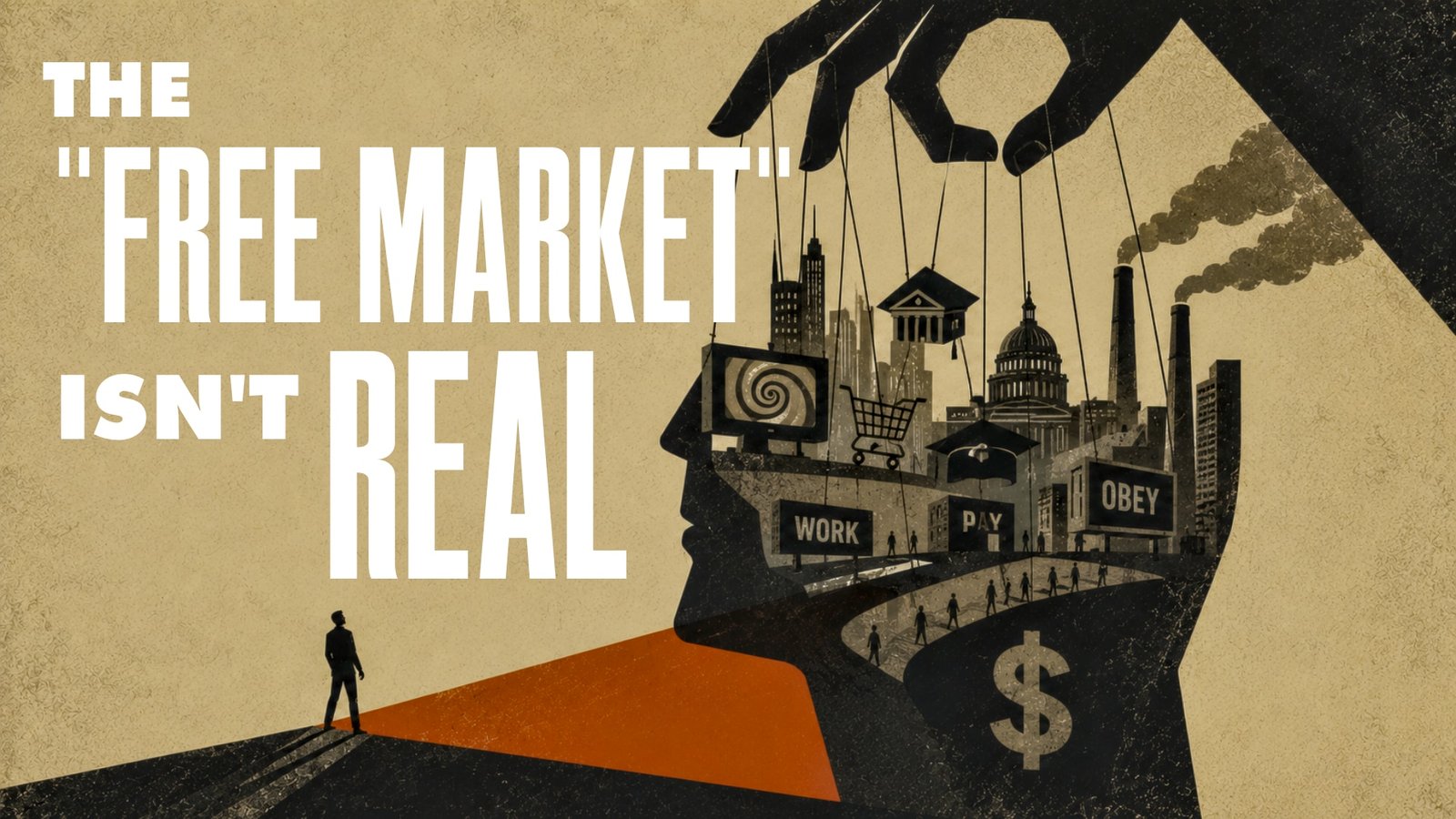
Oh, the “free market.” Like you, perhaps. I was taught my whole life that there’s a “free market” out there. And if we pesky kids would just, you know, not muck it up, some sort of gentlemanly invisible hand would guide us all toward prosperity. It’s a lovely idea, it is! But my friends, the free market is about as real as unicorns doing pilates.
Markets aren’t “free,” they’re built — designed, structured, curated. They’re held up by laws and courts, zoning, subsidies, contracts, tax codes, and the culture that continues to believe in them. We have this fantasy that “The Market” is some kind of emergent, benevolent, biological entity. It is not. The Market was made by humans, and it is controlled by humans with capital. And the story that it is somehow not made and controlled by humans was also, you guessed it, made up by humans… with capital.
There’s no such thing as a free market.
A better question is: is the market we have free for anyone? Right now, the market only feels free for the holders of capital. You know this — if you’ve got money, you’re fine. If you don’t, you struggle every day of your life. So “free market”… not really a thing. But FREEDOM — that’s a real thing. And it’s important because we all want it. So let’s talk about that.
2: LOSS OF FREEDOM
The next freak out is… question two, “Wouldn’t moving beyond capitalism take away individual agency and personal freedom?” Totally legitimate freak out.
We care about freedom and choice and liberty. But let’s check in on the agency and freedom we actually have. We have the freedom to spend 40 years doing work that sucks the life out of us. because we got to pay the rent. We have the freedom to go bankrupt due to medical bills.
We have the freedom to work on whatever CAPITAL wants us to work absolutely nothing it doesn’t. What do I mean by that? last one? Well, let’s imagine an economy that builds the things most of us want, like walkable neighborhoods, arts, community spaces, childcare, parks, elder care, etc. This sounds nice, right? Too doesn’t like that sh*t. It’s not a good “investment” so it doesn’t get built. Individual “agency” under capitalism is basically Henry Ford’s famous line: “You can choose any colored car you want as long as it’s black.” That’s “agency” inside of capitalism, y’all. Feel free to choose anything you want… as long as it maximizes shareholder value.
Yes, I know we will need to show that the next thing will provide agency and freedom. But first, I want us to see that the bar for freedom is much lower than we think. We don’t have very much freedom and agency NOW. We live in a political democracy and we have our say in how our country is run, right? Why shouldn’t we also have a say in what we get to build and create with our work?
3: EVERYTHING WILL BECOME INEFFICIENT
That leads us to Question three: “Won’t replacing capitalism make everything inefficient and bureaucratic?” This was a deep belief system for me to deconstruct. I had this understanding that the only alternative to capitalism was government. And government is inefficient and mostly terrible because, well, I’ve personally interacted with the California DMV and I’m here to tell you it really is run by the sloths of Zootopia.
But I admittedly had some baggage to work through on this point. As I did the research for this episode, I had a bit of an epiphany.
I now think my perception of “government inefficiency” is what it is because of something we might call “generational cycle” trauma. Now to deeply understand what I’m about to say, you have to listen to my episode about the Fourth Turning. I was born in 1981. So my entire life has been lived during a Third and now Fourth Turning. These are eras that are ALWAYS defined by institutional decay, polarization, and government dysfunction.
So if you buy into this theory of Turnings, we notice I’ve literally NEVER been alive during a time when government was actually working. So that means when I think “government,” my mind conjures that DMV waiting room, and also stories of bridges that collapsed because they weren’t fixed and high speed rail lines that can’t get frickin’ built and a completely almost comically inept Congress. Maybe you feel all of that too. But as I look deeper at government, I’m pretty sure this wasn’t always the case. It’s just the era we’ve been in for the last four+ decades.
If we look backward to the time before I was born, during the First and Second Turnings of just this last cycle, government was quite extraordinary. All around us, we see evidence of the massive, impressive systems that were built then, but still exist today. Things like the internet, the interstate highway system, public university expansion, social security, and rural electrification. Giant public works like Hoover Dam, NASA putting humans on the freaking moon with less computing power than your phone’s calculator.
So if we expand our view to something larger than my lifetime, we can clearly see that government can be wildly competent. Many of us just haven’t lived through that version of government.
This is the challenge with Turnings. By the time the cycle comes around again, most of the humans that lived through the last one have passed on. I’ll also point out that this era that I’m pointing to, coming out of the Great Depression in World War II and the 30 to 40 years after, that’s largely what collective nostalgia now seems to refer to as the “good old days.” Now let me be clear: those times were absolutely NOT good for everyone and I don’t want us to go back there. I’m just saying that it’s a time period that is widely regarded as stable and functional in the civic sphere. We built public things that we were proud of and we had a kind of communal stability to show for it.
Meanwhile, in today’s era, capitalism has some pretty great PR to convince us of its incomparable efficiency, but it can actually be wildly inefficient and deeply bureaucratic.
Consider health insurance billing labyrinths. You ever been stuck in one of those? I bet you have. Actually, ALL insurance paperwork processes are basically hellscapes, like truly representing every flaming circle of hell for me. HR policies, thicker than Tolkien novels, right, with language that feels just about as made up. Private energy utilities that collapse in bad weather. (Here’s looking at you, Texas.) Legalese that’s completely impregnable without a Harvard Law degree.
All this bureaucracy… that’s not coming from the government, my friends. That’s driven by capitalism.
So capitalism isn’t across the board efficient. It’s just very efficient in the things that make more capital. And it’s deeply, often torturously, inefficient in the ways that don’t or won’t make more capital. Conversely, government isn’t across the board inefficient. It can and has accomplished amazing things. So it’s not government “incapable” and private market “incredible.”
A better question is… are we actually producing the kind of things we want? Are we getting to work on the things we want? Are we making the kind of world we want? Right now, I believe most of us answer NO to those questions.
4: INNOVATION WILL DIE
All right, let’s do one more of these freak-outs. You ready? Question four. “But won’t innovation die without capitalism?” This is capitalism’s favorite bedtime story. “Without capitalism, the iPhone wouldn’t exist.” I’m calling it: bullsh*t.
Innovation comes from human curiosity, not from corporations. Also, historically, a tremendous amount of innovation springs from patient long-term civic- funded research, things like universities, government labs, collective research, openly explored science. And then what happens, many decades later, is that capital shows up to slap a logo on it and then sell that innovation back to you.
So the bedtime story is actually, “Without a strong public investment, the iPhone would never be able to exist.” That’s somehow less sexy than the “tech bro savior of the world in hoodie” persona. But it’s much more true. Humans have been innovating for thousands of years. Without capitalism, we’re not gonna forget how.
All right, those are the big four freak-outs.
Now let’s talk about what do we do instead? If we’re not gonna do that, what are we gonna do?
I’m gonna give you a preview of what I’m thinking so far.
WHAT WE DO INSTEAD: THE COMMONS
Here’s the crux of it. We don’t replace capitalism with one big new system. We build a second economy, which I call The Commons, that will live in parallel to the capital-based economy, which I call The Market. Let me explain these two economies.
Let’s talk about The Commons. If a thing is required for life, it should not be for profit. This is basically the guiding mantra for what goes in the economy of The Commons. The Commons is where we put everything required for a good life in the modern world. Things like clean water, food, healthcare and essential medicines, housing, childcare, energy to power the place that you live, high speed internet access, which some will need for work, mobility, which some will need to get to work like public transit, education, emergency services. This isn’t meant to be a comprehensive list, but you get the idea.
Inside The Commons, everything gets governed by principles we might best call “economic democracy.” I hinted at this idea earlier in the episode when I said “Shouldn’t you have a say in what you get to build and create with your work?” Right now, almost no one has any say in what they work on. Most of us are stuck in workplace situations where we have very little control. You don’t vote on business strategy. You don’t direct resources. You don’t choose what gets built. Think about it. You’re basically a subcontractor to someone else’s (ahem, a billionaire’s) desires. Economic democracy fixes that inside The Commons. It says, if your life runs on it, if your kids depend on it, if your future is chained to it, you should have a say in how it works.
You get a say in how your country is run. Why shouldn’t you get a say in what kind of work you spend your life doing? The Commons is the new economy we must build.
Now let’s talk about The Market. The Market is basically what we have now, just with fewer things in it. And in my view, we simply let the Market keep doing market-y things. This is the home for cool gadgets and quirky tech and bougie restaurants and niche products and $19 craft cocktails with mysterious smoke and artisan socks and weird snacks at Trader Joe’s.
The Market’s phenomenal at novelty and creativity, variety, entertainment and convenience, and making life weird in delightful ways. All that’s good and fine, and fun as long as it’s not happening in the domains where human lives or our collective future depends on it. Capitalism is terrific at making dessert. It’s a frickin’ disaster at making dinner.
That’s the idea for what comes next. Two parallel economies: one for the things we need, The Commons, one for the things we want, The Market. I’ll explain more in future episodes and in the book why this solution isn’t just elegant and easy to understand, but it’s actually going to make both economies better.
So what do we need to do right now? We don’t need to overthrow capitalism this afternoon, right? We just need to start seeing clearly what it is doing.
Here’s my favorite Rebel practice… to help us build that kind of eyesight. Ready? I call it The Requirement Scan. Once a day, just ask, “Is this thing required for life?” If it is, the next question will almost certainly be, “Then why is someone allowed to profit off of it?” Healthcare, housing, childcare, medicine, safety, all the necessities of life that have been privatized to make someone — not you, but someone — a lot of money, is an act of rebellion that cracks the spell.
Capitalism isn’t oxygen. It’s not gravity. It’s not an irreducible element or an immutable law of nature. And it’s not the peak of human imagination either. It’s just the current chapter. And this chapter is getting tired. What comes next? It isn’t a single system. It’s two economies running side by side. This unleashes a world where survival isn’t a product. It’s a place where the future can be a shared asset. It’s a place where The Market will actually have to compete for the privilege of employing us. This is a future where work gets better, where life gets saner, and tomorrow feels like something we actually want to walk toward. We’re not waiting for that world. We are already building it. One tiny act of Optimistic Rebellion at a time.
Original post with all source links: https://joshallan.com/2025/12/09/what-do-we-do-instead-of-capitalism-the-two-economy-solution/