Do you hate A.I.? The data’s pretty clear right now, and it’s intense. A March 2026 NBC News poll found only 26 % of registered voters view A.I. positively, which means it’s less popular than ICE. Quinnipiac found 55 % of Americans think A.I. will do more harm than good, up 11 points in a single year. Gallup found that only 18 % of Gen Z are hopeful about it. 31 % of Gen Z say they’re angry about A.I.!
We got a lot of A.I. haters out there. You might be one of them. Or maybe you’re just curious about what all the hate’s about. Either way, we’re gonna get to the bottom of it! Because the anger isn’t just showing up in the polls, it’s now showing up in my mailbox.
I got a pamphlet sent to my house in Denver, paid for by a clean energy advocacy group. The front says, “A lot goes into data centers. What do we get out of it?” The inside lays it out with two big points. Data centers guzzle power, which means utilities keep aging coal plants running past their sunset dates and then pass those costs on to us. Data centers also guzzle water for cooling. And a state like mine where we’re already facing water restrictions, this is a legitimate concern.
Let’s quickly address these two issues.
I hear a lot about this water thing, but I think most people don’t know the technology to fix the data center water problem already exists. Microsoft is building closed- loop systems that recycle water continuously without drawing from local supplies. And states like South Carolina and Kansas are both working on legislation to require this kind of closed- loop system for any new data centers. This is a governance issue. Businesses won’t just opt in to these extra costs, we need to make it mandatory. We could, and we should.
The coal problem has a similar fix: we just don’t let data centers plug into our grid and leave customers holding the fossil fuel bill. We make them build new clean energy to cover the new capacity they need. It turns out Colorado already has a proposed bill for this. It just needs to pass.
So this fear-mongering rhetoric… it’s out there a lot. Some of it has a real basis in truth. But we can’t let ourselves get sucked into the fear vortex. We gotta keep doing our research.
That said, I do understand the fear and the anger. I’ve talked at length on this show about a bunch of really big challenges with A.I. But here’s the other thing I am reasonably certain about… No matter how you or I feel about it, this train ain’t stopping. This has been my position on this show since the beginning, and it’s why I talk about A.I. as much as I do. If we’re on this train, we need to understand how it works and where the frick it’s taking us. And if you’re upset, that’s reasonable, but if you vote a data center out of your town, tech companies will just build it in the next county or state or Canada or frickin’ space, apparently. The capital on this is too committed and the momentum is too established. Getting angry at A.I. isn’t gonna be a winning strategy. Our anger needs a better target and frankly, a better plan.
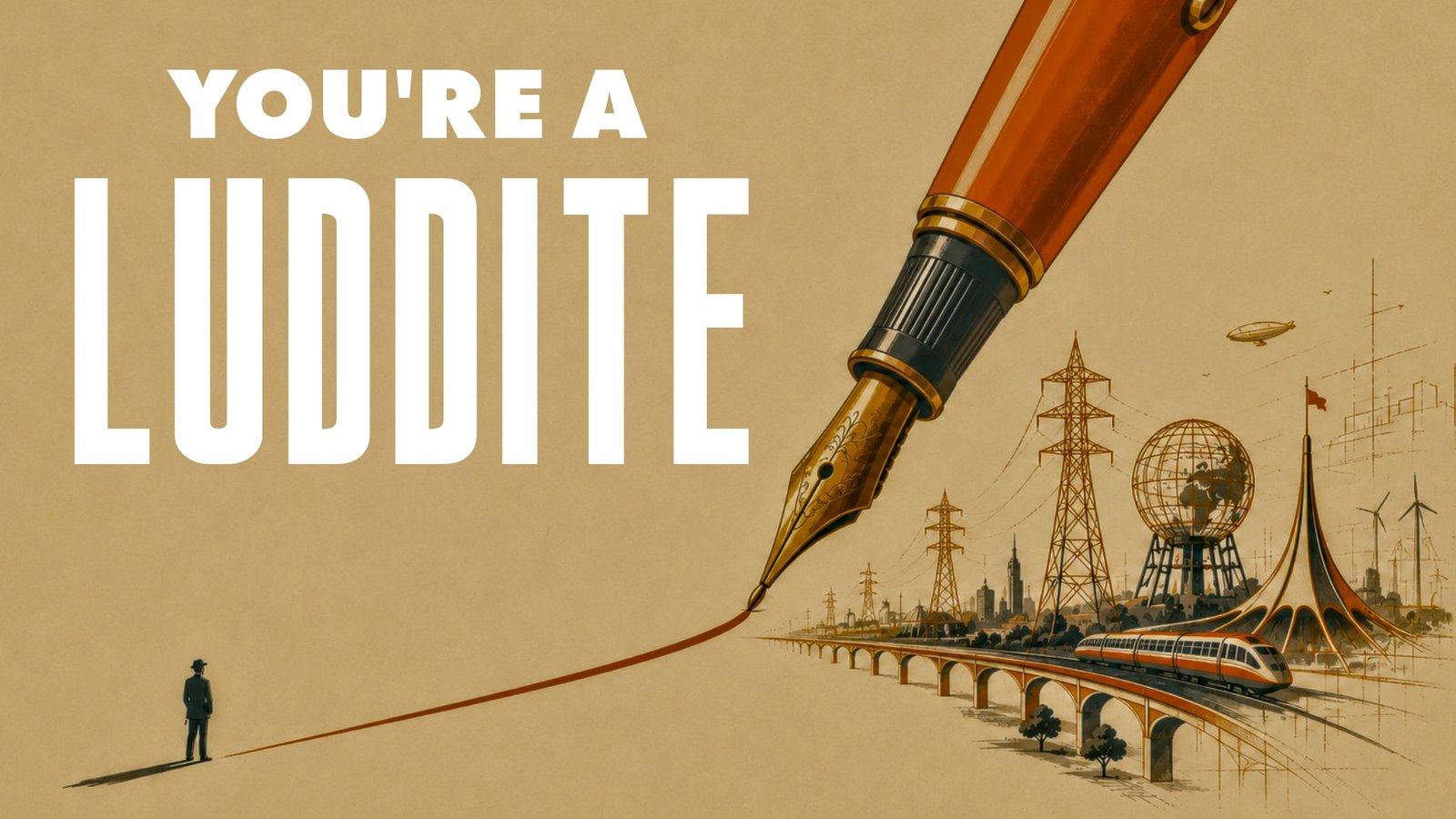
I’m guessing you’ve heard the word “Luddite” — basically, a scared, backwards- looking anti–technology peasant who can’t handle progress. Well, that’s what it means now. That’s how I’ve always used it! But it wasn’t always this way. Here’s who the Luddites actually were.
It’s 1811, England. The Industrial Revolution is underway. A group of textile workers in Nottingham begin a campaign of organized machine- breaking, targeting the automated looms and knitting frames displacing their labor.
They called themselves “Luddites,” followers of the mythical General Ludd, a kind of “Robin Hood” figure for the industrial age. To this day, nobody knows if General Ludd was a real person, but it didn’t really matter. He was a symbol of the idea that workers deserve a say in how transformative technology reshapes their lives. These were not ignorant peasants. They were skilled, trained, middle-class artisans. Weavers who had spent years mastering their craft. And what many people don’t know is: before they broke a single machine, they tried every polite option available to them.
In 1807, 130,000 workers signed a petition and sent it to Parliament demanding a minimum wage. 130,000 signatures! Parliament rejected it, mostly because the MPs voting it down were the same factory owners who would have had to pay the wage. They asked for pensions for displaced workers. They asked for minimum labor standards. They requested that if machines were gonna take their jobs, the gains should at least be shared. They were ignored.
So, in March of 1811, they changed their methods… and picked up some sledgehammers. They raided factories at night, targeting only the owners who were cutting wages and ignoring their demands. In the early period alone, Luddite bands conducted at least a hundred separate attacks, destroying roughly a thousand machines. They were organized, strategic, surgical.
The government’s response was savage. Machine breaking was made a capital offense. At least 12,000 militiamen flooded the textile counties, and in a painful twist of irony, many of the troops were probably unemployed weavers. In 1813, 17 Luddites were executed. Others were transported to Australia. The movement was crushed, not by argument, but by state force.
And over time, “Luddite” got redefined from “worker demanding fair terms in the face of displacement” to “idiot afraid of progress.” Nobody even had to organize the smear campaign. The word just got quietly repurposed during the computer revolution. And by the time it landed in our dictionary, the labor movement it came from had basically been written out of the definition.
Since learning this, I’ve come to a rather strange realization… I think I’m a Luddite. Not in the redefined way, of course, but in the Original sense.
I believe A.I. is transformative, it’s happening, and in many ways, it’s extraordinary. I just wanna know: who gets the gains? I want the terms renegotiated. I want workers to have a seat at the table when decisions get made. That’s the Original Luddite position: workers deserve a say in how transformative technology reshapes our lives. And looking at the polling, looking at the Molotov cocktails, looking at Gen Z’s anger, I wonder if this isn’t the real source of our fear. Here’s my theory… I think most of us are Original Luddites right now.
We aren’t anti-technology; I mean, just look at how much we love our freaking phones. But we are anti- a whole bunch of things that surround A.I. right now.
We’re anti- concentrated gains, but we can see the inequality gap widening with every OpenAI fundraise.
We’re anti- job displacement, but our leaders don’t have a plan for this.
We’re anti- crappy labor standards, but our gig economy already treats workers as disposable and A.I. is about to turbocharge that.
We’re anti- surveillance, but A.I. tools want access to everything we do.
We’re anti- propaganda, but A.I. is making it nearly impossible to know what’s real.
We’re anti- powerlessness, but nobody asked us if we wanted any of this.
We’re anti-oligarchy, but the people building this technology aren’t elected and aren’t really accountable.
We’re anti-being-replaced, but tech CEOs are literally on record saying that’s the plan.
Generally speaking, I think all these fears are triggering a bunch of generational, like “body keeps the score” kind of response somewhere deep in our DNA that’s making our collective Spidey Sense get massively triggered by A.I. and its most visible proxy, data centers. I think most of us are Luddites. We just didn’t know that was the word for what we are. I suppose because it’s not anymore.
Here’s what history shows across every major economic transition: the gains go to the top first. The workers being displaced resist and get called irrational. Eventually, after enormous suffering and protest and pain, government intervenes and forces redistribution. And then everybody acts like that outcome was inevitable all along. The Industrial Revolution, child labor, women’s suffrage, worker safety conditions… on and on, same pattern every damn time.
But is it possible that this time enough of us know better?
I would like to think that this is a possible positive outcome of us being drowned in information constantly. Maybe just maybe, this time around, in this Chaos Window, because enough of us see the historical pattern, we can find a way to shorten the brutal conditions that always accompany this kind of societal transition.
But as far as I can tell, the only thing powerful enough to do this is government… which obviously brings us to another problem.
I don’t often skewer other podcasts, but when I do, you know it’s for a good forkin’ reason. Hard Fork is a New York Times technology podcast hosted by Kevin Roos and Casey Newton. These are two of the sharpest tech journalists working today. In their episode about the A.I. backlash, they got closer to the real answer than almost anyone in the mainstream media I’ve heard. And then they fumbled it. Twice.
Around the 28- minute mark, Kevin correctly identifies that the real solution to the A.I. backlash is described in OpenAI’s recent paper that mentions Shared Wealth Funds and more adaptive safety nets. But then Casey responds: “That seems to require America to turn into Europe overnight.” Kevin, who just articulated the right answer, mind you, immediately retreats.
This is a kind of “preemptive surrender” — calling the right answer impossible before anyone even really tries. This is exactly how the status quo protects itself without having to lift a finger. And it’s actually even stupider because this answer actually doesn’t require the U.S. to become Europe at all. It just requires us to remember the great things we’ve already done.
In the late 1920s, nearly 90% of rural U.S. households had no electricity. Private utilities had zero interest in changing that. There wasn’t enough profit in running lines to farms in small towns. The technology existed, the need was obvious, the market simply had no incentive to care. Then FDR’s team decided that this transformative technology was essential for everybody to have. The Rural Electrification Act passed in 1936. Two decades later, rural electrification had gone from 3 % to 90%. Turns out, we are very good at sharing the wealth when the right incentives are in place. That wasn’t “the U.S. turning into Europe.” It was just the U.S. just being a united fricking group of states, caring about each other and deciding that some things matter too much to leave to the market.
When Casey and Kevin let this convo just move on, I thought I couldn’t be more disappointed in them. But I was wrong, because they did it again, immediately.
A couple minutes earlier in the show, Kevin talked about the OpenAI paper that calls for a public A.I. wealth fund, a mechanism where every citizen gets a stake in A.I’s economic upside. Basically, this is an Alaska-style dividend like we’ve been talking about on this show since Episode 1. Kevin says he’d be happy if one member of Congress was reading that paper.
Then Casey makes a genuinely valid point: that OpenAI is simultaneously backing politicians who would never support wealth distribution and lobbying against the very A.I. regulations it claims to want. This is an amazing point. But then they just… drop it, send up some kind of “podcast prayer” for new politicians, end the segment and move on to the next one.
For goodness sake guys, don’t let the hypocrisy of the messenger kill the message!
The Alaska Permanent Fund, which has paid every Alaskan resident an annual dividend from oil revenues since 1982, didn’t happen because OIL COMPANIES had a change of heart. It happened because wise Alaskan leaders like Republican Governor Jay Hammond had the foresight to enshrine it in the state’s constitution on the front end. They didn’t need Exxon to become a saint. They just needed good governance in place. This kind of thing. It’s not a market-based outcome, my friends. It’s a civic design choice.
Now remember, too: an A.I. shared wealth fund isn’t redistribution like taxes. It’s pre-distribution, which builds shared ownership into the model before the value concentrates. The Luddites asked for this in 1811. Alaska and a ton of countries around the world have been running the oil version of this for decades. And OpenAI basically endorsed the A.I. version last month. I don’t care if any OpenAI executives actually mean it. We don’t need the tech CEOs to mean it. We need enough of US to demand it. And we need more elected officials with foresight like Jay Hammond.
Speaking of elected officials, let’s talk about government. I know, I know. Right now the government feels like a punchline at best. The ineptitude is off the charts. Our collective trust in government is at historic lows. I know all this. I see it every day, just like you do. I doom scroll and curse at the headlines just like you do.
But there’s a critical difference between “the government is currently screwed up” and “government itself is broken beyond repair.” The first one, it’s just… Tuesday. But if we drift into “broken beyond repair” territory, we’re giving ourselves an excuse to give up. My friends, we cannot give up! Let me tell you why.
First, you gotta remember, this is the part of the Fourth Turning Cycle where we ALWAYS lose faith in government. We’re right on time. The old systems have to break and die so the new things can be born.
Second, there’s exactly ONE institution on earth powerful enough to rein in the A.I. tech bros and venture capitalists and billionaires. It’s not your employer. It’s not a nonprofit. It’s not a newspaper. Sadly, it’s not even a great podcast. It’s a democratically-elected, accountable-to-the-people, can-actually-pass-laws government.
Before you balk at this, let me remind you: the people currently capturing the gains from A.I., they aren’t confused about how power works. They’re hiring lobbyists, they’re funding campaigns, they’re flying to Washington, having dinner with senators. They are playing the game with everything they’ve got. But then a lot of us are sitting on the sidelines saying, “Ugh, what’s the point? Government is worthless.”
That asymmetry is not an accident. Learned helplessness is the cheapest and most effective political strategy ever frickin’ invented. Those in power don’t need to silence the masses if they can convince them their voice doesn’t matter anyway. Please, you must not fall for this.
South Carolina and Kansas are working on zero- water- waste data center laws. Colorado has a bill to make data centers build their own clean energy. Alaska baked an oil dividend into its constitution, has been writing checks to every resident for over 40 years.
The democratic machinery, rusty and as imperfect as it currently is, still moves when enough of us push it. Our system isn’t perfect, but it’s still functional enough and it’s worth reforming because it’s our best shot at actually creating the future we want. If enough of us show up, things actually can change. We have done it before, we can do it again.
And seriously, we need more Jay Hammonds — elected officials with foresight and thoughtfulness. The only way we get them is to find them, support them, elect them, BE them.
The new rules are being written right now by whoever shows up to write them. Please, my friends, we need you. Let’s show up however we can while we still have time to negotiate what comes next.
Original post with all source links: https://joshallan.com/2026/05/05/do-you-hate-ai/