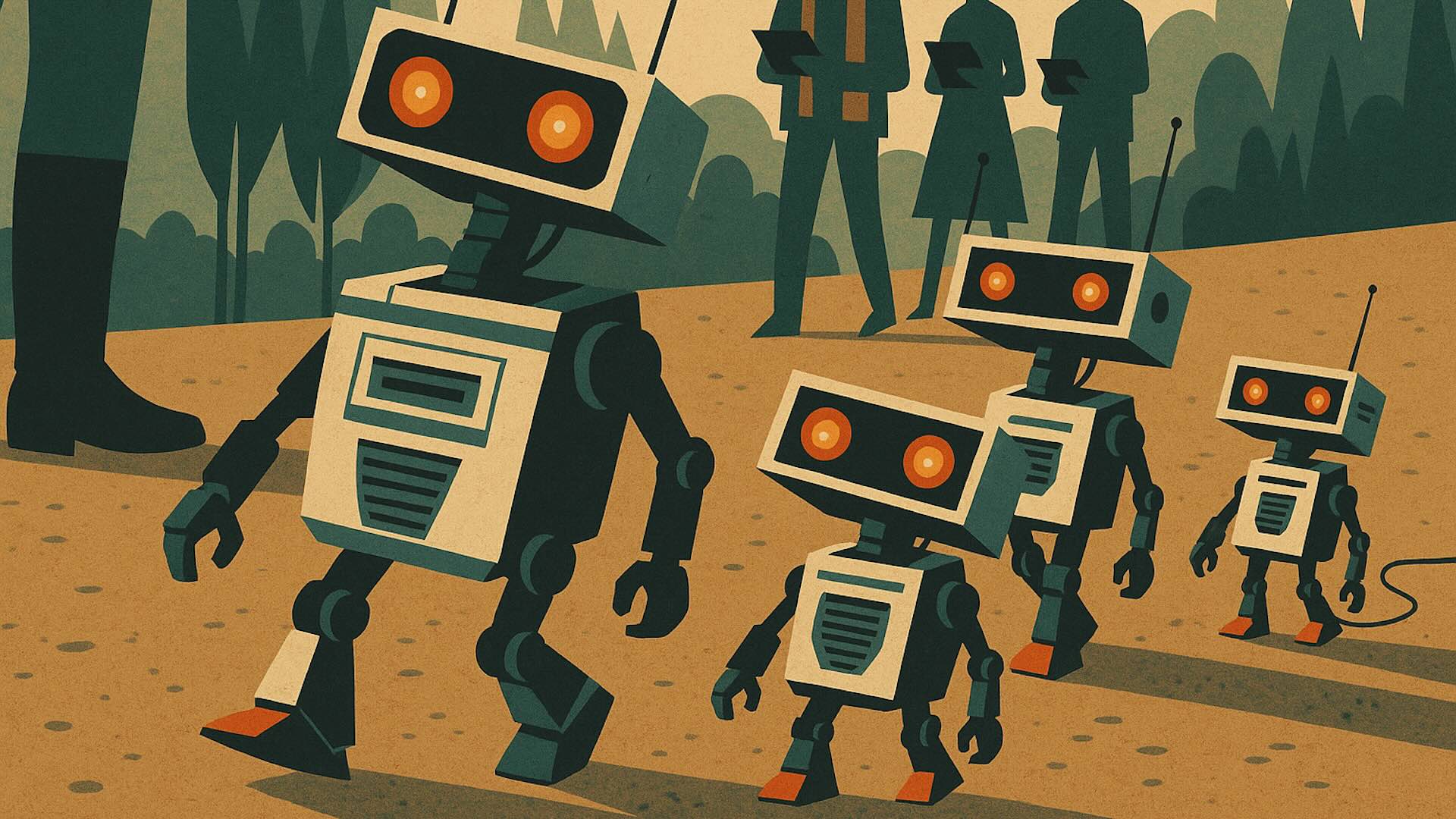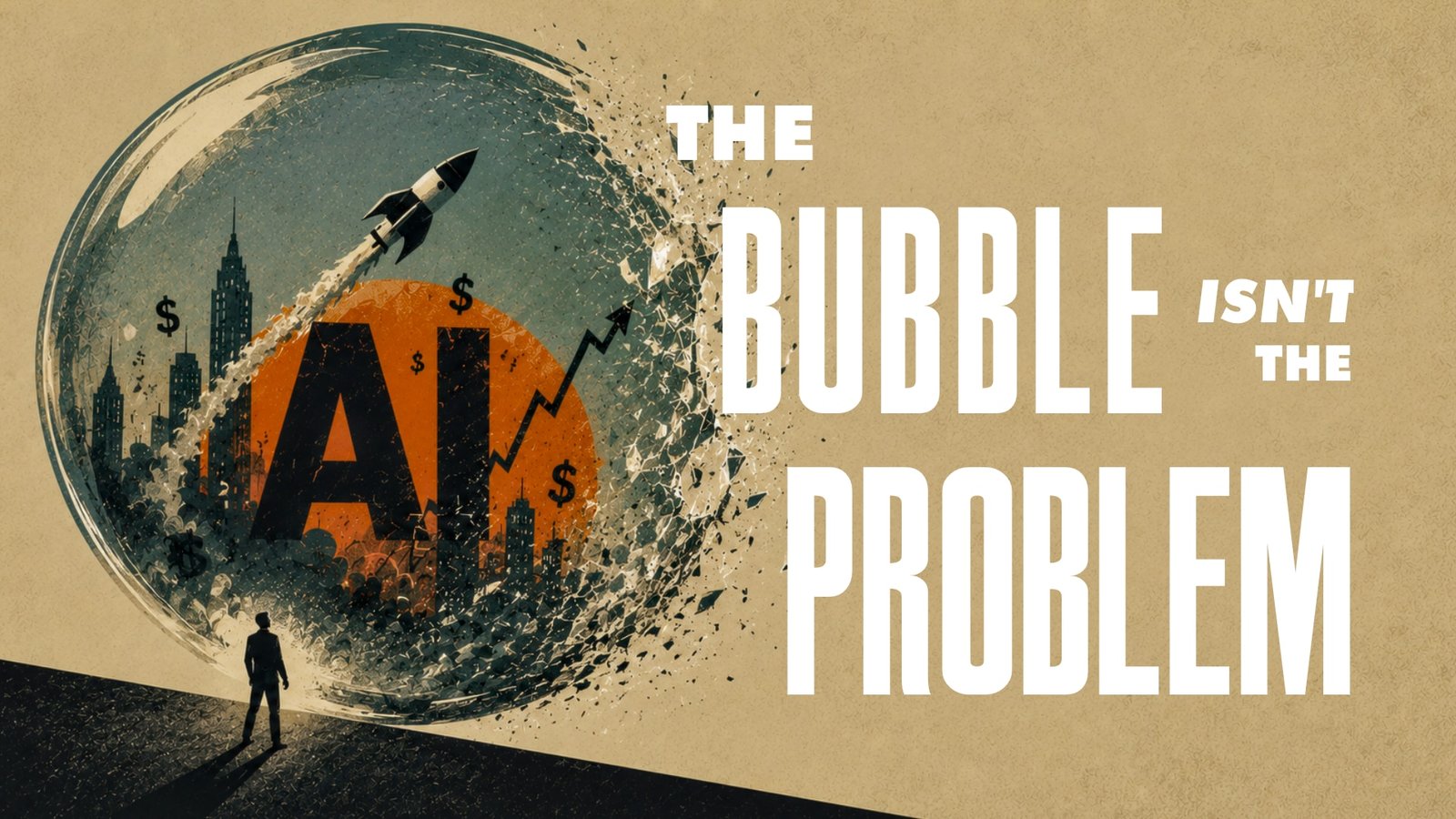
I’ve been hearing a lot lately about a possible A.I. bubble. Is this in your awareness too? I think we need to talk about it, because these financial bubbles matter in all of our lives.
If we don’t understand bubbles, we experience them as random chaos. And when we do understand them, we can see the pattern. These “bubble times,” they’re unique times when a decision window is open, and we get to decide whether we want to be passive spectators or conscious creators in helping shape what comes next.
So, what is a bubble? Well, a bubble is what happens when a real world-changing idea gets valued as if the future has already arrived before reality can catch up. So, with A.I., folks with capital are are valuing it like it’s already making a lot of money, even though it’s not yet. And what causes this to happen? Well, it’s not caused by stupidity, greed, or irrational markets. It’s mostly caused by just misaligned time horizons.
We humans, we’re incredible at imagining futures, but we’re kind of terrible at pacing ourselves. We want the shiny thing now. We treat long-term transformation like it should somehow show up on the next quarter’s balance sheet. That mismatch between how long real change takes and how fast capital expects returns, that’s where bubbles are born.
Here’s how they form. Six steps, ready?
Step one, something genuinely new and exciting appears. Railroads were real. The internet was real. A.I. is real. Whatever the technology is, it really is going to change what’s possible. And we see it. That part matters. Bubbles form around truth, not fiction.
But then, step two. We dramatically overestimate how fast the payoff is going to arrive. We see the future and completely screw up the timeline. We start pricing things as if we’ve already arrived at the destination.
And then step three, money rushes in faster than reality can keep up. Capital outruns capability. Expectations outrun infrastructure. Hype outruns the humans.
Then, step four, the speculation starts to feed on itself. Rising prices become proof. Belief becomes validation. Skepticism sounds boring. Caution sounds weak. Reality quietly exits the building.
Then step five, something breaks the spell. Revenue doesn’t match expectations. Costs stay high. Growth slows. Suddenly everybody’s asking the same question. Wait, what are we actually paying for?
And then the story collapses in step six. Not the technology, the fantasy. Remember “.com” — the internet was, and is, very real, but pets.com still went out of business.
So what happens when the bubble bursts? When a bubble ends, what actually collapses ISN’T the underlying technology. It’s the story we told ourselves about that technology… usually the idea that it would be fast or easy, that “everybody would win.” Businesses and investors that over-leveraged in that fantasy will also lose when the bubble bursts.
Now when that story breaks down one of two things usually happens. The first option is LOUD. That’s the kind of collapse we remember. This is railroads, “.com,” crypto. Prices fall hard. Companies fail publicly. Headlines are screaming. Trillions of dollars in paper value vanish seemingly overnight. It feels like a catastrophe. And in the headlines, and for investors, sometimes it is. But the technology survives. Railroads still crisscross continents. The internet still runs the world. Crypto is still out there. So even when a bubble pops dramatically, the fantasy story may die, but the infrastructure remains. But that’s the first option. It’s loud.
The second option is quieter. Sometimes when a bubble pops, it just kinda… dissolves. In these cases, there’s no single dramatic crash, no obvious popping noise. Instead, expectations just slowly reset. Funding dries up and companies disappear or get acquired. Power concentrates. Bubbles like that were electricity, automobiles, radio. Those industries didn’t explode with a bang, they just reorganized. Behind the scenes, entire industries were reshaped over time, jobs changed and business models shifted. A few dominant players emerged and quietly rewrote the the rules.
This part’s important: for those of us who aren’t capital, this version, the quiet version, is counterintuitively more disruptive because by the time it becomes visible to us, the defaults have already been set by those with capital. So the big point: all bubbles burst. Some with a bang and some without.
So where does A.I. sit in this cycle? I would say we’re probably between steps four and five. We know A.I. works, and an astonishing amount of potentially reality- ignoring money has been poured into its future promise.
Conservatively, and I mean conservatively, hundreds of billions of dollars have already been invested directly into A.I. companies, models, chips, infrastructure. The hyperscalers — Microsoft, Google, Amazon, Meta — are collectively spending $200 to $400 billion dollars every year on A.I related capital expenditures. When we zoom out and add in committed future spend, we’re looking north of a trillion dollars, either already deployed or firmly locked in.
Now, that does not mean we’re definitely in a bubble, but it does mean we are making a massive bet on a future timeline. A timeline where productivity gains arrive quickly, where costs fall fast enough, and monetization catches up to expectations. Right now that timeline is… optimistic. Revenue’s still catching up. Productivity gains: cloudy. Energy constraints, very real. Which is why this moment feels so intense, so charged, so unstable.
And I think that brings us to the deeper pattern underneath all of this. There’s a great term that describes exactly what’s happening: Creative Destruction. Creative Destruction is the idea that progress doesn’t arrive gently. Old systems don’t politely step aside, they get destroyed. Jobs disappear, industries collapse, skills lose value. Entire ways of organizing work and life just stop making sense. And something better emerges.
When it was first talked about, Creative Destruction was intertwined with capitalism as its engine of innovation. It’s the reason economies evolve instead of fossilize. It’s why new industries get born.
But this pattern isn’t unique to capital markets. It’s a systems pattern. We see it in many areas of life. Ecology: forests burn so ecosystems can regenerate. In biology: extinction clears space for adaption of new species. paradigms fall apart so new models can emerge. tear down norms to create social progress. Politics: revolutions, rewrite civic contracts. If some of this language is reminding you of a Fourth Turning, I think you’re hearing the same music I am.
The important part, I think, is to remember that we are part of the dance. Our choices help create the future. And the capital systems we’re choosing to run the show right now are extremely artificial. By which I mean: they are not integrated with our biological world at all. So there is absolutely zero guarantee that the Creative Destruction brought about by A.I. will actually emerge with any kind of goodness on the other side.
In healthy systems, like the one Earth’s biosphere has been cultivating for half a billion years, destruction and regeneration are in balance. In unhealthy systems, destruction accelerates faster than renewal. That’s when things break. And that’s the danger zone we’re flirting with right now. So I think there’s a distinction we desperately need. Creative Destruction is value- neutral. It can lead to renewal or collapse. The outcome depends on incentives and ownership.
But what if A.I. isn’t Creative Destruction, but a Destructive Creation? A Destructive Creation would be what happens when we build astonishing tools on quarterly timelines, inside extractive incentive systems without cultural, ethical, or institutional shock absorbers. If we did that, we wouldn’t just be tearing down old forms of work. We’d be creating new systems faster than humans and our planet can adapt to them. Faster than governance can evolve. Faster than culture can metabolize the change. Faster than meaning can catch up. Sounding familiar?
The real risk with A.I. isn’t really that it replaces jobs. That’s been part of every major technological shift we’ve ever seen. The real risk is that we collapse the time horizons, we centralize power, we externalize human and planetary costs, and we call the whole thing “inevitable progress.” That wouldn’t be evolution. That would be a stress test on our global society, and it’d be one that most of us did not consciously agree to take.
The deepest danger of A.I. is that it lives inside an organizing story that only cares about creating capital. The tech will do what we tell it. But right now, we, at the decision-making level, only care about making more capital. Not because all humans feel that way, but because that’s what the current system demands. So if nothing changes, making capital is what the tech WILL end up being used for.
Do you see why we need a new organizing story so badly?
All right, back to bubbles. Here’s the honest truth we need to sit with. Not all bubbles explode, some pop dramatically. Railroads, dot com, crypto — big headlines, big losses, seemingly overnight. But others don’t really pop at all. They just diffuse. Electricity, automobiles, radio. The hype quietly fades, expectations reset, and the tech just becomes part of the background of everyday life.
The uncomfortable but honest answer about A.I. is we don’t yet know what kind of bubble this will be. What I think we know is that some kind of correction is coming. Capital moved really fast. Expectations are likely ahead of reality. Whether that correction looks like a sharp crash or a slow deflation, this fantasy is going to break. But remember, when it does, the technology will remain.
The bubble matters to investors. The after matters to all of us.
So, what do we do with this? Here’s your Optimistic Rebellion: learn to share this idea in your own words. When the A.I bubble comes up in conversation, you can say something like, “Yeah, remember, bubbles aren’t really about whether the tech is real. They’re about capital getting ahead of what we can realistically build. So the bigger question is what happens after the correction? Because that affects all of us.” That’s a higher quality conversation. Right now, we really need better conversations.
The future isn’t fragile because of A.I., it’s fragile because of how poorly we understand the forces shaping it and the systems that will seek to control it. Stay vigilant, pay attention. The future needs you.
Original post with all source links: https://joshallan.com/2025/12/16/is-there-an-ai-bubble-and-why-it-matters-to-all-of-us/