🚨 If you’d rather WATCH or LISTEN TO this article, you can!
📺 YouTube // 🎧 Spotify // 🍏 Apple
Today we’re starting by going back to January 2009.
I’m in my second semester of grad school at the University of Nebraska-Lincoln, in a class called Lean Management & Building Shareholder Value. I wasn’t super excited about it — I mean c’mon, that syllabus title is a frickin’ snorefest — but that was before I knew that this particular class would absolutely change my life.
The instructors were two fabulous men: Mike Morrison and Brian Brim, amazing organizational leaders and brilliant thinkers, both Senior Scientists at Gallup.
It was in this class that I was first introduced to something called “systems thinking.” If I had heard this term before in my life I somehow missed it, because everything Mike and Brian said in this class felt like they were shooting rainbows of fresh insight directly into my brain.
I don’t remember ever being more invigorated by a topic in my entire life.
Learning about systems thinking made me somehow feel complete, like I must have had a puzzle piece missing and it just got put in.
It was in that class where I first heard Mike articulate a simple metaphor that has guided my thinking every day since.
You ready?
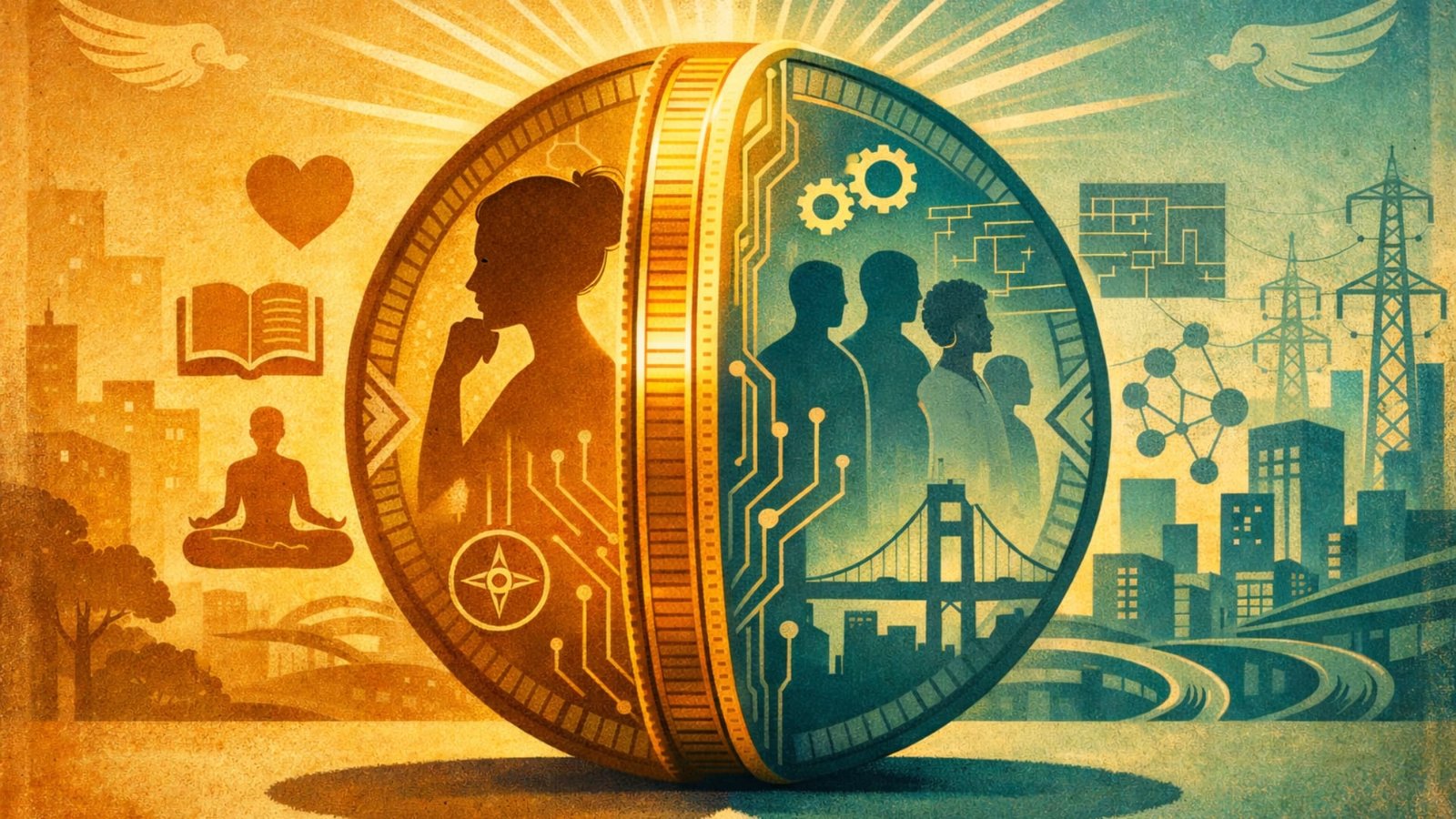
He explained that our daily lives are like a coin with two sides: ME and WE.
The ME side is individual stuff — character, choice, discipline, agency, the personal.
The WE side is system stuff — incentives, culture, norms, architecture, the collective.
After pondering this for almost two decades, I’ve come to understand that this Coin is basically the currency of reality.
And you cannot spend a one-sided coin, because civilization runs on both.
Every human situation you could possibly encounter always contains both sides of The Coin. There’s an endless feedback loop from ME to WE and back to ME.
Everything works this way.
Bias Isn’t Stupidity (But Thinking We’re Not Biased Might Be)
So when someone hears me talk, they might miss the ME side of The Coin. This is understandable, because I don’t talk much about that side.
This is a conscious choice on my part. I happen to believe there are a lot of truly brilliant teachers and coaches and authors and spiritual leaders who address the ME side of The Coin more deeply and adeptly than I ever will.
But if you didn’t know this about me, or know about The Coin, it’d be easy for you to think… “Whoa, Josh, how can you say this ISN’T about the individuals who make these choices and keep these systems afloat? It has to be about them!”
And of course, it is! Just… also!
What’s happening in this comment is a person is only looking at one side of The Coin. They’re compressing complexity into something more manageable. And this feels good and reassuring, but it isn’t actually explaining what’s happening in a complete way.
It’s actually bias.
Now, you need to understand: bias isn’t stupidity.
It’s compression for the sake of efficiency.
Our brains are constantly compressing reality so we can survive reality. If we had to frontal-lobe long-form process everything in our lives I’m pretty sure we’d literally die from the overwhelm. So our brains create these shortcuts. They keep us alive. But they also keep us wrong.
Bias isn’t stupidity… but pretending we’re NOT biased just might be. We’ve gotta use these big frontal lobes to override our bias and see both sides of The Coin.
Because reality is recursive.
People build systems.
Systems shape people.
People form incentives.
Incentives create choices.
Choices reshape people.
All at once.
All the time.
Whenever we deny one side of The Coin, we’re distorting what’s actually happening.
Eating The Rich Will Still Leave Us Hungry
A few weeks ago I did an episode about how Economics (as we know it) Is A Lie. At the end, I talked about the wealthy, and said that “eating the rich” is too simple. It’s reductive, because all elites aren’t bad people and bad systems beat good humans all day long.
I also said that doesn’t mean we shouldn’t stop holding people accountable.
But I still get comments saying: “Are you saying no one is responsible for their bad actions?”
I am absolutely NOT saying that. I am saying systems explain behavior, they do not excuse it.
Let me say that again.
Systems explain behavior, they do not excuse behavior.
Individuals are morally accountable AND incentives are powerful. Two sides!
If a system rewards short-term extraction, some people will extract. They are still responsible. But pretending architecture doesn’t shape behavior is naïve. AND pretending character doesn’t matter would be equally blind.
It’s not either/or, it’s both/and.
On this show, I am mostly focused on the WE side of The Coin. But this isn’t because I don’t respect and appreciate and see the importance of the other side.
Neutral Systems Don’t Exist
I do want to talk a bit more today about another important part of the WE side of The Coin.
This is an important thing to know, even though it makes some people uncomfortable.
Neutral systems don’t exist.
We are either actively defying entropy through intelligence and thoughtful design or we are drifting toward decay. For systems, there is no middle ground. And so far, entropy is undefeated.
Left alone:
- Infrastructure inevitably decays.
- Trust erodes.
- Wealth concentrates.
- Power centralizes.
- Short-term thinking accelerates.
We talk a lot about these things on this show.
The drift of entropy is not neutral — it has a direction, and that direction is decline.
So in the world of Hello Tomorrow, part of what we fight for is the ability to be an active participant in the future by designing systems that can uplift us all. This matters, because when someone says, “Just let it evolve organically” what they’re accidentally advocating for is drift.
And drift favors the already-powerful.
As we discussed a couple months ago, these things have a cyclical nature throughout history.
Humanity comes out of a Crisis with the collective will to build new systems, better systems. And those systems work, for a while. But eventually the drift takes hold and entropy does its work, and the seasons change from spring and summer to autumn and then winter.
I highly recommend checking out my episode about The Fourth Turning if you want to understand these cycles better.
Right now, culturally, we’re in a “winter” mood.
Institutions feel corrupt.
Governance feels captured.
Markets feel extractive.
Media feels manipulative.
I know I talk a lot about how today’s systems are shaping our future in a way we don’t want. But today I want to remind us that isn’t all systems can do.
Systems can also uplift us, help us aspire to our better nature.
At first glance, that might sound terribly naïve. A long winter season can make us forget that spring ever existed. We forget that institutions have been redesigned before. We forget that leaders once spoke about civic architecture as moral work. We forget that systems of the past have stabilized fear instead of amplifying it.
So let me take you back to a couple times when these things actually happened.
The Last Time We Fixed The System
First example. It’s 1933. The banks are failing. Not wobbling, failing.
People are standing in lines wrapped around city blocks trying to pull out whatever money they have left in their account before the whole thing collapses. Fear spreads faster than logic. When one bank fails, people rush the next one. When the next person panics, everyone panics. It feels like the whole system is starting to eat itself.
This is what a negative feedback loop looks like in real life. We’ve talked about this: panic is a terrible advisor. When we’re afraid, we don’t make our highest and best decisions. We just make fast ones.
Enter FDR, Franklin Delano Roosevelt, who steps into the Presidential office right in the middle of this. One of the first things he does is declare a national bank holiday. Shuts the whole system down for a few days and stops the bleeding.
Then he helps create the FDIC — federal deposit insurance. And something subtle but massive happens. The incentive for a bank run disappears. Not because people suddenly become smarter. But because the architecture changed.
If your deposits are insured, you don’t need to sprint to the bank at dawn. If you don’t sprint, your neighbor doesn’t sprint. If your neighbor doesn’t sprint, the panic loop weakens.
FDIC didn’t control the people’s banking behaviors, it just changed the conditions. It reduced fear, and expanded the possibility for wisdom.
That’s a system actively shaping behavior, the WE side strengthening the ME side.
We’ve Done This Before!
Of course the FDR era policies didn’t fix everything, but they did alter the architecture of what governance could do. They made panic less profitable. They made exploitation a little harder. They made jobs, and dignity, easier to find. They helped redesign our collective operating system.
And for decades, that system expanded the American middle class. Not perfectly. Not permanently. Entropy always returns. But for two generations? Systems actually worked for people!
And that’s the point.
Systems can uplift.
They can reduce the cost of being decent.
They can create breathing room for displaying good character.
They can welcome and encourage respect.
Good systems are active participants in our collective quest to become better humans.
Which means when The Crisis comes — and history suggests it will — the question won’t be whether we redesign the systems. The question will be whether we remember that good redesign is possible. We need to remember that architecture can help shape aspiration.
I’m not giving any policy blueprints today.
I’m reminding us that we’ve done this before.
And we can do it again.
Great Moments With Mr. Lincoln
Let me take you back even further for one more example.
In 1861, on the brink of Civil War, Abraham Lincoln stood before a fractured nation and said this:
“We must not be enemies. Though passion may have strained [us], it must not break our bonds of affection. The mystic chords of memory… will yet swell the chorus of the Union, when again touched… by the better angels of our nature.”
Lincoln understood something crucial: individuals rise higher when they are invited into a collective vision.
Our “better angels” are not activated in isolation, they’re made alive in the collective.
The Union wasn’t just a legal structure, it was a moral project. A future people could step into together. That’s architecture. Not in the bureaucratic sense, in the narrative sense.
A shared story is a system.
A constitution is a system.
A civic identity is a system.
These aren’t abstractions — they’re the operating systems of civilization.
And these systems shape our behavior.
Good systems are active participants in our choices. Lincoln wasn’t wagging a finger saying, “Be good.” He was saying: “Remember who we are. Remember what we’re building. Remember what this means. And rise into it.”
That’s WE shaping ME.
Systems don’t just constrain bad behavior.
They can elevate aspirational behavior.
The U.S. Constitution says: We believe in self-governance.
The Social Security program says: We believe aging shouldn’t equal destitution.
Civil Rights legislation says: We believe equality under law matters.
Each system is an architectural statement about who we are trying to be. Not what we are, but what we WANT. And when those systems function well, they make it easier for individuals to align with that identity.
They make it easier to hear our better angels.
I’m not just talking about policy here, I’m talking about civic imagination. A system is really just a story with enforcement power.
Lincoln understood that.
Roosevelt understood that.
Which is why they framed architecture as moral aspiration.
To me, this is what feels missing right now. Our leaders stoke division not togetherness. At best, they talk about tactics, not transcendence.
Where’s the vision for what we could build? What we could become?
I think we are starving for that kind of system — one we can actually feel proud of building and being a part of.
The Optimistic Rebellion
So what’s our Optimistic Rebellion?
Today, it gets really personal, and it goes back to The Coin.
Some of you listening are ME-side people.
- You coach.
- You mentor.
- You shape hearts.
- You build character.
That work matters deeply.
Others of you are WE-side people.
- You design structures.
- You think in incentives.
- You care about governance.
- You obsess over architecture.
That work matters deeply.
If the WE side is broken, individual work exhausts itself trying to swim upstream.
If the ME side is weak, collective work will start to feel hopeless and coercive.
We cannot spend a one-sided coin, civilization requires both.
So here’s our Optimistic Rebellion: let’s stop arguing about which side matters more, and remember that we need BOTH. They always go together!
But whatever side you get fired up about, use that fire to discern the side YOU are called to work on.
Are you ME?
Or are you WE?
And then commit. Strengthen your side of The Coin, while offering deep respect for the workers on the other side.
For my WE-side friends, remember: neutral systems don’t exist. We are either actively defying entropy through intelligent design or we are letting things drift toward decay. Let’s start imagining the better systems we are going to create tomorrow, today.
For all my friends: Winter is long. But spring is inevitable. The only question is: what are you planting?